Trump vows to raise tariffs to 25% on South Korean goods
Published in Political News
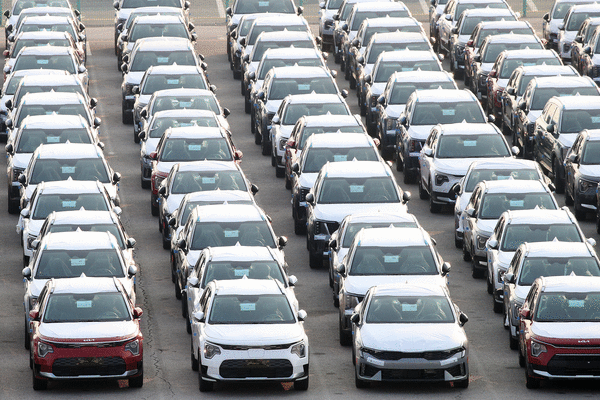
President Donald Trump threatened to hike tariffs on goods from South Korea to 25%, citing what he said was the failure of the country’s legislature to codify the trade deal the two nations reached last year.
Trump in a social media post on Monday said the new rate would apply to autos, lumber, pharmaceutical products and “all other Reciprocal TARIFFS.” Under the existing agreement, the president set a 15% levy on South Korean exports.
“South Korea’s Legislature is not living up to its Deal with the United States,” Trump said in his post. “In each of these Deals, we have acted swiftly to reduce our TARIFFS in line with the Transaction agreed to. We, of course, expect our Trading Partners to do the same.”
If implemented, the move could have wide-ranging effects on major South Korean companies that export to the U.S., such as Hyundai Motor Co., which sent 1.1 million vehicles to America in 2024.
South Korea’s presidential Blue House said it hasn’t yet received any formal notification or detailed explanation from the U.S. regarding Trump’s post on Truth Social. Industry Minister Kim Jung-kwan, who’s currently in Canada, plans to travel to the U.S. as soon as possible to discuss the matter with Commerce Secretary Howard Lutnick, the statement said.
Separately, the Blue House plans to hold a meeting chaired by its policy chief involving relevant ministries on Tuesday.
The “special law on strategic investment with the U.S.” is a domestic bill meant to give South Korea’s government the legal authority to manage and carry out the large-scale investments it pledged to the U.S. under last year’s trade deal. The bill was introduced to parliament in late November, which under a bilateral memorandum triggered the retroactive cut in auto tariffs from 25% to 15%, effective from the start of that month.
When the bill was submitted in November, Huh Young, a lawmaker with the ruling Democratic Party, said the parliament is not considering putting the bill on a fast-track process and that no specific timetable has been set for its passage.
“The National Assembly will conduct a very careful and thorough review of the special law,” Huh, the senior policy floor leader of the ruling party, told reporters on Nov. 26. “If there are any provisions that could potentially undermine the national interest, we hope the ruling and opposition parties will put their heads together to ensure the bill passes as a more complete piece of legislation governing investment in the U.S.”
Trump’s announcement marks his latest move to ratchet up trade tensions with allies. In recent weeks, he has threatened to raise duties on Canadian products to 100% if Ottawa signed a trade deal with China and to slap new charges on European countries’ goods over his quest to seize control of Greenland.
In addition, the president has said he would place tariffs on exports from countries doing business with Iran in an effort to pressure Tehran over anti-government protests.
The administration hasn’t issued formal notices to implement Trump’s threatened tariff changes.
Beyond the investment legislation, the U.S. has also voiced concerns over South Korea’s handling of digital regulation, citing what they see as disproportionate scrutiny of U.S.-linked technology firms following a high-profile data-breach incident at Coupang Inc. The issue has added to broader friction between Washington and Seoul over market access and regulatory treatment in the digital sector in recent months.
Hanging over Trump’s latest round of trade brinkmanship is the Supreme Court’s upcoming decision in a case challenging his global tariffs. If the justices rule against the president, it will likely constrain his ability to quickly raise and lower import taxes on his own. The court’s next scheduled courtroom session is Feb. 20.
Trump has made a series of provocative moves at the start of the year, as polls show Americans souring on his leadership ahead of November’s midterm elections.
Allies roundly rebuked Trump’s pressure campaign over Greenland, and a pair of deadly shootings by federal immigration agents in Minnesota has prompted Trump to shift course in his aggressive deportation campaign. The audacious U.S. military raid that captured Venezuela’s Nicolás Maduro also ruffled feathers on the world stage.
(With assistance from Soo-Hyang Choi and Yuko Takeo.)
©2026 Bloomberg L.P. Visit bloomberg.com. Distributed by Tribune Content Agency, LLC.





































Comments