This week: Senate returns, staring at possible partial government shutdown
Published in Political News
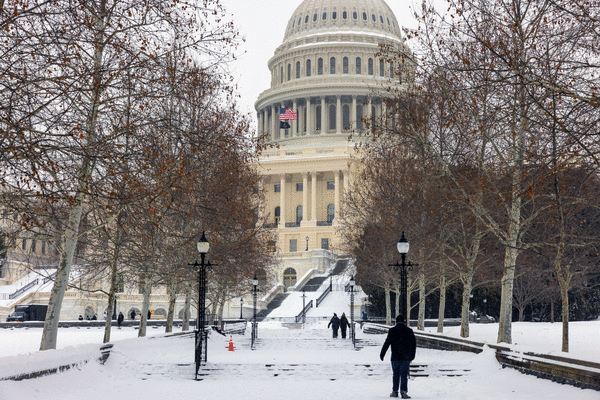
WASHINGTON — As Capitol Hill digs out from the weekend snow this week, the Senate is setting up for another standoff over government funding after federal agents shot and killed a Minneapolis resident on Saturday.
The bipartisan path forward for a package of six appropriation bills, including funding for the Department of Homeland Security, quickly evaporated on Saturday after the shooting. Senate Minority Leader Charles E. Schumer, D-N.Y., said Sunday that Democrats would oppose the package unless the DHS bill is revamped.
“Senate Republicans must work with Democrats to advance the other five funding bills while we work to rewrite the DHS bill,” Schumer said. “This is best course of action, and the American people are on our side.”
Sen. Amy Klobuchar, D-Minn., who is expected to run for governor, said Sunday on NBC’s “Meet the Press,” “There have been three killings in Minneapolis since the beginning of the year. And two have been committed by federal agents — one ICE, and the other border control. That’s what we’re dealing with here.”
The House already passed the remaining six spending bills last week and bundled them together into a single package for the Senate. The package includes the Financial Services, National Security-State, Defense, Labor-HHS-Education and Transportation-HUD measures, along with Homeland Security. If the Senate makes any changes, the measure would have to go back to the House for a new vote.
So with the House not in session this week, a partial shutdown appears likely.
It may be possible, though not necessarily expected, for the Senate to clear the funding for Financial Services and National Security-State without a resolution on DHS funding by the Jan. 30 deadline, when current funding expires.
“Republicans are determined to not have another government shutdown. We will move forward as planned and hope Democrats can find a path forward to join us,” a GOP aide said Sunday.
The Senate’s first scheduled roll call vote of the week, which has been delayed until Tuesday because of the winter storm, is on a motion to limit debate on the Senate version of a bill that would require higher education institutions participating in a federal education program to inform prospective and enrolled students about rights and resources for pregnant students to carry their pregnancy to term.
Democrats have contended that the bill would not provide pregnant students with complete information about their options. The House passed its version of the measure last week, 217-211. It would need 60 votes in the Senate to get past the initial hurdle.
Committee business
Secretary of State Marco Rubio, who is also the acting national security adviser, is scheduled to testify Wednesday at the Senate Foreign Relations Committee about the recent U.S. intervention in Venezuela, including the raid that captured Venezuelan President Nicolás Maduro.
The hearing will likely also look ahead to U.S.-Venezuela policy going forward, with Delcy Rodríguez, who had been vice president under Maduro, serving as the acting leader of the country.
Elsewhere, the Senate Agriculture, Nutrition and Forestry Committee is scheduled to mark up its version of cryptocurrency market structure legislation this week, which could also prove to be a venue for debates about broader banking regulation.
Among the amendments already filed, Sen. Roger Marshall, R-Kan., has a bipartisan proposal intended to increase competition among credit card issuers in a bid to reduce fees. The amendment, offered with Minority Whip Richard J. Durbin, D-Ill., and Sen. Peter Welch, D-Vt., won an endorsement from President Donald Trump earlier this month, effectively reviving the issue.
---------
©2026 CQ-Roll Call, Inc. Visit at rollcall.com. Distributed by Tribune Content Agency, LLC.



















































Comments