Final fiscal 2026 spending bills pass House; Senate up next
Published in Political News
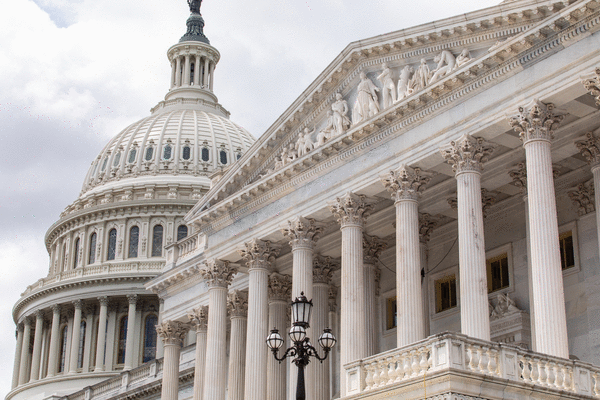
WASHINGTON — The House passed a roughly $1.25 trillion spending package Thursday in a pair of votes that overcame internal GOP divisions and Democratic protests over the Trump administration’s immigration policies.
The most closely watched of the four bills at stake was the Homeland Security measure, which was at greatest risk of defeat amid an immigration crackdown that raised civil rights concerns.
But the bill, which was taken up separately from the rest of the package, passed on a 220-207 vote. Seven Democrats joined almost all Republicans to support the measure. Kentucky Rep. Thomas Massie was the lone GOP dissenter.
The other, larger bill, containing the Defense, Labor-HHS-Education, and Transportation-HUD funding measures, passed with lopsided bipartisan support on a vote of 341-88.
The rule for debate, adopted earlier on a close party-line vote after some wheeling and dealing with holdouts, allows the bills to be combined before being sent to the Senate. The rule also tacks on a separate two-bill package containing the Financial Services and National Security-State bills that the House already passed earlier this month to create a sprawling six-bill “minibus.”
The Senate plans to take up that mega package next week to meet a Jan. 30 deadline, when current funding for most federal agencies is set to run out. An expected weekend snowstorm, however, could make meeting the deadline more difficult.
The House also added a last-minute repeal of a provision Senate Republicans baked into a November funding deal to end the partial government shutdown. The provision, which prompted bipartisan furor in the House, allows senators to sue for at least $500,000 when federal investigators search their phone records in a judicially sanctioned probe without notifying them.
“I cannot overstate how wholly inappropriate it was that the Senate included this provision in the continuing resolution to reopen the government late last year,” House Rules Chairwoman Virginia Foxx, R-N.C., who offered the rule amendment, said during floor debate.
The House in November unanimously passed legislation from Rep. Austin Scott, R-Ga., that would repeal the payouts provision. But that bill has stalled in the Senate.
Senators now face a choice between accepting the House repeal of their payouts provision or stripping the measure from the spending package and sending it back to the House for another vote. But that latter option would risk a partial government shutdown because the House is scheduled to be in recess next week.
Come-from-behind win
House passage of the two packages came after GOP leaders rallied their members on a critical vote to support a rule needed to take up the measures. The rule vote Thursday morning initially looked to be in jeopardy, with GOP leaders struggling to hold together its razor-thin majority without any Democratic help.
The rule came under threat partly because of a push from farm-state Republicans who were advocating for a provision allowing year-round sales of gasoline containing a higher percentage of corn-derived ethanol.
Such a provision could have tanked the rule due to opposition from oil-state lawmakers and the refining industry, so it wasn’t included in the final rule. But leaders scheduled a separate Rules meeting on an ethanol bill from Rep. Adrian Smith, R-Neb., which could become the vehicle for an eventual compromise on the push to allow year-round sales of gasoline with 15 percent ethanol, a blend known as E15.
House GOP leaders also made a concession in the rule to farm-state members in the form of a proposal to create a “rural domestic energy council” aimed at developing E15 legislation by Feb. 15 for a vote by Feb. 25. For some in the industry, however, that promise isn’t enough.
“Corn growers are disgusted, disappointed and disillusioned that after spending years of calling for passage of E15, Congress has again punted, and it has done so in a spectacularly weak and offensive way,” National Corn Growers Association President Jed Bower said in a statement.
Homeland security dispute
Democrats have been up in arms over Trump administration immigration policies, a push that has only been inflamed by the fatal shooting of Minneapolis resident Renee Good, a U.S. citizen, by an Immigration and Customs Enforcement agent.
Most Democrats, including party leadership, opposed the Homeland Security bill, which they say does not contain enough new restrictions on ICE and leaves out more significant restraints on the agency that the party pushed for in negotiations.
Rep. Rosa DeLauro of Connecticut, top Democrat on the House Appropriations Committee, also notably voted against the Homeland Security spending bill, despite previously defending the compromises secured in the measure, as the party seeks to mobilize against the administration’s immigration crackdown.
Her decision indicated there would likely be enough Democrats voting for the Homeland Security bill to ensure House passage without her vote.
However, the rule tightened the screws on Democrats with a provision that would prevent the rest of the package from being sent to the Senate if the Homeland Security measure didn’t pass.
Bipartisan buy-in is more critical in the Senate, where 60 votes will be required, but the inclusion of the bill as part of a larger package could discourage Democrats in that chamber from derailing other spending bills to address ICE concerns.
Before passing the larger spending package, the House rejected two amendments sought by hard-line conservatives.
One, from Massie, would have barred funding for the National Highway Traffic Safety Administration to implement a requirement of the 2021 infrastructure package that newly built cars be equipped with drunk-driving detection technology.
Such a “kill switch” would involuntarily disable vehicles to prevent drunk driving. Massie and other conservatives, however, have said the technology would be an invasion of privacy. That amendment was rejected, 164-268.
Another amendment, from Rep. Ralph Norman, R-S.C., would have stripped all earmarks from the Labor-HHS-Education title of the bill, totaling about $1.4 billion. Those earmarks exclusively came from the Senate, because House Republicans didn’t allow for earmarks in their version of the bill.
Norman’s amendment also came up short, with a vote of 136-291.
If the Senate clears the final package next week for the president’s signature, the vote would put a bookend to a tumultuous appropriations season, from months of partisan fights over the president’s testing of the limits of his authority over spending to the nation’s witnessing of the longest partial government shutdown in history.
____
(Paul M. Krawzak and Olivia M. Bridges contributed to this report.)
©2026 CQ-Roll Call, Inc., All Rights Reserved. Visit cqrollcall.com. Distributed by Tribune Content Agency, LLC.

















































Comments