Sidelined last election, abortion returns to policy limelight
Published in Political News
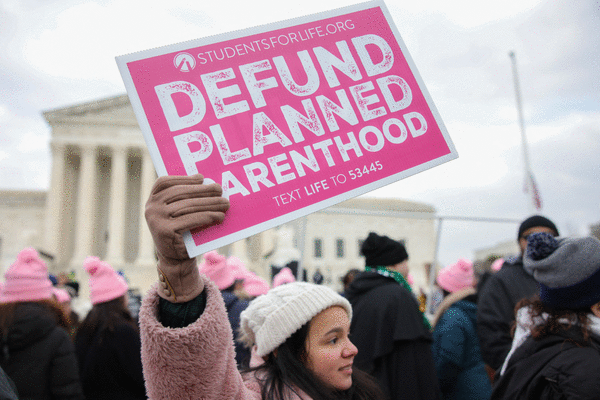
WASHINGTON — In the months leading up to the 2024 election, many Republicans tried to play off abortion as a lesser campaign priority following the backlash to the Supreme Court’s Dobbs decision that overturned Roe v. Wade.
But one year into President Donald Trump’s second term, anti-abortion advocates are aiming to push the issue back into the limelight. The movement has been emboldened following successful lobbying to get Planned Parenthood defunded for one year in Republicans’ 2025 reconciliation law.
Friday’s annual anti-abortion rally, the March for Life, typically coincides with renewed activism: A Congress under Republican control tees up messaging votes, and the administration issues proclamations or executive orders.
While Democrats made abortion their top election issue up and down the ballot in 2024, spending $175 million on abortion-related TV ads for Senate campaigns alone, Republicans largely avoided emphasizing abortion policy in ads and on the campaign trail. Whether or not those choices resonated with voters, the result was a GOP-trifecta of the White House and both chambers of Congress.
“It’s not a federal issue. It’ll never be a federal issue again,” Trump said of abortion prior to his reelection, attempting to distance himself from the policies laid out by Project 2025 that called for cracking down on abortion drugs, rolling back Biden-era abortion regulations and promoting fetal personhood.
However, the president is expected to make a related policy announcement Friday, according to Rep. Christopher H. Smith, R-N.J., who is set to speak at the march Friday.
“There’s a number of issues that he could announce, and better not to say it,” Smith said in a brief interview. “I’ve been told it will be announced on Friday. So I think that’s a good thing. You know, it’s an opportunity for the president to come forward.”
That should reassure conservative lawmakers and anti-abortion advocates that have worried Trump could be getting soft on the issue, after the president told lawmakers to be “flexible” on abortion funding restrictions during a House Republican policy retreat earlier this month.
“Abandoning the most popular pro-life provision in history is a losing strategy, especially as we look toward the 2026 midterm elections,” said a coalition of anti-abortion groups, blindsided by the remarks after many had lobbied to keep Hyde language in any health package passed by Congress.
The Hyde amendment is a longstanding annual appropriations rider that prohibits federal spending on abortion except for cases of rape, incest or to save a life.
Since then, anti-abortion groups have been more reassured that the president remains committed to their issue.
Trump told reporters on Jan. 16 that he had just “taped a beautiful piece for them and they’re going to play it,” referring to the upcoming march and his support for the Hyde amendment.
March prelude
For Congress, the lead up to the march is mirroring the course of action in 2024, with a focus for Republicans on pregnancy centers.
The House passed a bill Wednesday that would clarify the authority of states to use certain federal funds to support pregnancy centers, medical facilities that support protecting the life of the unborn child that abortion opponents have pushed as an alternative to abortion clinics.
The chamber is slated to vote on legislation this week that would increase protections and resources for college or university students who carry a pregnancy to term.
The Senate, which is in recess this week, is expected to hold a procedural vote on its version (S 3627) of the college pregnancy bill next week.
Despite Republican lawmakers’ support for those and other bills, at least one issue has drawn criticism: the administration’s regulation of the abortion drug mifepristone.
Smith said he hoped there will be a renewed focus on the abortion pill, which he plans to address in his own remarks.
Advocates last year cheered a decision by the Department of Health and Human Services and the Food and Drug Administration to reexamine whether the agency’s drug safety program is “sufficient” in how it regulates mifepristone. But when the FDA announced a month later that it had approved another generic form of mifepristone, those groups called for Commissioner Marty Makary’s resignation, arguing he was “severely undermining” the administration’s credentials.
“The pro-life cause is alive and well in the Republican-controlled House and Senate and we’re going to speak up,” said Sen. Lindsey Graham, R-S.C., during a news conference last week. “So we’re, all of us, telling the administration: ‘You’ve been a great pro-life president. ... It’s now time to deal with this issue.’”
The Senate Health, Education, Labor and Pensions Committee held a hearing last week at which Republicans criticized the administration’s handling of its mifepristone review amid word that the findings may not be released until after the midterm elections.
“It’d be great to get an announcement that the FDA has completed their review, and they’ve acknowledged the dangers of mifepristone,” said Tony Perkins, president of the Family Research Council. “There’s no indication that that’s coming.”
The endorsement of key anti-abortion groups can make or break political campaigns, which invest millions into competitive races. Susan B. Anthony Pro-Life America and its associated PAC poured $92 million into the 2024 election cycle.
“If there are those that don’t care about the life issue, they should care about the politics of this. This is going to be a political problem for those who have sold out the pro-life movement, Perkins said.
©2026 CQ-Roll Call, Inc., All Rights Reserved. Visit cqrollcall.com. Distributed by Tribune Content Agency, LLC.



















































Comments