Japan's Takaichi set to call early election to shore up mandate
Published in Political News
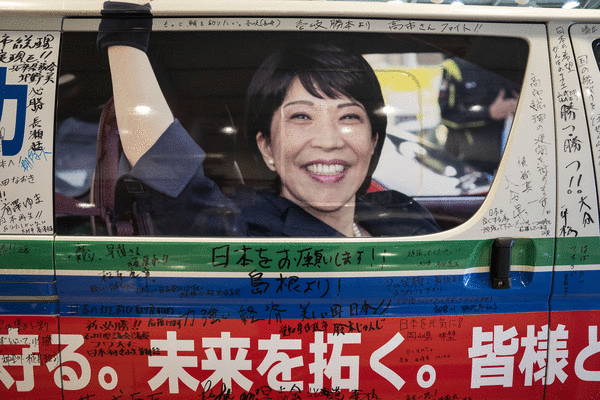
Japanese Prime Minister Sanae Takaichi will call a snap election early in the parliamentary session starting later this month, in a bid to shore up her leadership and secure a mandate for the new ruling coalition.
Takaichi told officials from the ruling bloc that she will give more details of the dissolution on Jan. 19, according to Liberal Democratic Party Secretary General Shunichi Suzuki and Hirofumi Yoshimura, co-leader of the Japan Innovation Party, the LDP’s coalition partner.
“The last election was held under the LDP-Komeito coalition, but our alliance partner has now changed and the public has yet to give a verdict on that,” Suzuki told reporters, when asked about the reason for the election. He added that Takaichi also wanted to seek public approval for policies including proactive fiscal spending and a review of Japan’s defense strategy.
The confirmation of plans for the election comes after media reports stoked speculation over the weekend that Takaichi, who took power in October, will attempt to win a mandate to press ahead with her hawkish diplomatic agenda and pro-stimulus economic policies.
While election success is far from certain, market players have so far taken the view that Takaichi will likely prevail and that her pro-stimulus policies will continue to ramp up public spending to spur the economy while slowing down Bank of Japan rate hikes.
The yen marked a fresh 18—month weak point Wednesday morning in Tokyo, touching 159.45 against the dollar before strengthening after Finance Minister Satsuki Katayama issued another warning to currency speculators that hinted at possible currency intervention. The yen reacted little to the election news following so many media reports of a looming poll.
The yield on 30-year government debt matched a record high on Tuesday while stocks hit another record on Wednesday.
Reports indicate that the election is likely to be formally called on the opening day of parliament on Jan. 23 with the vote taking place on Feb. 8 or the following week as Takaichi looks to capitalize on her elevated support ratings. An early election presents Takaichi with an opportunity to restore a comfortable majority in parliament’s lower house and show that she can stick around as prime minister for years, not months, as she looks to reassert Japan’s economic and defensive presence.
But the move also comes with risks. Her predecessor Shigeru Ishiba also opted to call an early election and ended up losing the ruling coalition’s majority in the lower house. Takaichi’s new coalition with the JIP is untested as an election force and doesn’t have an electoral agreement. Additionally, while her own popularity is the highest for a Japanese prime minister in more than a decade, there is little change in subdued support ratings for the LDP itself.
Together with the JIP and some independents, the ruling bloc currently has a razor thin majority of 233 seats out of 465 in the lower house.
The LDP’s new ally has a strong presence in the area around Osaka but has proved less successful in securing votes beyond that region.
Other smaller parties, including the Democratic Party For the People and Sanseito have made large gains in recent elections, muddying the outlook for any upcoming election. Opinion polls suggest that Takaichi has made inroads in drawing back support from those parties. Still, voters may not welcome an early poll.
A February election will delay passage of the budget for the fiscal year starting April, risking criticism that Takaichi is putting inflation countermeasures on the back-burner as she focuses on securing her own personal grip on power.
Some senior members of the LDP, including heavyweight former Prime Minister Taro Aso, were not completely on board with the timing, according to the Mainichi newspaper, raising questions of how much support Takaichi has within her own party after scant prior consultation with members.
Still, a victory that delivers a stable majority for the LDP would make it easier for Takaichi to proceed with her expansionary economic policies and offer validation for the new coalition. That would provide her with bold optics ahead of her next meeting with U.S. President Donald Trump in the spring and might also spark a rethink in Beijing on how to deal with her views on Taiwan.
The JIP’s Yoshimura cited the need to establish a mandate for the new alliance.
“Rather than continuing with an unstable government, I believe that to truly build a strong economy and implement various economic support measures for the people, we must firmly seek the people’s trust,” Yoshimura said. “If we gain that trust, I believe we can accelerate our efforts.”
--------
—With assistance from Sakura Murakami.
©2026 Bloomberg L.P. Visit bloomberg.com. Distributed by Tribune Content Agency, LLC.




















































Comments