Exxon calls Venezuela 'uninvestable' as Trump pushes oil plan
Published in Political News
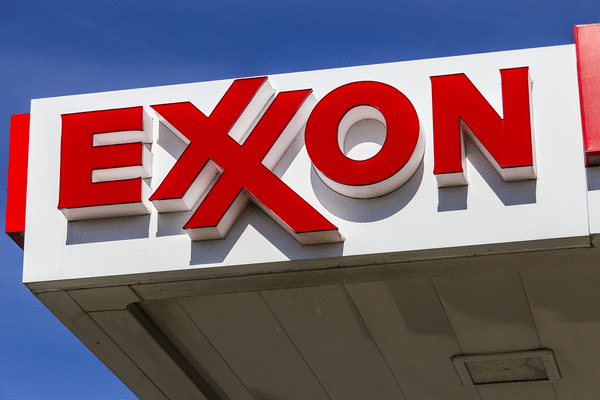
WASHINGTON — Major U.S. oil executives expressed caution about President Donald Trump’s push for them to spend at least $100 billion to rebuild Venezuela, with the head of Exxon Mobil Corp. calling the nation currently “uninvestable.”
Trump convened nearly 20 industry representatives in the East Room of the White House on Friday and predicted they could come to an agreement “today or very shortly thereafter” to reinvigorate operations in the oil-rich Latin American country following the brazen capture of leader Nicolás Maduro.
“If you don’t want to go in, just let me know, because I’ve got 25 people that aren’t here today that are willing to take your place,” Trump told the executives.
Comments from some of the company representatives indicated the president may need to do more convincing. While many praised Trump and said they relished the opportunity in Venezuela, they stressed that hard work remained before they could make substantive investments.
Exxon Chief Executive Officer Darren Woods expressed some of the strongest reservations.
“If we look at the legal and commercial constructs and frameworks in place today in Venezuela today, it’s uninvestable,” Woods said, adding his company’s assets had been seized by the government in Caracas twice before.
“How durable are the protections from a financial standpoint? What will the returns look like? What are the commercial arrangements, the legal frameworks?” Woods asked. “All those things have to be put in place in order to make a decision to understand what your return would be over the next several decades.”
Nonetheless, Woods said Exxon was ready “to put a team on the ground” if there is an invitation from the Venezuelan government and appropriate security guarantees.
Even Continental Resources Inc.’s Harold Hamm, a longtime Trump donor, sidestepped a question about his personal plans to enter Venezuela, though he said the prospect “excites me as an explorationist.”
“There’s a huge investment that needs to be done — we’ve all agreed on that, and certainly we need time to see that through,” Hamm told the president.
Trump expressed confidence after the meeting.
“We sort of formed a deal,” he told reporters. “They’re going to be going in with hundreds of billions of dollars in drilling oil, and it’s good for Venezuela and it’s great for the United States.”
Still, when asked about any specific commitments, Energy Secretary Chris Wright pointed to Chevron Corp. — the only U.S. major still in Venezuela — as the “one specific pledge” from an oil company to help revive the nation’s crude production.
Chevron Vice Chairman Mark Nelson said the company was poised to significantly ramp up its output in the country, which is currently about 240,000 barrels per day, and could increase production by roughly 50% over the next 18 to 24 months.
As he tried to rally support during the meeting, Trump said the U.S. would provide security guarantees to companies in Venezuela, without providing details. He also predicted companies would quickly make back investments in new or updated equipment.
“We’re dealing with the country, so we’re empowered to make that deal. And you have total safety, total security,” Trump said. “You’re dealing with us directly — you’re not dealing with Venezuela or we don’t want you to deal with Venezuela.”
In an interview later, Wright said the biggest thing the Trump administration could do to mitigate risks for oil companies “is change the behavior of the government in Venezuela” and “drive better business conditions.”
Trump said the U.S. would not consider previous losses suffered by companies that had to abandon their Venezuelan operations.
At one point, Trump asked Ryan Lance how much the company had forfeited in Venezuela, prompting the ConocoPhillips CEO to say it had taken a $12 billion loss.
“Good write-off,” Trump joked.
“It’s already been written off,” Lance responded.
Several companies expressed optimism about the opportunity, with Repsol SA CEO Josu Jon Imaz San Miguel telling Trump his company was “ready to invest more in Venezuela today” following a “commercial and legal framework that could allow this.”
Bill Armstrong, CEO of Armstrong Oil & Gas, was also enthusiastic.
“We are ready to go to Venezuela,” Armstrong said. “In real estate terms, it is prime real estate. And it’s kind of like West Palm about 50 years ago: very ripe.”
Still, the overall tenor underscored the difficult road ahead for the Trump administration in enticing oil majors back to Venezuela. The U.S.’s military intervention there stunned many Americans, including some of Trump’s own supporters, who called it a naked attempt to seize another country’s natural resources.
The president has framed it as a chance to oust Maduro, saying he posed a national security threat, and tap Venezuela’s massive oil reserves as a source of hemispheric power and revenue.
“If we didn’t do this, China or Russia would have done it,” Trump said.
After the meeting, Wright expressed optimism, predicting Venezuela’s production would “hopefully” be rising by summer.
“They are going to ramp up investment immediately in the next few weeks,” Wright said on Bloomberg Television. “Can we achieve $100 billion investment over next 10 years? I think absolutely.”
Trump’s exhortations to the oil industry dovetail with a broader push to address cost-of-living concerns weighing heavily on Republicans’ bid to maintain control of Congress in November’s midterm elections.
The president frequently touts sinking oil and gasoline prices, which on Friday averaged $2.81 per unleaded gallon, according to the American Automobile Association, as salve for American consumers. That is, however, a double-edged sword. Low prices are viewed warily within the oil industry, which Trump is counting on to keep pumping crude.
Some U.S. oil operators, particularly smaller producers, are concerned about current prices that have strained the economics of some drilling. And they’re worried about the prospect of an influx of Venezuelan crude suppressing prices further, making more wells too expensive to produce.
Although the president had previously dangled the prospect of U.S. subsidies, he said Friday that companies “will be spending at least $100 billion of their money — not the government’s money.”
Markets have already reacted to the administration’s plans to start selling upward of 50 million barrels of Venezuelan crude, including supplies that built up in storage amid the U.S, naval blockade.
Futures for West Texas Intermediate, the U.S. benchmark, were hovering near $59 on Friday.
The meeting created an awkward dynamic for oil companies that belies Trump’s predictions of bountiful Venezuelan production under U.S. control.
Some industry representatives ahead of the meeting expressed worry that attending risked casting them as willing participants in a callously opportunistic grab for Venezuela’s crude, people familiar with the matter said. At the same time, executives need to tread a fine line with the president, who is pressing them to swiftly pledge new investments.
Adding to the tension is the strong political support Trump has enjoyed from the oil industry, including from Hilcorp Energy Co. founder Jeff Hildebrand, who also in the room Friday.
Venezuela sits atop the world’s largest proved crude reserves, but its output has dwindled to less than 1 million barrels per day amid decades of disrepair and the exodus of foreign companies.
Cleaning up environmental damage and rebuilding the country’s abandoned rigs, leaky pipelines and fire-ravaged equipment could take years — and tens of billions of dollars — simply to modestly boost production, much less approach the country’s 1970s peak of almost 4 million barrels per day.
(Phil Kuntz, Kevin Crowley and Ari Natter contributed to this report.)
©2026 Bloomberg L.P. Visit bloomberg.com. Distributed by Tribune Content Agency, LLC.









































Comments