Trump's 'Golden Fleet' plan to resurrect battleships meets sharp criticism in Connecticut submarine country
Published in Political News
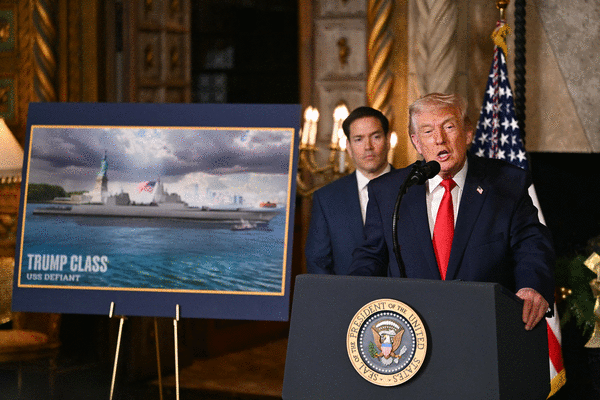
President Donald Trump’s stunning year-end announcement that he is redirecting decades of U.S. Naval planning by re-emphasizing surface, rather than submarine warfare with construction of a new class of battleships is running into a buzzsaw of skepticism and could face a Congressional challenge.
Among the critics is U.S. Rep. Joe Courtney, D-Conn., now ranking member and — if Democrats take the House in the midterm election next fall — likely chairman of the House Armed Services committee’s influential Seapower Subcommittee.
“I would love to have a hearing on the Seapower Subcommittee on how battleships make any sense, given what we have already got in the hopper,” Courtney said during a recent interview. “By rights our committee should be all over this.”
“Starting a class of Navy warships is not about satisfying some obsession with ‘aesthetics’ – but rather about strengthening our force posture and Navy personnel in a new highly contested maritime domain,” he said. “Submarines, destroyers and carriers accomplish that goal by distributing seapower, unlike battleships that we know from World War II are dangerously vulnerable from the air and undersea. We can do much better than living in the past.”
Trump provoked a chorus of such questions across the shipbuilding industry when on Dec. 22 he announced at a press conference — from which uniformed U.S. Navy personnel were absent — a modernization program he called the “Golden Fleet.” His plan is focused on construction of a new class of hi-tech battleships he designated the “Trump class” as part of a naval fleet that for decades has been built on unrivaled submarine technology.
For years, Trump has talked of upgrading a U.S. war fleet he has called “terrible-looking” and covered in rust.
“As you know, we’re desperately in need of ships,” he said. “Our ships, some of them have gotten old and tired and obsolete. As commander in chief, it’s my great honor to announce that I have approved a plan for the Navy to begin the construction of two brand-new, very large, the largest we’ve ever built, battleships.“
The Congressional Research Service reported on December 30 that Trump’s battleship fleet, as proposed, could reach as many as 20 to 25 ships. Courtney said the first ship of the class — the first ship usually is the costliest in any class — could cost as much as $15 billion.
What is known so far about the Trump plan is that it is at odds with the naval warfare consensus that has developed over more than a half century — that big, slow surface ships like battleships are highly vulnerable, in particular to new missile technology. Battleships haven’t been considered effective elements of the U.S. fleet since airpower revealed their vulnerability during World War II.
The key to U.S. security lies, according to the consensus, in the U.S. advantage in a highly maneuverable, extraordinarily lethal and largely undetectable nuclear submarine fleet capable of launching missiles from hiding places anywhere in the oceans. Trump acknowledged that U.S. submarine technology remains nearly a generation ahead of China, whose aggressive posture toward Australia, Taiwan and others in the Indo-Pacific has made it the focus of U.S defense planning.
The Pentagon recently underscored concern about large surface ship vulnerability in its annual report to Congress for 2025 on military and security developments involving China. The report tracks, among other things, the development of Chinese anti-ship missiles with enough range to hit the U.S. west coast.
The report highlights a missile referred to by Courtney and others as the “carrier killer” because of its ability to threaten aircraft carriers and other large surface ships with maneuverable, high-speed warheads.
In addition, China’s goal in the Indo-Pacific is to block U.S. efforts to project force into the region and Courtney argues that reliance on battleships could weaken U.S. efforts to defuse that strategy by disturbing its lethal force across a wide area
“The concept is that you can’t concentrate your forces because it leaves you vulnerable,” he said. “And this concept on battleships is completely at odds with what has been the counter strategy to China’s military buildup.“
The Navy has issued notices that it intends to issue design contracts for the Trump class battleships with six-year performance windows. That means the ships couldn’t be contracted for construction until the early 2030s and would not enter service if built until the late 2030s or early 2040, the research service said.
Trump announced the golden fleet concept four days after signing a Pentagon budget agreed upon by both houses of Congress that includes nothing for new battleships. Courtney said there has been “chatter” over the holiday break about finding money.
“It’s just a rumor,” said Courtney, whose district includes submarine builder Electric Boat in Groton, Connecticut. “But that is something that we are going to be watching when we get back in town. And I’m sure there are going to be lots of questions to the office of legislative affairs to explain what is going on here. We are crawling over broken glass to try to keep all the different programs going.”
Trump’s talk of building expensive new surface ships comes at a time when Congress has been pouring billions of dollars into jump-starting the country’s flagging industrial base and speeding production of what had been the Pentagon’s top priority — the Virginia attack and Columbia missile submarines being built by Electric Boat, a division of General Dynamics, at shipyards in Connecticut and Rhode Island.
As the Pentagon has learned in its effort to counterbalance Chinese expansion, decades of flat, post-Cold War military spending not only shrunk the U.S. Naval fleet by half but depleted the ranks of welders, shipfitters and riggers who build ships, not to mention their employers, the companies that form the submarine industrial base.
As a measure of the decline in industrial capacity, the number of subcontractors making up the submarine industrial base has shrunk from 15,000 at the close of the Cold War to the current 3,000 to 4,000, Courtney said.
“In terms of that effort to try to get people back in the game, we really have to convince them that this is not going to be another peaks-and- valleys kind of situation,” Courtney said.
EB, the Pentagon’s prime submarine contractor, has hired at a rate of at least 3,000 in recent years. The combined workforce at its Connecticut and Rhode Island yards has hit 25,000 and the company has said it is targeting a workforce of 30,000.
The recently approved defense budget includes funding years in advance for Virginia-class attack submarines and for a third Columbia class ballistic missile sub. The Navy has said it wants a dozen Columbias and from 60 to 65 of the Virginias. The U.S. has promised at last three Virginia subs to Australia under AUKUS, the Australia-United Kingdom-U.S. security agreement written to balance Chinese naval expansion.
Wherever talk of funding battleships goes, it should not affect submarine construction at the Electric Boat shipyards, where employment is booming, according to Courtney and others.
And there are experts who suspect the Trump plan for a Golden Fleet will go nowhere, given the lag time between design to production and the lack of a role for big surface ships in defense planning.
Analyst Mark F. Cancian predicted the Trump battleship “will never sail” in a widely discussed December 23 article published by the Center for Strategic and International Studies.
“A future administration will cancel the program before the first ship hits the water,” Cacian wrote.
_____
©2026 Hartford Courant. Visit courant.com. Distributed by Tribune Content Agency, LLC.




















































Comments