Can Congress find a path on government 'jawboning' limits?
Published in Political News
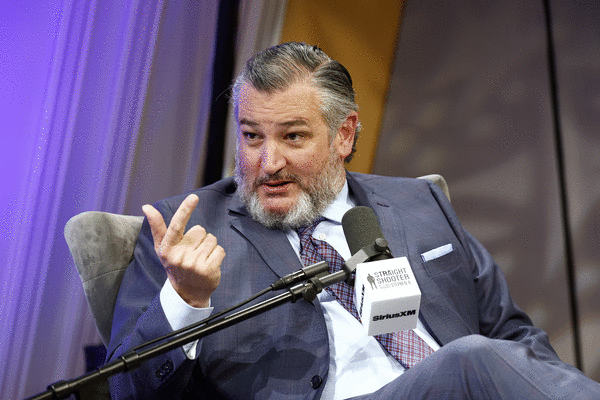
WASHINGTON — Members of both parties want government officials to stop putting pressure on social media platforms to censor speech, but turning that stance into law would require getting specific about what kind of pressure is inappropriate, and what those censored can do about it.
Senate Commerce Chair Ted Cruz has said he will “soon introduce” legislation that would “provide transparency” about government contacts with social media companies and allow individuals to sue if their speech has been indirectly censored due to government pressure, known as jawboning.
The Texas Republican has not yet released bill text for his anti-jawboning push, but any legislation that would prohibit indirect censorship would need to draw a careful line around what kind of communications the government can have with platforms, experts say. It would also have to establish standing for those who were harmed and put an economic value on their losses, and determine whether individual government officials or larger agencies can be held accountable.
Cruz would not be the first to offer anti-jawboning legislation. Sens. Eric Schmitt, R-Mo., and Rand Paul, R-Ky., have both introduced their own bills.
The Commerce Committee held two hearings on jawboning, questioning executives from Facebook owner Meta and Google as well as individuals who said that their online speech was suppressed at the request of the Biden administration.
Cruz and his fellow Republicans have focused on those claims, which mostly dealt with misinformation about COVID-19 or the 2020 election. For their part, Democrats have pointed to Federal Communications Commission Chair Brendan Carr’s comments about late night host Jimmy Kimmel that appeared to threaten local TV affiliates that aired his late night show.
While both Democrats and Republicans share concerns about jawboning, agreement on possible remedies remains elusive.
When asked about Cruz’s proposals, Commerce ranking member Maria Cantwell, D-Wash., said that transparency is a “good antiseptic,” but that “I don’t think transparency is going to rein in President [Donald] Trump.”
Transparency
Cruz has not specified what greater transparency would look like, but the general idea has support from the tech industry and free-speech experts.
One of Schmitt’s bills, introduced at the start of 2025, would require agency inspectors general to include in their semiannual reports “a detailed description of the contents and particular circumstances of” communications with platforms or content providers.
Paul’s anti-jawboning bill, also introduced last January, would require federal agencies to submit frequent reports on employees’ communications with social media platforms, including the names and titles of any employees who violated that bill’s ban on communications to encourage or suggest censorship.
Clay Calvert, a fellow with the conservative-leaning American Enterprise Institute, suggested that transparency could include requiring the government to keep public records of contacts with platforms, including who was emailed.
“The problem with jawboning, typically, is that it takes place out of public sight, and that it’s very hard to discover unless somebody slips up and it becomes public, or else litigation takes place and it surfaces through the discovery process when documents have to be produced,” he said.
David Inserra, a fellow at the libertarian CATO Institute, pointed to recent incident in which Attorney General Pam Bondi said that after “outreach” from the Justice Department, Facebook removed a group in which members were sharing the locations of Immigrations and Customs Enforcement agents.
Inserra said that in that case, “transparency would tell us a lot more about what’s going on,” including whether Bondi threatened any kind of retribution against Facebook if it did not remove the group.
According to a 2024 Congressional Research Service report, “a government official cannot coerce a private party with threats of regulation in order to punish or censor disfavored speech,” so the specific contents of Bondi’s outreach could determine whether it was jawboning.
Inserra also posited that a requirement for transparency around government contacts with platforms could work in concert with prohibiting certain types of contacts and allowing individuals to sue by making it clear what kinds of requests or communications are made, whether they amount to jawboning or not.
“So I think transparency really is essential to making all the other portions work, and the transparency itself may even work on its own. Transparency may be its own … deterrent.”
At a Senate Commerce hearing in October, Markham Erickson, vice president of government affairs and public policy at Google, offered his support for a transparency requirement.
“Transparency regarding government … interactions with companies is essential to foster public trust and uphold the principles of freedom of expression. Google publishes data in our biannual transparency report on government content removal requests,” he said, adding that “We welcome the committee’s consideration of legislation that would create more transparency in how the U.S. government engages with industry.”
Private right of action
While transparency seems to have broad support, creating a private right of action for those harmed by jawboning raises more questions that Cruz would have to answer in any anti-jawboning legislation.
In 2024, the Supreme Court decided a case in which the National Rifle Association sued the former superintendent of the New York Department of Financial Services on the basis that she coerced bodies she regulated to suppress the NRA’s advocacy efforts. The court found in favor of the NRA.
The CRS report, which looked at lessons for Congress from that case, explained the difference courts have laid out between government officials’ own First Amendment speech rights and the necessity that they not infringe on other’s rights, including by improperly influencing private companies.
“Courts must draw fine lines between permissible government attempts to ‘convince’ others and advocate for or against a viewpoint, and prohibited attempts to ‘coerce’ private entities in order to punish or suppress disfavored speech,” the report said.
Inserra said that in the NRA case, there was “a clear threat that says that this is the action we will take. [This] is the punishment you will suffer or the benefit you will receive.”
But in other cases, those elements, and the chain of cause and effect to an individual or group whose speech was censored, might not be as clear.
In the case of Murthy v. Missouri, individuals and a group of states sued based on what they said were inappropriate communications by the Biden administration to convince platforms to take down certain posts related to COVID-19 and the 2020 election. In that case, the court found that neither the states nor individual users had standing to sue over government communications with social media platforms, because users had not shown that the removal of their speech was a direct result of government action.
Inserra and Calvert both said that anti-jawboning legislation could establish standing for individuals in jawboning cases.
Legislation would also need to answer whether suits would be against individual federal employees, an agency or the entire federal government.
Paul’s bill would allow suits against both entire agencies and individual employees.
One of Schmitt’s bills would put an onus on platforms themselves, limiting protections under Section 230 of the 1996 telecommunications law for platforms that limit speech as a result of communications with the government or third parties acting at the request of the government. That bill would make an exception for communications based on a “legitimate” law enforcement or national security purpose.
At the Commerce hearing in October, Neil Potts, vice president for public policy at Meta, took ownership for his platform’s role in conversations with government.
“To be clear, we believe that government pressure was wrong and wish we had been more outspoken about it. We should not compromise our content standards due to pressure from any administration in either direction, and we’re ready to push back if something like this happens again.”
Legislation could also put a dollar figure on the harm suffered by individuals whose speech was jawboned to redress the wrong and act as a deterrent.
“They might try to establish some amount and actually quantify it, which is going to be difficult to do, in terms of … what is the economic value of being de-platformed,” Calvert said said.
Paul’s bill would not set a dollar figure, but would allow individuals to recover attorneys fees, injunctive relief, and actual damages.
Jawboning definition
Inserra cautioned that if Cruz’s legislation seeks to prohibit certain communications between the government and social media platforms, “it’s hard to draw that line exactly right.”
A preliminary injunction from the district court in Murthy v. Missouri put broad restrictions on government communications with social media platforms. That injunction was ultimately vacated, but experts worried it was too restrictive.
Inserra gave an example of a news organization working on a story that could potentially give away the location of a spy. The government could ask for a short delay of the story to get the spy to safety, which the news organization might agree to.
“You may want the government to engage in some level of conversation with private platforms,” Inserra said.
Paul’s bill would prohibit government employees from using any form of communication to “direct, coerce, compel, or encourage a provider to take, suggest or imply that a provider should take, or request that a provider take any action to censor” constitutionally protected speech.
Schmitt’s bill that would create a private right of action that would make an individual government employee liable who “subjects, or causes to be subjected” an individual “to the deprivation of any rights, privileges, or immunities secured by the First Amendment.”
It’s not clear from Cruz’s comments exactly what kind of communications his bill would restrict.
“Is this going to be a really strict law?” Inserra said. “Is it going to say there’s going to be no communications, and these are only a few exceptions, and they are going to be really tightly defined? Or there’s been other approaches that have been more broadly … more permissive, you know, that create … more allowances for governance communication.”
©2025 CQ-Roll Call, Inc., All Rights Reserved. Visit cqrollcall.com. Distributed by Tribune Content Agency, LLC.








































Comments