Pennsylvania lawmakers traded up to $58.8M in securities in 2025 as Congress considers stock trading ban, Post-Gazette analysis finds
Published in Political News
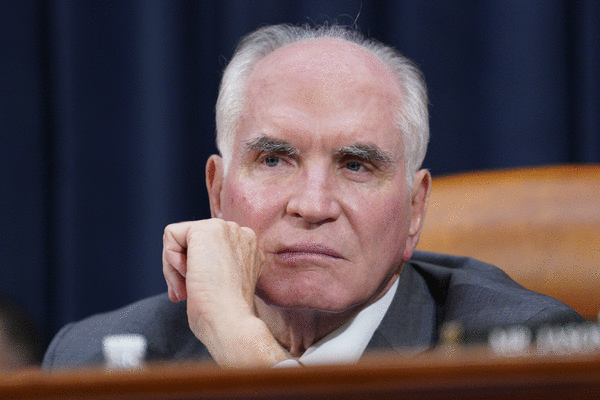



WASHINGTON — Pennsylvania's federal lawmakers bought and sold stocks or other securities collectively worth between $19.8 million and $58.8 million this year as Congress inches toward a potential vote on banning stock trading for its members and immediate family, a Post-Gazette analysis found.
The transactions — primarily by two wealthy freshmen in Pennsylvania's 19-member delegation — have sometimes raised concerns among ethics experts and government reform advocates throughout the year.
Their trades have also become less frequent as public scrutiny increased and as momentum to crack down on the practice has grown on Capitol Hill, according to the Post-Gazette's analysis of data from Capitol Trades, a website that tracks congressional financial disclosures.
"There are sacrifices that go along with being on the public payroll and being a public servant," said Dylan Hedtler-Gaudette, acting vice president of policy and government at the Washington, D.C.-based Project on Government Oversight. "This should be a part of that compact between the public and public officials."
Seven Pennsylvania lawmakers have disclosed trading stocks in 2025, though how they've played the market has varied widely.
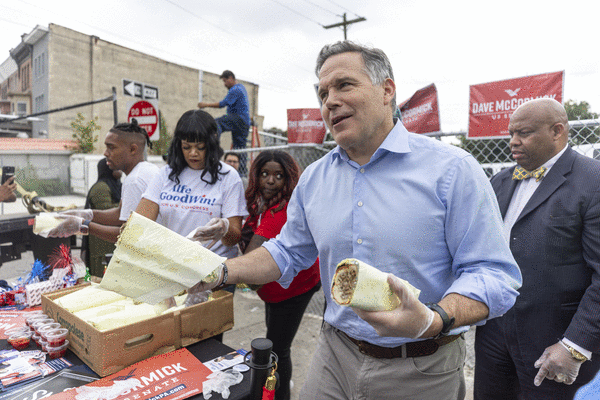
U.S. Sen. Dave McCormick, a Republican former hedge fund CEO who became one of the wealthiest members of Congress with his election last year, has disclosed between $15.9 million and nearly $41.4 million in transactions. While his investments in a bitcoin fund have raised concerns about conflicts with his committee roles, the vast majority of his activity has involved municipal bonds that ethics experts say are not an ethical issue. His Democratic counterpart, U.S. Sen. John Fetterman, has disclosed between $23,000 and $345,000 worth of trades in 2025, all of which belong to his children and are managed by accounts that the senator said were gifts from his father.
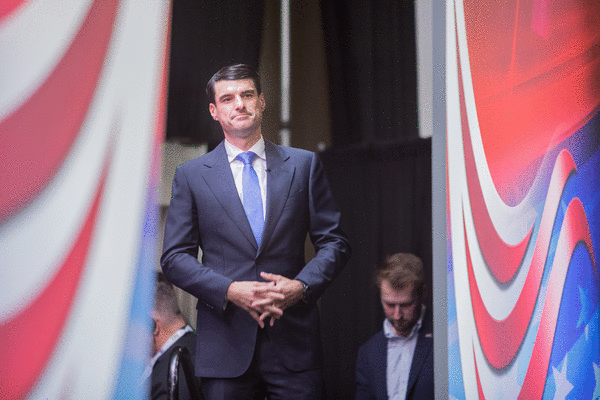
The most prolific trader in the delegation — and the fourth-most active in the entire Congress, according to Capitol Trades — is U.S. Rep. Rob Bresnahan, a Luzerne County Republican who campaigned last year on supporting a congressional stock trading ban.
He's disclosed 636 trades valued between about $2.3 million and $13.2 million, according to the disclosures that require values of income and assets to be described only in broad ranges.
Just under 600 of the trades occurred from January through May, when news organizations began highlighting the activity and Bresnahan introduced his own bill to ban congressional stock trading starting in 2027. Bresnahan said at the time that he never traded his own stocks and that he was working with the House Ethics Committee to create a qualified blind trust for his holdings.
He walked back the idea of a blind trust a few months later, blaming the "prehistoric" and "excruciating" ethics process in an interview with Scranton-based WVIA public broadcasting. He also rebuffed the idea of telling his investment managers to stop trading.
"And then do what with it?" he told WVIA. "Just leave it all in the accounts and just leave it there and lose money and go broke?"
One of the trades that drew outsized attention was his sale of $1,000 to $15,000 worth of stock in Centene on May 15. The company is a leading Medicaid plan provider whose stock proceeded to plummet after President Donald Trump signed his signature legislation that cut Medicaid in July.
The stock has dropped 35% since Bresnahan sold it, the Post-Gazette's review found. Stock in another major Medicaid plan provider, Elevance Health, that he sold $15,000 to $50,000 of on the same day has also dropped by more than 12%. The congressman's office did not respond to questions from the Post-Gazette.
Hedtler-Gaudette, whose organization is supporting a different stock-banning bill than the one Bresnahan introduced, said blind trusts are not particularly common among members of Congress but they're "especially doable" in cases like Bresnahan's.
Current laws prohibit officials from trading securities based on privileged information. But they allow for investments in companies or industries that are the subjects of lawmaking, and for candidates to collect campaign contributions from political organizations connected to companies, as long as they're disclosed publicly.
"It's preposterous, frankly, that that is allowed to happen," he said. "But it's the kind of legalized corruption that we're all accustomed to."
'We have to do something'
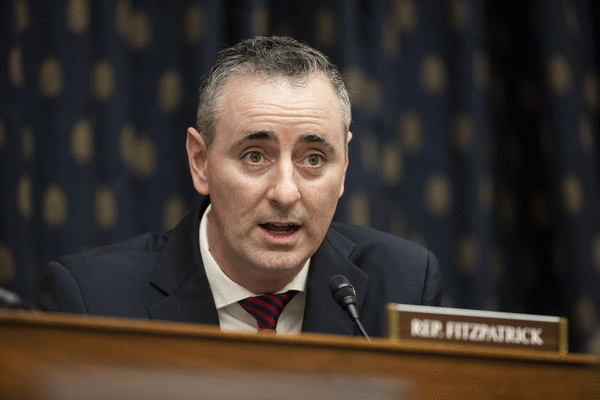
Among the leaders of the current bipartisan push to ban the practice is U.S. Rep. Brian Fitzpatrick, a Bucks County Republican whose district is routinely among the most competitive in the state.
Before a hearing on the issue last month, Fitzpatrick didn't equivocate as he promised a forthcoming vote — "mark my words," he said — and spoke about the underlying need.
"Members of Congress unequivocally have access to inside information," he told reporters. "If you accept that premise, then we have to do something on the stock trading front."
One of his more colorful colleagues put it another way: "This is a sewer ... This is a scam that's being played on the American public," U.S. Rep. Tim Burchett, a Tennessee Republican, said next to Fitzpatrick.
Both Republicans have since signed on to a petition that could soon force House Speaker Mike Johnson — who has said members should be allowed to trade stocks — to call for a vote on the Restore Trust in Congress Act, which would prohibit stock trading and ownership by lawmakers and their immediate family. Bresnahan and U.S. Rep. Chris Deluzio, D-Fox Chapel, joined the petition this week.
Others, such as U.S. Rep. Mike Kelly, R-Butler, have waved off concerns about insider trading.
Kelly and his wife, Victoria, until July were at the center of a nearly five-year House Ethics Committee investigation into whether they used privileged information to turn a profit on a steel company in 2020. The committee said Congressman Kelly violated ethics rules and refused to fully cooperate but it did not have enough evidence to prove the couple violated existing law.
The issue stemmed from Victoria Kelly's purchase of 5,000 shares of Cleveland-Cliffs at a time when Mike Kelly was involved in efforts to get the president to issue tariffs that might prevent the shuttering of its factories in Butler and Zanesville, Ohio. The day after he was informed that an initial step would be taken to benefit the company, Victoria Kelly made the purchase — her first purchase of an individual stock in almost a year, according to the committee's report. Less than nine months later, she sold the stock for a $64,500 profit.
The committee reported that Victoria Kelly did not cooperate with the investigation and Mike Kelly gave "inconsistent" testimony. It recommended that the Kellys completely divest from Cleveland-Cliffs — justifying that "rare" recommendation by referring to Mike Kelly's own acknowledgment of being an "insider" when it came to the company in his hometown.
"I know that plant, and I know what we make, and I know we're the last producer of that product in the United States," Mike Kelly told the committee, according to its report. "Am I an insider? Damn right. I have been inside that mill."
Congnressman Kelly's office did not respond to a question this week about whether the Kellys divested or still retain a financial interest in the company.
All of the transactions Mike Kelly has disclosed in 2025 — totaling between $459,000 and about $1.2 million — have also been attributed to his wife. The only individual stock among those was the purchase and selling of $15,000 to $50,000 worth of U.S. Steel during a roughly two-week period in June when a deal to sell the company to Japan-based Nippon Steel was announced and then finalized.
Victoria Kelly made the purchase on June 3, which was 11 days after Trump announced the salvaged partnership and four days after he rallied at the company's location in West Mifflin. At the time, the price of the stock was valued at $53.76 and some investment advisers suggested that any remaining shareholders should sell immediately in case the deal fell through.
Congressman Kelly's disclosures indicate his wife held on to the stock until June 18, when the deal was complete and shareholders automatically received $55 per share before the stock was delisted from the exchange.
McCormick's crypto concerns
McCormick has an estimated net worth of $175 million and the transactions he's reported since his swearing-in this year have been among the largest of any lawmaker, according to Quiver Quantitative, a site that tracks lawmaker's stock trading and other financial disclosures.
The former CEO of Bridgewater Associates' largest transactions were sales of between $1 million and $5 million in both the Goldman Sachs Group and Rumble, a video platform favored by conservatives.
The only other major investment he's made in an individual stock has been Bitwise Bitcoin ETF, a fund that provides investors access to the cryptocurrency. From late February through late November, McCormick, who boosted cryptocurrency during his campaign, has disclosed 22 purchases worth a combined $645,000 to $1,550,000 in the fund.
Ethics experts say the transactions raise conflict of interest concerns because of the Republican's roles on the Senate Banking Committee and its Subcommittee on Digital Assets. It's also potentially problematic because of the emerging nature of cryptocurrency regulation, they say. The GENIUS Act, supported by McCormick and signed into law by Trump in July, was the first major law on the topic and aims to set a regulatory framework for stablecoins, a cryptocurrency, but not specifically bitcoin.
"Sen. McCormick's portfolio and committee assignments raise pretty significant concerns because the Banking Committee has a large role in overseeing lots of industries that intersect with his personal financial portfolio and particularly with cryptocurrency," said Donald Sherman, executive director and chief counsel for Citizens for Responsibility and Ethics, an advocacy group focused on government reform.
The potential conflict around "having an ownership stake in cryptocurrency is even more pronounced because it's a place where the industry is new," Sherman said.
McCormick, whose office did not respond to questions from the Post-Gazette, has mostly disclosed purchases and sales that he and his wife made of municipal securities across Pennsylvania.
Those securities are methods for state and local governments to finance projects. Investors such as McCormick buy the bonds and then collect interest, and they are not subject to federal taxes. The McCormicks' municipal bond purchases this year include bonds worth up to $1.9 million from the city of Pittsburgh and up to $1 million from Allegheny County. Other large bonds included $1 million to $2 million from the Allentown School District and up to about $1 million each from Penn State University, the Pennsylvania Department of State, North Allegheny School District, Pittsburgh Water and Sewer Authority and the Philadelphia School District.
Sherman said the "conflict concern is different and far less significant" with such bonds compared to stock trades. And the bill that's being teed up for a House vote would specifically continue to allow the trading of state or municipal bonds.
Fetterman and others
McCormick's wealth and disclosed transactions far surpass his current Pennsylvania colleagues and his immediate predecessors, former Democratic U.S. Sen. Bob Casey and Republican U.S. Sen. Pat Toomey.
Fetterman, in an interview with the Post-Gazette, said repeatedly that he doesn't own any stocks and that he supports a complete ban for members of Congress. In a statement from his staff later, he clarified that the 23 trades he disclosed this year — each valued between $1,000 and $15,000 — were "a gift from my father to his grandchildren."
"I have no managing role, no access, and don't know what is in them," he said. "As I've maintained, I support banning Members of Congress from trading stocks, including immediate family members."
Other Pennsylvania lawmakers who've disclosed stock transactions were U.S. Reps. Dan Meuser, of Luzerne County; Dwight Evans, of Philadelphia; and Guy Reschenthaler, of Peters.
Meuser disclosed between $1.9 million and $2.3 million in stock sales in August, most of which was in Nvidia, the chip maker that's become the world's most valuable company. Two-thirds of Meuser's trades, however, were made about a year before the disclosure — and the rest were from six months earlier. Ethics rules require disclosure within 30 days.
In a statement responding to the Post-Gazette's questions, Meuser said he "had no involvement in investment decisions made by my broker."
"I was informed that my broker failed to report these transactions in a timely manner, in what should have been a simple, automatic filing that occurred without error," Meuser said. "When accounts were reconciled during my annual financial disclosure, and the error became apparent, the transactions were reported immediately. These assets have been owned by my wife for nearly 10 years, well before I entered Congress. I immediately informed the House Ethics Committee that the mistake was made solely by my brokerage firm, benefited me in no way, and it was made clear to me that no rule was violated other than the late filing."
The congressman said he believes rules around congressional stock trading "should not just be tightened, but also be clear and enforced." He said he would follow all rules, though he did not specifically say if he would vote for the comprehensive ban.
Sherman, of the group known as CREW, often takes legal action regarding ethical concerns among federal officials. But he said his organization has not filed formal complaints about stock trading because of the laws on the books and the difficulty with proving allegations of insider trading.
"If we just file complaints on Stock Act violations, or perceived violations, we'd be filing complaints every day," Sherman said. "It's just too big of a problem, and that's why legislation is the right fix."
_____
© 2025 the Pittsburgh Post-Gazette. Visit www.post-gazette.com. Distributed by Tribune Content Agency, LLC.














































Comments