Republicans in Congress eye more power for states to remove voters
Published in Political News
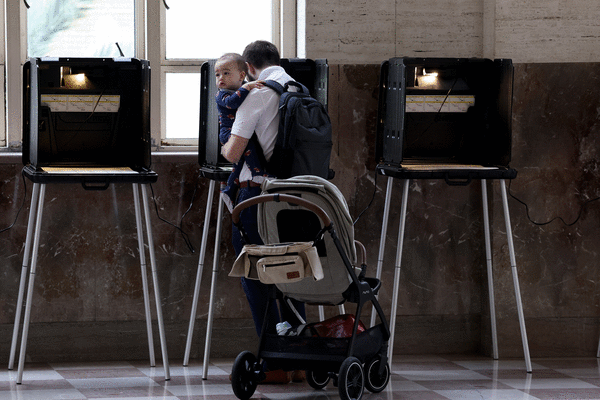
Republicans in Congress want to give states more authority to remove ineligible voters — including noncitizens and people who have moved or died — from voter rolls, seeking to reinforce the Trump administration’s own push to scrub the lists.
At a U.S. House hearing on Wednesday, lawmakers weighed changing a landmark federal voter registration law, the 1993 National Voter Registration Act, or NVRA, which requires state motor vehicle agencies to offer residents the opportunity to register to vote. Some conservatives say the law makes it too difficult for states to keep their voter rolls up to date.
Since President Donald Trump took office, the U.S. Departments of Justice and Homeland Security have ramped up efforts to scoop up data on voters and pressure state officials to conduct more aggressive maintenance of their lists to ensure that everyone on the roll is eligible to vote.
Some Democrats and privacy advocates have raised concerns about how the Trump administration plans to use the information. The Justice Department has sued more than a dozen mostly Democratic states, seeking to force officials to turn over lists of registered voters.
While Republicans control Congress and the White House, any GOP-led measure likely would face a Democratic filibuster in the Senate. And the chance of major voting legislation clearing Congress before the November 2026 midterm elections is minimal.
But Wednesday’s hearing before the Committee on House Administration’s Subcommittee on Elections showed that at least some congressional Republicans are fully on board with the Trump administration’s efforts to inject the federal government into a process, voting roll maintenance, that has historically been left to the states.
Other congressional election measures have stalled, however. The House in April passed a measure that would require voters to show proof of citizenship when registering, but the bill has stalled in the Senate. Trump attempted to impose a proof of citizenship requirement through an executive order that has been blocked in federal court.
U.S. Rep. Laurel Lee, a Florida Republican who chairs the subcommittee, said the NVRA’s language on maintenance of state voter rolls should be more clear. The law requires states to have a general program of maintenance but leaves many of the specifics up to states.
“Election officials benefit from clear and unambiguous laws, which will help them carry out their duties and ensure voter lists are accurate and up to date,” Lee said at the hearing.
Options for data sharing
Michael Morley, a law professor and the faculty director of the Election Law Center at Florida State University, testified that the NVRA only allows states to remove voters due to changes in their circumstances, such as a felony conviction or death. The law doesn’t explicitly allow states to remove voters who should have never been registered in the first place, he said.
Morley urged lawmakers to amend the law to require states to try to identify voters “who are ineligible on any basis” — a change that could significantly expand the scope of voter removals.
“There are a variety of circumstances under which a person could be ineligible to vote,” Morley told lawmakers, such as a lack of citizenship or a move out of state.
Morley also raised the prospect of Congress mandating that state election officials receive information from the U.S. Department of Homeland Security’s SAVE system, a powerful search tool originally built to check the immigration status of individuals applying for government benefits. The Trump administration has repurposed SAVE into a program to verify citizenship.
Homeland Security has been encouraging states to upload their voter rolls into SAVE, after the agency linked the program with Social Security data in May.
“This committee could look at the possibility of either requiring states to enter into agreements to receive information from the SAVE database, or potentially even other databases to the extent that there are other agencies that have information concerning citizenship that could be shared with states,” Morley said.
Some Democratic state election officials oppose using SAVE, citing worries about whether residents’ personal data could be shared with other agencies. Unredacted voter rolls often contain driver’s license numbers and partial Social Security numbers.
Twelve state secretaries of state submitted a federal public comment on Dec. 1 sharply criticizing the SAVE rollout. The changes to SAVE “are likely to degrade, not enhance, State efforts to ensure free, fair, and secure elections,” they wrote.
“This is, again, part of a power grab pattern when it comes to control over our elections,” Minnesota Democratic Secretary of State Steve Simon told Stateline earlier this month.
Many Republican secretaries of state had called on the Trump administration to implement the changes to SAVE. A handful of GOP states also sued Homeland Security last year, alleging the Biden administration wasn’t doing enough to help states identify ineligible voters; those states — Florida, Indiana, Iowa and Ohio — settled with the Trump administration in late November.
“Accurate and up-to-date voter rolls are essential for safe, secure, transparent, and accessible elections,” Montana Republican Secretary of State Christi Jacobsen said in a November news release announcing that her state would soon use SAVE.
Worries about ‘overzealous’ purges
On Wednesday, Sophia Lin Lakin, director of the American Civil Liberties Union’s Voting Rights Project, cautioned lawmakers against engaging in “overzealous” purges of voters.
The current law, she testified at the U.S. House hearing, includes protections that guard against hasty removals of voters made in error. For example, the NVRA mandates a 90-day “quiet period” before federal elections that prevents election officials from systematically removing ineligible voters during that period.
“This prevents last-minute purges that leave voters to discover they’ve been removed and get back on the rolls in time to cast a ball that will count,” Lakin testified.
U.S. Rep. Terri Sewell of Alabama, the ranking Democrat on the subcommittee, said Americans too often have to jump over unnecessary barriers to cast their ballots. She said conspiracy theories and misinformation surrounding elections have spurred state-level legislation to make voting harder.
“The NVRA is a critical component to our federal voting legislation,” Sewell said, “and it provides vital access and protections to voters, as well as guardrails for election officials to conduct voter maintenance.”
____
Stateline’s Jonathan Shorman can be reached at jshorman@stateline.org.
©2025 States Newsroom. Visit at stateline.org. Distributed by Tribune Content Agency, LLC.









































Comments