GAO chief's pending exit tees up battle for a successor
Published in Political News
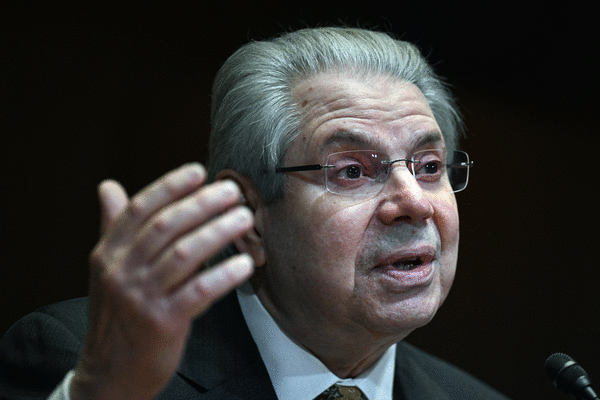
WASHINGTON — The Government Accountability Office’s new leader starting later this year, at least on an acting basis, will be a veteran investigator with over three decades’ experience at the nonpartisan legislative branch agency.
Orice Williams Brown, currently the GAO’s chief operating officer, will take the reins from outgoing Comptroller General Gene L. Dodaro, whose 15-year term comes to an end Dec. 29 with no sign of movement on a more permanent replacement.
President Donald Trump, who’s had an adversarial relationship with congressional investigators, gets to nominate Dodaro’s successor — an oddity of federal law that has raised separation-of-powers questions and drawn the ire of some GAO veterans.
And if Trump nominates someone viewed as likely to use the agency for political purposes — or to simply neuter it, as the administration has done with other independent agencies such as the Consumer Financial Protection Bureau — a Senate confirmation would be a hard sell.
In the meantime, without a Senate-confirmed successor, the statute makes clear that it’s up to Dodaro to appoint his replacement when there is no deputy comptroller general. And there’s been no deputy confirmed by the Senate since the Nixon administration.
Without a deputy comptroller general in place, federal law going back to 1944 stipulates that the comptroller general “shall designate an officer or employee” at the GAO to serve as his or her acting successor.
An internal GAO memo designates the agency’s chief operating officer as next in line in the absence of a comptroller general or his or her deputy, according to GAO’s general counsel, Edda Emmanuelli Perez.
Therefore, the job will fall to Brown starting on Dec. 30 unless there is some unusually quick and unexpected move to confirm someone else, which seems highly unlikely.
‘At war with GAO’
As chief operating officer since 2021, Brown oversees day-to-day management of the agency. Prior to that job, Brown was the GAO’s chief of congressional relations, serving as the agency’s top liaison with congressional offices and committees to ensure their requests are met and statutory requirements upheld.
Brown also worked in the GAO’s financial markets team starting in 2005, serving as managing director of that division from 2011 to 2017.
She’s won numerous awards during her tenure, including American University’s Roger W. Jones Award for Executive Leadership. That goes to senior career officials in the federal government who have “demonstrated dedication to superior leadership in achieving their agency’s mission and nurturing future managers,” according to the university’s website.
“Orice possesses all the qualities of an outstanding leader, colleague, and mentor,” Dodaro said when Brown won the award in 2023. “Both GAO and the American people are better off because of her unwavering commitment to public service.”
As such, Brown appears cut from the same by-the-book, nonpartisan cloth as Dodaro, whose agency has tussled with Trump and his budget director, Russ Vought, dating back to the president’s first term.
After Congress rejected a $15 billion presidential rescissions package in 2018, the GAO opined that a possible “pocket rescission” — putting a 45-day hold on funds and simply letting them lapse when the fiscal year ends — would be illegal. When Trump this year went through with a nearly $5 billion pocket rescission, GAO reiterated the illegality of such a move.
Perhaps most famously, the GAO said that Trump’s hold on military aid to Ukraine in 2019 — which resulted in the president’s first impeachment — included a violation of the 1974 law restricting presidential “impoundments.”
And throughout this year, the White House has been testing the boundaries of that 1974 law with various funding freezes that the GAO has found to be illegal. The agency has the power to sue for release of any money determined by the courts to be illegally withheld, but has not yet taken that unprecedented step.
Trump’s budget office has long contended that as a legislative branch office, the GAO has no authority over the executive branch or power to enforce laws.
“We’re in a situation where there are mixed views within Congress about GAO, and unfortunately the executive branch is at war with GAO,” said David M. Walker, who preceded Dodaro as comptroller general.
Walker added that he sees it as a war more between the Office of Management and Budget and the GAO, rather than with Trump directly. He said he anticipates that Trump will look to the OMB and others for advice on whom to nominate to follow Dodaro.
Hunt for permanent replacement
The upcoming vacancy also is teeing up another process — the formation of a legislative commission charged with making recommendations to the president for the next comptroller general.
A 1980 law directs the 10-member commission to recommend at least three individuals when there is a vacancy. The panel includes the leaders of the two committees with jurisdiction over the GAO — Senate Homeland Security and Governmental Affairs Chairman Rand Paul, R-Ky., and ranking member Gary Peters, D-Mich., and House Oversight and Government Reform Chairman James R. Comer, R-Ky., and ranking member Robert Garcia, D-Calif.
Both of these committees have begun to think about the process, but it is unclear when the commission will begin deliberating, according to people with knowledge of the conversations. Under the law, the commission does not have to begin work until the vacancy occurs.
The other members of the commission are Speaker Mike Johnson, R-La., Senate Majority Leader John Thune, R-S.D., Senate Minority Leader Charles E. Schumer, D-N.Y., House Minority Leader Hakeem Jeffries, D-N.Y., House Majority Leader Steve Scalise, R-La., and Sen. Charles E. Grassley, R-Iowa, president pro tempore of the Senate.
When the last two comptroller general vacancies occurred, the commission did not exactly rush into action.
Charles A. Bowsher, who was appointed by President Ronald Reagan, retired as comptroller general in 1996. It took more than a year for the commission to get to work and make its recommendations, leading to Walker’s nomination by President Bill Clinton and confirmation by the Senate in 1998.
Walker stepped down in 2008 before his term ended. He appointed Dodaro, who was chief operating officer at the time, as acting comptroller general. More than two years later, the commission made its recommendations and President Barack Obama nominated, and the Senate confirmed, Dodaro for the 15-year term.
Walker said he thinks Congress may act more quickly this time — possibly within six months — to make recommendations to the president.
“I think this is on the executive branch’s radar,” he said. “Given the tensions that exist between OMB and GAO and given some of the concerns that exist on the Hill about the president’s exertion of executive powers, in some cases in ways that the Congress questions whether he’s exceeding his authority, I think that this will end up getting quicker attention than otherwise might be the case.”
©2025 CQ-Roll Call, Inc., All Rights Reserved. Visit cqrollcall.com. Distributed by Tribune Content Agency, LLC.












































Comments