'Let's rock': Gene Simmons urges Congress to OK radio royalties
Published in Political News
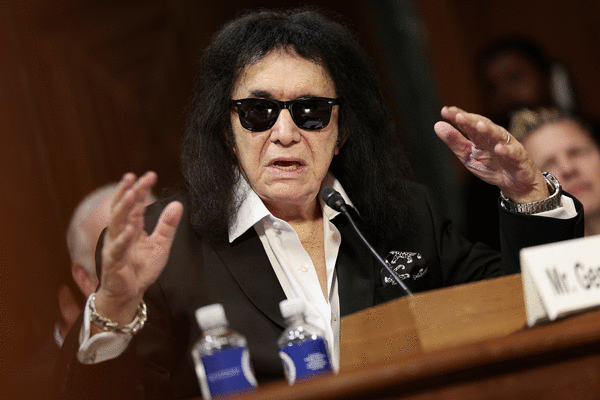
WASHINGTON — Swapping the stage for the second floor of the Dirksen Senate Office Building, Gene Simmons traded his usual rock-star trappings and signature black-and-white face makeup for a suit.
The hard-charging former KISS bassist testified in front of the Senate Judiciary Intellectual Property Subcommittee on Tuesday in support of a bill that aims to compensate artists for the use of their songs on the radio.
The bill, which was reintroduced in the Senate in January by Sen. Marsha Blackburn, R-Tenn., would require terrestrial AM/FM radio broadcasters to pay royalties to copyright holders when their songs are played.
“It looks like a small issue, there are wars going on and everything, but our emissaries to the world are Elvis and Frank Sinatra,” Simmons said. “When they find out we’re not treating our stars right — in other words, worse than slaves. Slaves get food and water, Elvis and Bing Crosby and Sinatra got nothing for their performance.”
Music royalties have long been a thorny issue in Congress. While a law passed in 2018 sought to address new copyright questions posed by digital streaming, it did not require pay for old-fashioned radio play. Simmons joins other artists who have promoted the royalties proposal over the years, including Dionne Warwick, Ken Casey of the Dropkick Murphys and Sam Moore of the R&B duo Sam & Dave, who all came to the Capitol in 2021.
“The system is so broken that whether or not an artist gets paid boils down to which button you push on your car dashboard. If you select Sirius XM or Spotify or Apple Music or even the iHeart streaming app, the artist gets paid,” SoundExchange CEO Michael Huppe testified at Tuesday’s hearing. “No legitimate business or policy reason can justify that difference.”
Henry Hinton, a member of the National Association of Broadcasters’ Radio Board and president of Inner Banks Media, also appeared at the hearing, describing local radio as an important resource that can’t afford to bear more costs. “This is the system that we operate on. … It’s worked for 100 years,” he said.
The lingering debate has divided lawmakers. In a concurrent resolution introduced earlier this year, some argued that local radio stations will suffer “severe economic hardship” if they are required to pay royalties and urged Congress not to impose “any new performance fee, tax, royalty, or other charge” on those broadcasters. The Senate version of that resolution currently has 25 co-sponsors, joined by 215 in the House.
The bill that Simmons promoted Tuesday, dubbed the American Music Fairness Act, outlines exceptions for stations with under $1.5 million in annual revenue and whose parent companies pull in less than $10 million. Proponents say that would help protect small and local outfits, with qualifying stations required to pay a flat rate of $500 a year or less. But opponents say that’s still too much on top of other costs they face.
Royalties are not the only radio-related topic in Congress right now. Another group of lawmakers, led on the Senate side by Edward J. Markey, D-Mass., and Ted Cruz, R-Texas, want to make sure that new cars coming off the assembly line are still equipped to play AM radio. Last month, musicians such as Carole King, Boyz II Men and Cyndi Lauper sent a letter to House and Senate leaders urging them to tie the two issues together.
“When you save the radio industry by mandating its technology remain in cars, we ask that you save the musician too and allow us to be paid fairly when our music is played,” the artists said.
The fight over recent radio issues has also been expensive. In the first nine months of 2025, the Recording Industry Association of America has spent over $5.8 million lobbying on the Hill, according to disclosure reports filed in the Senate. And SoundExchange, which collects and distributes digital performance royalties and whose CEO appeared at the hearing Tuesday, has spent $810,000.
Fault lines have emerged between lawmakers who represent places heavily involved in the recording industry and teeming with musicians, like Los Angeles or Nashville, and others from rural areas who argue that small radio stations are a lifeline and source of connection that deserve protection.
While the royalties bill hasn’t made it to the floor in past Congresses, Simmons appealed to members of both parties.
“I’m here to kindly ask all of you, both Republicans and Democrats, to help us remedy a situation, an injustice, let’s call it for what it is, that’s been ongoing for many, many decades,” he said.
For Simmons, the hearing was one stop on a busy D.C. agenda — the bassist and vocal supporter of President Donald Trump was also honored at the Kennedy Center over the weekend. On Tuesday he characterized Trump as a backer of the arts, praising him for “leadership important to our artists past, present and future.”
_____
©2025 CQ-Roll Call, Inc. Visit at rollcall.com. Distributed by Tribune Content Agency, LLC.








































Comments