Pa. Rep. Brian Fitzpatrick has a plan to extend ACA subsidies and avoid premium hikes for millions. He's ready for an uphill battle
Published in Political News
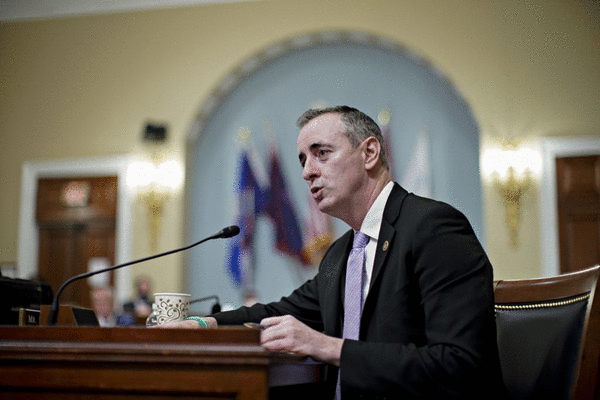
U.S. Rep. Brian Fitzpatrick of Pennsylvania plans to introduce a bipartisan bill as early as this week to extend Affordable Care Act subsidies after the prolonged, bitter shutdown battle this fall left the issue unresolved.
Fitzpatrick, a Bucks County Republican, said on Wednesday the bill’s language is “pretty much buttoned up” and has the support of some moderate Republicans and some Democrats.
He said the members of the bill’s working group have been in touch with the White House as they try to get a compromise deal through Congress before health care premiums spike when the subsidies expire at the end of the year.
“We’re trying to get to 218 and to 60,” Fitzpatrick said in an interview Wednesday, referencing the minimum vote thresholds to pass the House and Senate. “Anything that’s not designed with that end goal in mind is a futile legislative exercise.”
But Fitzpatrick was candid about the uphill climb to get the needed votes in both chambers weeks after the issue was at the center of the longest government shutdown in history.
Some Republicans don’t want to extend the credits at all, while others want abortion restrictions included. Democrats, meanwhile, have argued for a clean extension of the existing program and opposed an income cap for the enhanced credit.
“We’re trying our best to navigate all this, to figure out how we can do something. You know, nobody’s going to love it, but hopefully enough people are OK with it,” he said.
The countdown to premium hikes is deeply concerning to millions of Americans already frustrated by affordability, opinion surveys show. And vulnerable Republican incumbents in Washington have stressed the need to find a solution with next year’s midterms looming. Fitzpatrick, who has represented Bucks County since 2017, could face a tight reelection campaign next year.
So far, leadership has not engaged with Fitzpatrick on discussions over an ACA extension compromise, Fitzpatrick said. Republicans have not offered up a proposal, though Senate Majority Leader John Thune, R-S.D., has promised a vote in the coming weeks. House Democrats have offered a three-year clean extension of the existing tax credits, and are just four votes away from a discharge petition to force a vote, but no Republicans, including Fitzpatrick, have joined them.
Senate Democrats plan to propose a companion bill next week, Punchbowl News reported Wednesday.
But neither Democratic plan looks poised to get the votes needed, making it more of a messaging exercise for the party. And House Speaker Mike Johnson, R-La., is expected to release his own plan next week, Politico reported Thursday, but it’s unclear whether it will appeal to Democrats, whose support would be needed to pass in the Senate.
“On the right, they think the majority of the GOP conference does not like the premium tax credit structure, and I think the leadership on the left wants to use it as a political issue,” Fitzpatrick said.
That would mean the compromise bill’s only chance for a vote would be via a discharge petition, the tactic recently used to pass legislation to release the Jeffrey Epstein files after House leadership slow-walked the issue.
Fitzpatrick said he would back a discharge petition on the ACA bill but would not be the one to put it forward.
“I’ll support it,” Fitzpatrick said of an ACA discharge. “The question really is: Are 217 of my colleagues? Are they going to allow the perfect to be the enemy of the good? Are they willing to take 80% of something, or they’re going to get 100% of nothing? That’s really going to be the key, because, you know, so many people have so many ‘red lines.’”
Fitzpatrick said he is already committed to using a discharge petition to force legislation on sanctions against Russia amid the war in Ukraine.
What’s in the proposal?
Under the ACA, people who earn less than 400% of the federal poverty level — about $60,000 — are eligible for tax credits on a sliding scale, based on their income, to help offset the monthly cost of an insurance premium.
That tax credit is part of the law, and therefore not expiring. But what will expire is an expansion passed in 2021 when Congress increased financial assistance so that those buying coverage through an Obamacare marketplace do not pay more than 8.5% of their income.
Fitzpatrick’s proposal, awaiting legislative counsel review, would provide a two-year extension of the expiring ACA subsidies, with a cap on those enhanced credits for earners who make 700% of the federal poverty level, about $225,000 for a family of four. Currently there is no income cap on the enhanced credit.
The bill would also expand health savings accounts and crack down on pharmacy benefit managers.
And to appease Republicans concerned about fraud in the program, Fitzpatrick’s bill would implement a $5 monthly fee for low-income enrollees, intended to prompt them to actively confirm their eligibility. There’s an option, requested by Democrats who oppose such a fee, to pay it in a one-time $60 sum to avoid losing coverage.
“This is all like, give one to the left, give one to the right,” Fitzpatrick said.
Not included in the bill are restrictions on abortion, something Fitzpatrick’s Republican colleagues had pushed for.
“We kept that out. I don’t think it has any place in this bill,” Fitzpatrick said. “It would be a death knell to a lot of my colleagues on the left … and I don’t think abortion should be an issue here. This is about lowering health care costs for people who really need the assistance.”
_____
(Staff writer Sarah Gantz contributed to this article.)
_____
©2025 The Philadelphia Inquirer. Visit inquirer.com. Distributed by Tribune Content Agency, LLC.



















































Comments