Northwestern deal with Trump administration divides students and faculty
Published in Political News
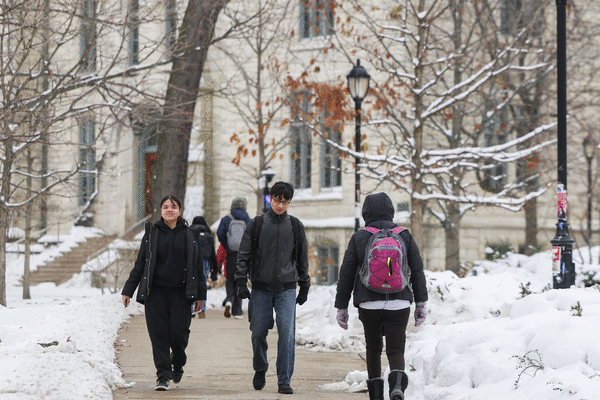
CHICAGO — Northwestern University’s $75-million deal with the White House has brought a mix of relief and concern to campus — concluding months of research cuts, while also marking a significant advance in the president’s push to reshape higher education.
The agreement, announced Friday, restores nearly $800 million in research funding and closes several government probes related to federal anti-discrimination laws.
Some researchers, exhausted by months of cost-cutting in their laboratories, are feeling relieved. But other faculty members and students raised alarms about the implications of negotiating with the Trump administration for academic freedom and institutional independence.
“I still wouldn’t have made a deal,” said Talia Winiarsky, a 22-year-old American studies major. “But I think the university is in such a tough position, and I do empathize with (administrators).”
The deal is a major milestone in President Donald Trump’s quest to bring universities to heel. Northwestern is the sixth university to announce a formal agreement with the White House to restore funding. The president has criticized elite schools as hubs for antisemitism and ideological indoctrination.
Northwestern’s $75 million fine will be paid to the U.S. Department of the Treasury over three years, the university said. Research funding, which was paused in April, is expected to flow again within the month.
In a news release, administrators noted that it does not give the government authority “to dictate faculty hiring, University hiring, admission decisions, Northwestern’s curriculum, or the content of academic speech and research.”
“Northwestern runs Northwestern. Period,” interim President Henry Bienen wrote in a statement.
Still, the sweeping, 12-page agreement touches on a wide range of Northwestern’s policies.
In exchange for restored funding, the university pledged to continue following federal anti-discrimination laws, review its international admissions policies and revoke a 2024 agreement with pro-Palestinian protestors, among other conditions.
“I think the central issue here is the White House desire for ideological control over institutions,” said Ian Hurd, a professor of political science and president of the Faculty Senate.
The terms of the deal
The deal closes three federal probes from the U.S. Departments of Health and Human Services, Education and Justice, which investigated alleged antisemitism and racial discrimination in admissions. Northwestern’s $75 million fine is not an admission of guilt, according to the document.
The terms of the settlement offer a glimpse into the Trump administration’s vision for higher education, and its broader push against so-called “woke-ism” and diversity, equity and inclusion policies.
Northwestern and its medical school are required to revise its policies related to hormonal interventions and gender-affirming surgeries for minors, “in compliance with federal laws.” The university said it has never performed those surgeries, but it has published research on the benefits for minor mental health.
The university also committed to following Title IX — which prohibits sex-based discrimination — by providing single-sex housing for women upon request and all-female locker room facilities, “defined on the basis of sex.”
Another provision is a “comprehensive” review of its international admissions policies. That includes training to “socialize international students to the norms of a campus dedicated to free inquiry,” according to the agreement.
The deal also revokes the so-called Deering Meadow Agreement, reached in 2024 between former President Michael Schill and pro-Palestinian protestors. That agreement had allowed students to continue demonstrations for several weeks, in exchange for the removal of their encampment. It was believed to be a first for a major U.S. university.
Schill, who is Jewish, faced an onslaught of criticism over the agreement from Republican lawmakers. Amid the federal pressure, he resigned in September. Most faculty and students reject the notion that there is widespread antisemitism on campus.
Northwestern’s webpage on the Deering Meadow Agreement has been removed. As part of the now-defunct agreement, the university agreed to provide greater information to students about its investments and create spaces for Muslim and Middle Eastern students on campus.
The university is required to continue mandatory antisemitism training, and provide the government with all complaints and reports of antisemitism since Oct. 7.
“I think that the university has been making great progress, and will continue to make progress, in learning more about campus antisemitism,” Claire Conner, president of Northwestern Hillel, said of the deal.
Uncertainty eases in laboratories
For faculty reliant on federal funding, Friday’s announcement offered a reprieve to months of uncertainty. Northwestern had been self-funding research — but at a cost of roughly $40 million a month, it was unclear how long it could continue. This summer, administrators pursued a string of cost-cutting measures, including hundreds of layoffs.
With a $14.3 billion endowment, Northwestern is among the wealthiest universities in the country. The school’s business model, however, was built on grants: During its 2023-24 fiscal year, Northwestern received $1.05 billion in research funding.
Amid the freeze, faculty were to reduce laboratory expenses wherever possible. Carole LaBonne, a professor in the Department of Molecular Biosciences, said she was unsure how much longer she could maintain a bare-bones operation. Her lab studies stem cell populations causing cancer and birth defects.
“Scientists at this university have been living in a state of existential dread for months,” LaBonne said. “The biggest reaction (to the deal), I can tell you, is relief that the worst of it is over.”
Scott Budinger, chief of pulmonary and critical care in the department of medicine, has spent more than two decades researching drugs to treat pneumonia. But his team’s clinical trials had effectively ground to a halt, at the expense of patients, he added.
“I try to think of things objectively, and take the politics out of it,” Budinger said of the deal. “The costs of the freeze, I think, are pretty clear … This imposed a delay on that research that’s going to benefit patients.”
Academic freedom, institutional independence
While recognizing the need for restored funding, several students and faculty members said they felt Northwestern was bowing down to government overreach.
“Any deal with the Trump administration is a bad decision and sets a bad precedent,” said Cass Dempsey, a 20-year-old political science major. “Northwestern, and other high-profile universities and educational institutions, should have taken a stand.”
Some wondered if the university should have challenged the freeze in court. Harvard University won back $2.2 billion in paused grants after a months-long legal battle this fall. Northwestern countered that litigation was too costly, and could have been drawn out for years.
Jackie Stevens, president of Northwestern’s chapter of the American Association of University Professors, noted that a large cohort of faculty feels “ongoing disappointment” about the agreement. She characterized it as both an acquiescence to Trump and a betrayal to academic freedom.
“It’s extortion,” Stevens said. “I don’t even think it’s about the $75 million, I think it’s just about the show of power, right?”
Others, like political science professor Paul Gowder, expressed concern that the Trump administration would not uphold its end of the agreement. He called the $75 million fee “embarrassing.”
Gowder is a member of the Faculty Concerned Faculty Group, which this summer released a statement urging Northwestern to avoid dealmaking with the White House. “The reality is that the Trump administration can’t be trusted,” he said. “This is a temporary fix at best.”
Guillermo Oliver, a professor in the Division of Nephrology and Hypertension, was left more conflicted. His lab, which studies the biological development of the lymphatic system, was hammered by cuts and squeezed for funding each day under the freeze. But he also wonders about the ramifications for free scientific inquiry.
“Every university should be able to make their own decisions. There should be no interference from any government,” Oliver said. “The fact that we will need to pay a penalty, no one will be happy.”
____
©2025 Chicago Tribune. Visit at chicagotribune.com. Distributed by Tribune Content Agency, LLC.















Comments