Commentary: This Arbor Day, let's move past the myths
Published in Op Eds
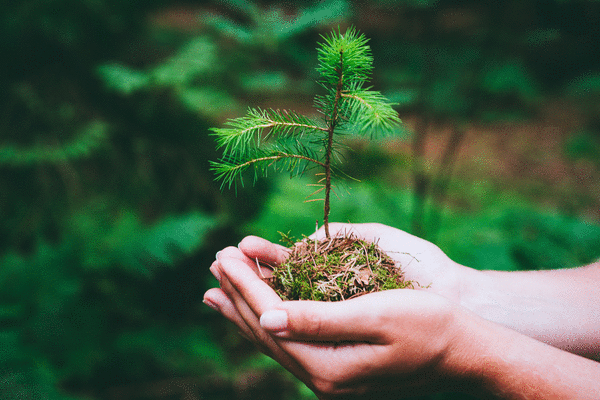
April 24 is Arbor Day, when Americans will gather to plant trees on city streets, in parks, and within other open spaces. But this year, as wildfires, drought and flooding threaten communities from California to the Carolinas, we need to think bigger than individual saplings.
Arbor Day was founded in 1872 to green the once-treeless Great Plains. Planting trees made sense then. But 154 years later, our challenge isn’t a lack of trees — it’s a lack of understanding about what healthy, functioning forests actually deliver.
When properly managed and conserved, forests can produce timber sustainably, support wildlife, reduce wildfire risk, feed watersheds and strengthen rural communities. But current policy often treats these as competing goals when they’re not.
Several stubborn myths keep us from effective forest conservation. Science has debunked them, but policy hasn’t caught up.
Myth: Conservation kills timber jobs
This myth drives the either/or approach, but it crumbles under scrutiny. Working forest conservation easements prove forests can produce timber while delivering conservation outcomes. These permanent legal agreements keep forests in private hands and on local tax rolls while ensuring sustainable management.
The van Eck forests in Northern California and Oregon demonstrate this in practice. They harvest between one million and two million board feet annually while quadrupling carbon storage and providing habitat for more than 250 species. From Texas to Tennessee, landowners are discovering properly structured easements deliver both economic returns and conservation benefits.
Breaking free from this false choice allows forests to serve as working landscapes that produce what rural communities need while building the climate resilience all communities need.
Myth: Planting trees is the best thing we can do for forest health
Tree planting matters, but protecting and restoring existing mature forests delivers exponentially more benefits.
Consider carbon storage. At the van Eck forests, carbon storage nearly quadrupled over 20 years through restoration to older forest conditions, all while maintaining timber harvest. The largest trees account for 42% of stored forest carbon. Bacteria in old tree bark consume methane, a greenhouse gas 80 times more potent than carbon dioxide.
Ecological forest management on the van Eck now means the habitat supports more than 250 species that were lost when forests were intensively logged. Mature forests support complex systems and functions young forests cannot replicate, with structural complexity taking centuries to develop. Young planted trees take decades to deliver some of these benefits.
Myth: Forests are about trees, not water
Nearly half of U.S. drinking water originates in forested lands. Forests filter, regulate and store water before it reaches reservoirs.
When Gifford Pinchot founded the U.S. Forest Service in 1905, its foundational legislation cited “securing favorable conditions of water flows” as its central purpose. Water came first, not timber. Pinchot understood forests are water infrastructure.
California’s 11,000-acre Trinity Headwaters demonstrates the stakes, protecting water supplies for millions of acres of farmland and cities as far south as San Diego. Yet policies still overwhelmingly favor dams and treatment plants over natural solutions.
Myth: Fire is bad for forests
The snow/drought connection extends to wildfire. Low snowpack means forests enter fire season already stressed and dry. But this myth keeps us from management that could reduce catastrophic fires.
For millennia, forests evolved with frequent, low-intensity fires that Indigenous communities used to maintain soil fertility and forest health. Catastrophic mega-fires result from decades of fire suppression, not fire itself.
Research shows working with good fire through thinning and prescribed burns can reduce catastrophic wildfire risk by up to 75%. Strategic thinning and timber harvesting reduce hazardous fuels while supporting rural economies. High-intensity fires create massive emissions. Low-intensity fires combined with proactive management create resilient forests that protect communities.
This Arbor Day, we should not only plant saplings but protect existing forests, ensuring that timber production happens sustainably on landscapes that deliver water security, climate resilience and biodiversity. Let’s move past the myths holding us back and embrace what forests can actually deliver when we manage them for multiple benefits.
____
Laurie Wayburn is co-founder and president of Pacific Forest Trust and chair of California's Natural and Working Lands Expert Advisory Committee. This column was produced for Progressive Perspectives, a project of The Progressive magazine, and distributed by Tribune News Service.
_____
©2026 Tribune Content Agency, LLC.




















































Comments