Commentary: The coming fertilizer crisis will cause food prices to rise -- unless we act now
Published in Op Eds
With gasoline prices over $4 a gallon, the highest level since 2022, it’s clear that the war with Iran is inflicting economic pain. And not just at the pump: Food prices are poised to rise significantly if federal lawmakers do nothing to address a fertilizer crisis that was, in part, their own making.
The problem stems from countervailing duties (CVDs) that the Commerce Department imposed under former President Joe Biden on certain phosphorus-heavy fertilizers from Morocco and Russia. CVDs are a kind of tariff designed to level the playing field for American businesses by offsetting foreign subsidies. The idea is to impose a tax equal to the foreign subsidy, thereby canceling it out and returning to fair competition.
But that theory falls apart in times of emergency, like we’re facing today. The war with Iran has resulted in not just an energy shock but a fertilizer shock too because approximately 20% of global phosphate supply has been disrupted by the Strait of Hormuz being effectively closed. Unlike the oil crisis, which has already caused gasoline and diesel prices to skyrocket, the fertilizer crisis is more of a ticking time bomb.
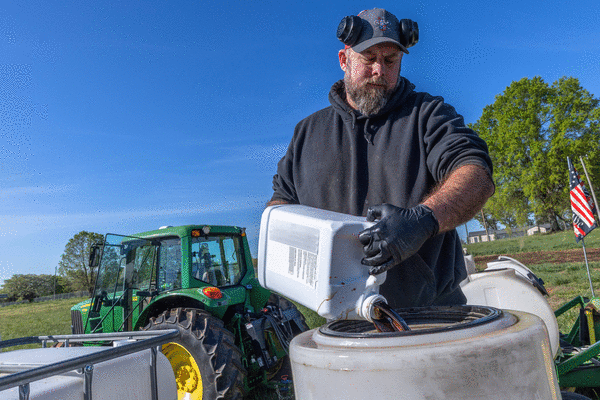
The Spring planting season is already underway, and American farmers are facing exploding fertilizer prices as the world grapples with severely constrained supply. If those farmers cannot purchase enough affordable fertilizers, then application rates will be severely reduced, and crop yields will be lower. That’ll produce a supply crunch, driving food prices higher.
There simply is no substitute for synthetic fertilizer, without which literally half of the world’s population would likely starve. Farmers have no cost-effective alternative, which is why higher fertilizer prices directly translate into higher food prices. This isn’t mere economic theory—it’s borne out by the data.
Academic research from Texas A&M University’s Agricultural and Food Policy Center found that the CVDs on phosphorus-heavy fertilizers contributed to higher prices paid by farmers, which ultimately meant higher prices paid by families for groceries. The costs here weren’t trivial, amounting to over $1 billion a year on average.
Yet one group saw a windfall: domestic producers. Firms like The Mosaic Company and J.R. Simplot Company, who make fertilizer stateside, were able to charge significantly higher prices because of the CVDs, which made it prohibitively expensive for some foreign firms to sell their product in the U.S., thus reducing competition.
Whether or not this is a sensible policy in peace time, it certainly doesn’t make sense during a war, especially one creating a fertilizer crisis. Domestic producers simply don’t have the capacity to replace all the foreign supply lost by the chaos in the Middle East, including from Saudi Arabia, one of the world’s largest exporters of phosphorus-heavy fertilizers.
American farmers need access to as much supply as possible to help keep costs down and to ensure an adequate food supply. This isn’t just an economic issue but a national security issue too, since a nation that cannot affordably and reliably feed itself has ceded some level of sovereignty.
Ideally, domestic fertilizer supply chains could compensate for disruptions abroad, but that’s not currently the case, and until that happens, we need to stop the bleeding. That means removing the CVDs until this global emergency has subsided. Effectively forbidding imports during a time of crisis does not strengthen national security, but undermines it.
Many in the agricultural community believe there is empirical evidence that the CVDs on Morocco and Russia have actually been set too high, which caused excessive reductions in foreign supplies of fertilizer and artificially pushed up prices—costs which were passed to American families. These concerns are very real and should be thoroughly reviewed right now during the mandatory five-year “sunset” review.
Regardless of whether these CVDs are ultimately renewed or allowed to expire, there should certainly be a temporary suspension granted immediately due to the global fertilizer crisis. The Trump administration needs to pull out all the stops to ensure that American farmers have access to ample supplies of fertilizer at affordable prices. Otherwise, we’ll certainly be facing even higher grocery bills later this year.
_____
E.J. Antoni, Ph.D., is chief economist and the Richard Aster fellow at the Heritage Foundation and a senior fellow at Unleash Prosperity, which was co-founded by Stephen Moore, a former Trump economic advisor and senior fellow at America First Policy Institute.
_____
©2026 Tribune Content Agency, LLC.















































Comments