Commentary: The global ripple effects of the United States' diplomacy with Iran
Published in Op Eds
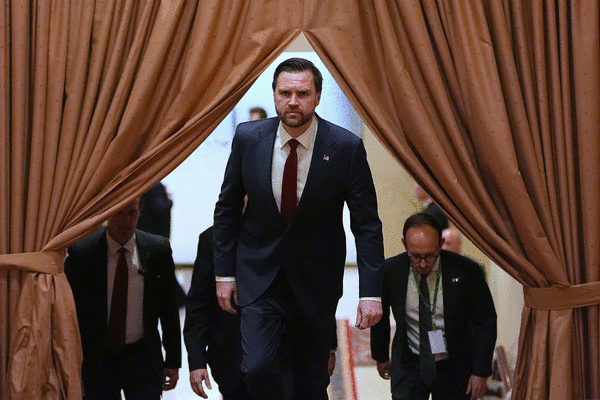
Vice President JD Vance and hundreds of expert-level U.S. officials arrived in Islamabad last weekend with a sliver of hope that a deal to end the nearly seven-week war in Iran could be hammered out. By the time they left on Sunday after 21 hours of negotiations, that hope had deflated. Vance, who never wanted the United States to wage a preventive war against Iran, announced that the two sides were still unable to reach an agreement.
His boss, President Donald Trump, wasted little time upping the ante. Even before the U.S. delegation returned to Washington, Trump had declared a blockade of Iranian ports in the Strait of Hormuz. Any ships coming or going to Iran would be prevented from doing so, and the U.S. Navy would have the power to interdict vessels that refused to comply. By Monday morning, the blockade was in effect.
As it stands, diplomacy with Iran is at a bit of a stalemate. Despite Vance departing Pakistan empty-handed, the mediators are still working to keep open channels of communication between the United States and Iran. Both sides will continue to submit messages and proposals. Still, with U.S. terms virtually unchanged since the war began last month — no Iranian enrichment, the destruction of Iran’s major nuclear facilities, the elimination of Iran’s uranium stockpile and a full reopening of the Strait of Hormuz — one can’t help but be pessimistic about the prospects of successful diplomacy.
While it’s tempting to get sucked into the day-to-day minutia of the U.S.-Iran talks, last weekend’s negotiations did not occur in a vacuum. Other U.S. adversaries are paying attention to the talks and evaluating how the Trump administration is conducting itself. Among their takeaways, one stands above all others: If you don’t have your own cards to play, the U.S. will poke, prod and aim for outright capitulation.
It’s important to note that Iran is not the only country engaged in high-stakes talks with Washington. Cuba, Russia and Ukraine all have their own set of negotiations with the Trump administration, and while none of them is identical in terms of the issues at hand, each of these countries may be a bit warier after watching events play out last weekend.
Of all those countries, Cuba is the closest to Iran in terms of its relations with the United States. The Caribbean island nation has been an avowed U.S. enemy from the moment Fidel Castro overthrew a U.S.-backed dictatorship there and replaced it with a communist regime. Despite a decades-old U.S. trade embargo, U.S. financial sanctions and covert U.S. operations, the regime remains in power today. Trump is merely the latest U.S. president trying to enhance the pressure on the Cuban government to, if not fall apart, then at least allow a transition to democracy to take place.
Right now, the Trump administration is in discreet talks with members of the Cuban regime, including members of the Castro family, to determine whether a political transition and an economic opening on the island are possible. To date, Trump has chosen to implement a strategy of extensive economic coercion to compel the Cubans into accepting U.S. terms. With the exception of a Russian oil tanker that was allowed to dock in Cuba earlier this month, Washington has maintained a de-facto fuel embargo on the country, exacerbating the extreme energy shortages that bedevil the Cuban population on a daily basis.
Havana has acknowledged that the U.S. strategy is having an effect but nevertheless remains steadfast in resisting some of the central concessions the U.S. is demanding, including the resignation of Cuban President Miguel Díaz-Canel and a broader political opening. The Cubans are willing to bring U.S. companies into the Cuban economy but fundamentally reject the dissolution of the one-party state and are highly suspicious of U.S. motives. The failed talks with Iran will only inject more doubt in the minds of Cuban officials.
“The U.S. has been engaged in talks with other countries, and while these negotiations are underway, they have attacked those countries, and all of this creates a lot of distrust,” Díaz-Canel observed.
Of course, even as U.S. officials seek to come to terms with Iran, the Trump administration’s other major diplomatic initiative — ending the war in Ukraine — remains a priority. The war, now in its fifth year, has claimed the lives of over a million people, with tens of thousands of Ukrainian and Russian soldiers dying on a weekly basis. The front lines have barely moved; the map of the battlefield today is almost indistinguishable from what it looked like in early 2024. Several diplomatic initiatives have been organized by the Trump administration over the last year, including multiple meetings with Ukrainian President Volodymyr Zelenskyy, a summit with Russian President Vladimir Putin and numerous lower-level sessions that have aimed to establish the basis for a ceasefire.
To date, Trump’s diplomacy hasn’t produced results. The one tangible achievement, a temporary ceasefire on Ukrainian and Russian energy facilities last spring, quickly dissolved. Striking a settlement in Ukraine is no longer the prime object of Washington’s attention, much to Putin’s delight. The war in Iran has been a short-term reprieve for the Russian dictator, whose finances were in trouble earlier in the year but have since rebounded due to the rise in oil prices produced by conflict in the Persian Gulf. The inability of U.S. and Iranian officials to come to terms means a longer war, which in turn translates into an even deeper U.S. commitment in a region Trump claimed an interest in extricating from. Putin therefore has even less of an incentive to play ball.
Trump is learning a critical lesson in international statecraft: A single decision in one part of the world can have adverse impacts in others.
____
Daniel DePetris is a fellow at Defense Priorities and a foreign affairs columnist for the Chicago Tribune.
___
©2026 Chicago Tribune. Visit at chicagotribune.com. Distributed by Tribune Content Agency, LLC.




















































Comments