Howard Chua-Eoan: Do you too have a fear of not flying?
Published in Op Eds
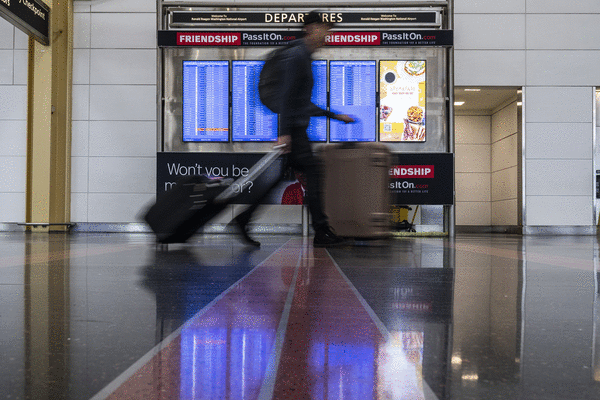
I’m not averse to flying. I dislike the scowling security checks and inefficient bureaucracies at the airports much more than I’m afraid of turbulence or the potential for catastrophic mishaps. But the Gulf War has made me nervous over something else: the fear of not flying.
Sometimes, a plane’s the only way to get where you have to go. My concern isn’t just about delays. Like aerophobia, it’s an almost irrational terror but not of what might happen on the plane; rather it’s about not getting on it at all, that the trip won’t happen because of some intervening event out of my control. Why even try to fly then?
On March 18, I had to book an emergency trip from London to California to be able to be with family at a difficult moment. I was grateful to get on a flight the next morning, even though the cost was more than double the normal fare. Given the urgency, it was worth paying $2,000+ for a cramped economy seat on a bumpy, half-a-day journey.
The war, however, made the booking process an anxious one. What if travel costs became prohibitive and flights were scarce? Two days before my departure — as a direct result of the U.S. and Israel’s war on Iran — jet fuel prices for Europe had spiked to the equivalent of $210-a-barrel from about $100 before the fighting started. Commercial passenger planes require a specially refined form of kerosene that can function under extreme cold. All that adds to travel costs. (In the same period, Brent crude contracts rose to about $105-a-barrel from $60.) Such spikes may or may not show up on ticket prices depending on how skillful an airline has been in hedging its fuel purchases.
I was also worried about the domino effects on Heathrow Airport’s schedules from the shutdown of Dubai’s gigantic air hub. What if drones and projectiles caused even broader havoc? My siblings were traveling within the U.S., but I had to cross the Atlantic. In a fever dream of worst-case scenarios — no planes, just boats, trains and automobiles — I calculated it would be take nearly two weeks for me to get to my family via ship from Southampton, England to the port of New York and then a series of trains to the West Coast. But I got on my flight.
We take air travel for granted. It has become such a commonplace that populist paranoia has latched onto it as a threat hiding in plain sight. “Eight billion people are one plane ride away from having a child who’s a U.S. citizen,” said Solicitor General John Sauer, as he argued on April 1 before the U.S. Supreme Court to end the right to citizenship for people who just happen to be born in the country.
In truth, the omnipresence of commercial flight is an illusion. Only one-in-five people on earth has ever been on a plane. While that’s the equivalent of 1.6 billion fliers, most — about three quarters — are passengers traveling within huge countries like the U.S., China and Brazil, or semi-integrated regions like Europe. Australians are kind of an exception: One statistic estimates that 60% of the population has traveled overseas. But that may include the 30% or so of Aussies who were born outside Oz to start with. The rest of the world doesn’t fly much at all — even if it appears everyone can get anywhere, everywhere, all at once.
It’s not always as easy as booking a ticket or getting a passport. For example, it would take a Filipino about two weeks to receive a tourist visa to the U.S. (provided they pass an initial interview at the American embassy in Manila). Washington has granted the equivalent of visa-free entry to passport holders of only about 40 countries. Affording the flight is a whole different issue. The price of a peak-season, round-trip ticket to Los Angeles (more than 7,000 miles from Manila and requiring at least 12 hours) would be around $1,000 — or about a third of the average annual household income in the Philippines. Travel is only for the well-heeled middle class. The frequent-flying caste — including those twitchy aerophobes — is, thus, a privileged one.
But the privilege can be suspended if the world beyond the airport doesn’t behave. There have been two near-total global shutdowns: During World War II, most airlines were drafted into military service; and during the the various peaks of the global Covid pandemic, most governments banned travel to keep the virus away. The attack on the U.S. on Sept. 11, 2001, led to a three-day cessation of flights in the country and shuttered airports around Europe, leading to weeks of disrupted airline schedules.
Today, the world isn’t calm and there’s been a lot of talk of another world war. Dubai and the other large Gulf airports have yet to fully reopen and the Strait of Hormuz crisis is at a nervous pause. The war in Ukraine continues to force many airlines to reroute along a narrow corridor to get from Europe to East Asia — and vice versa. Sudden changes might cancel your flight completely, or put it off for days or longer.
There are other potential ruptures. In late March, China imposed 40-day restrictions (not quite no-fly zones but still a lot of fuss) on its east-coast airspace, increasing jitters way beyond the Taiwan strait. Meanwhile, the new U.S. Homeland Security secretary is threatening to withdraw Customs and Border Protection officers from “sanctuary cities” — refuges for undocumented immigrants — like New York and Los Angeles, technically stripping them of their roles as Ports of Entry for millions of foreign visitors and Americans like me returning to see family and friends.
I know flying is a privilege, but it’s a necessary one. I still remember my first plane ride — up to the temperate mountains north of humid Manila. I was five years old and my father was with me. He and my mother also took me and my siblings on the most important plane journey of our lives: as immigrants from the Philippines to Los Angeles in 1979. For the last eight years, he’d been in San Diego while I worked in London. I was so afraid I wouldn’t be able to fly back in time to say goodbye. But I did.
____
This column reflects the personal views of the author and does not necessarily reflect the opinion of the editorial board or Bloomberg LP and its owners.
Howard Chua-Eoan is a columnist for Bloomberg Opinion covering culture and business. He previously served as Bloomberg Opinion's international editor and is a former news director at Time magazine.
©2026 Bloomberg L.P. Visit bloomberg.com/opinion. Distributed by Tribune Content Agency, LLC.












































Comments