Mihir Sharma: Gen-Z revolts show toppling leaders is just the start
Published in Op Eds
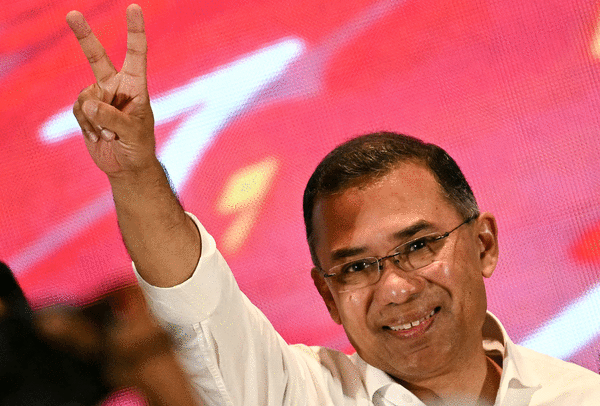
South Asia has had three youth-led revolts and three changes of government — and still has three countries with problems that haven’t changed a bit.
In February, Bangladesh’s electorate gave Tarique Rahman, exiled in London for 17 years, a sweeping mandate; and in early March Nepalis voted overwhelmingly for Balen Shah, previously a rapper and mayor of Kathmandu. Meanwhile, in Sri Lanka, the former Marxist-Leninist Anura Dissanayake is just 18 months into his tenure and is already facing multiple crises, including a crippling shortage of fuel that has force his government to institute a four-day work week.
All took power after mass protests forced out their predecessors, promising a clean break from the old elite’s sloth, incompetence and corruption. And yet, as Sri Lanka is discovering and the others might, too, rupture is not replacement. Regime change is easier than transforming states; and, in the subcontinent, the ancien régime never really leaves.
Dissanayake’s appeal lay as a clean break from the traditional politicians Sri Lankans had targeted in what they call the Aragalaya — Sinhalese for “struggle” — in 2022. In Bangladesh, the 15-year rule of Sheikh Hasina came to an end when student protestors took over the streets of Dhaka in the summer of 2024, in what came to be known as the July Uprising. And in Nepal, large-scale Gen-Z protests six months ago were sparked by a ban on social media and coordinated on Discord.
But this part of the world too often confuses toppling leaders with transforming states. Protests promise an exciting new moral order, but actual governance requires boring competence: Regulatory reform, judicial independence, checks on the executive.
In Bangladesh, Rahman’s return isn’t even that much of a rupture with the past: His father was a military dictator and his mother prime minister. And we’re already seeing the consequences of that. Legislators from his Bangladesh Nationalist Party are refusing to participate in a process to amend the constitution and constrain executive power, as was agreed last year.
Dissanayake, meanwhile, has found that cutting sleaze isn’t as easy once in government, especially if you have made the mistake of blaming structural economic problems, such as Sri Lanka’s chronic balance-of-payments problems, on corruption. The country’s anti-bribery commission received just over 8,400 complaints last year; it made 84 arrests. A conversion rate of one in 100 isn’t great.
Institutional reform, independent regulators, and depoliticized decision-making are the best antidotes to corruption. But that isn’t on the agenda in Sri Lanka. The anti-corruption investigators are supposed to be independent, but government ministers regularly proclaim on their activities and the commission’s head has complained that the finance ministry wants to control its funding. As a consequence, Dissanayake has had to take headline-grabbing but fundamentally unjustifiable steps like arresting a former president, Ranil Wickremesinghe, on what one Indian politician described as “petty charges.”
The new government in Nepal seems to be speed-running the same script. Barely a day after it took office, a former prime minister, K.P. Sharma Oli, was arrested and detained. The new cabinet — presided over by Shah in black sunglasses — has produced a 100-point agenda for its first weeks, but the chances are that it will work on vengeance and public relations first, and postpone the hard graft of institutional change.
This is an error. The longer the gap between revolt on the city’s streets and revolution in the corridors of power, the harder it is for real change to take hold. Insurgent governments have a narrow window in which they have genuine legitimacy; they need to use that to transform hidebound or sclerotic bureaucracies. If they waste that on tempting headlines and political scores instead, they may be reelected — but they will never achieve what they’ve promised.
This has happened in South Asia before. In India, Prime Minister Narendra Modi rose to power claiming to be an outsider, after years of protest against a supposedly corrupt government in New Delhi. If he wanted to transform the country, as he pledged, he could have used that energy to reinvent how government works — for example, by replacing the coddled bureaucracy that independent India inherited from the British to make it more accountable.
But administrative reform was way down his list of priorities and, as a consequence, his government has never quite lived up to its initial promise. Too little has changed in how the Indian state operates. The subcontinent’s insurgents will realize that winning power is easy. What’s hard is wielding it without becoming what they replaced.
____
This column reflects the personal views of the author and does not necessarily reflect the opinion of the editorial board or Bloomberg LP and its owners.
Mihir Sharma is a Bloomberg Opinion columnist. A senior fellow at the Observer Research Foundation in New Delhi, he is author of “Restart: The Last Chance for the Indian Economy.”
©2026 Bloomberg L.P. Visit bloomberg.com/opinion. Distributed by Tribune Content Agency, LLC.



















































Comments