Commentary: The world's dumbest tariff has been revealed
Published in Op Eds
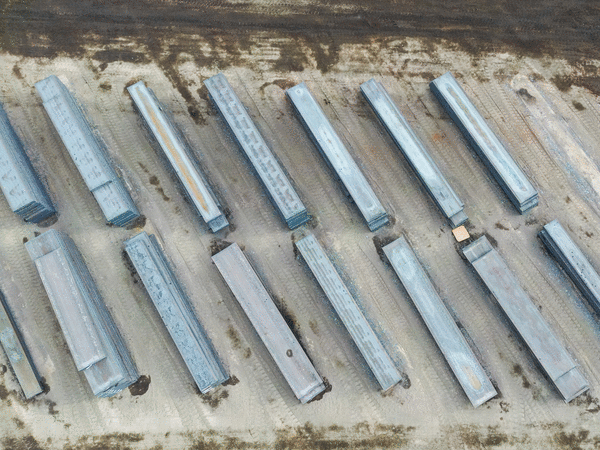
With the Iran war threatening supplies of critical, energy-intensive materials, one might assume the U.S. government was prepared for this risk and has been working hard to soften the blow. In the case of aluminum, that assumption would be incorrect. Instead, Washington is making things worse.
The United States has spent much of the past decade constructing a protectionist wall around the domestic aluminum industry. First, in 2018, President Donald Trump invoked Section 232 of the Trade Expansion Act of 1962 to impose 10% “national security” tariffs on aluminum products from most countries. Then last year, he raised the tariffs to 50% and eliminated exemptions for allies, while also expanding the levies to cover hundreds of "derivative" products – ranging from canned goods to industrial wires – that contain the metal.
Over roughly the same period, the U.S. implemented a web of “trade remedy” (antidumping and countervailing duty) measures on imports of aluminum extrusions, foil, and other products. Imports, in turn, have declined substantially – especially after the 50% levies took effect.
So far, this is a standard U.S. tariff story, but aluminum isn’t a standard product. According to the U.S. Geological Survey, imports constituted approximately 60% of domestic consumption last year, even with high tariffs. This dependence does not reflect “unfair trade” but deep structural realities. Aluminum production is extremely electricity-intensive, and U.S. power prices – along with fierce competition for electricity from AI and other high-value industries – have made smelting uneconomical relative to regions with abundant power and access to the core inputs bauxite and alumina.
In just the last few years, primary aluminum smelters in Washington, Missouri, and Kentucky have each shut down, and production has declined. Now, only four smelters are in operation, just two at full capacity. And this contraction occurred despite tariff protection expressly intended to boost output.
Taxes, regulations, and permitting burdens add to the headwinds, as do the cost and complexity of bringing a modern smelter online. Thus, the one new U.S. facility under development in power-rich Oklahoma won't start until 2030 at the earliest. Until then, and likely well beyond, America will continue to depend on imports to keep store shelves stocked and factories running – and tariffs will continue to impose major costs.
Most obviously, the tariff wall has caused domestic aluminum prices to skyrocket, rising much faster than global prices did last year, Bloomberg News reported in early February. The “Midwest premium” – the surcharge American buyers pay above the London Metal Exchange (LME) benchmark – more than doubled after the 50% tariffs took effect, and producers have since applied another surcharge on top of that.
The Iran war has further inflated prices. Gulf states produce around 8% of the world’s output, and large volumes of aluminum, bauxite, and alumina annually transit the Strait of Hormuz. The strait’s closure and Iranian missile attacks have stopped shipments and idled regional capacity, including at the world’s largest aluminum smelter in Bahrain. Prices on the LME have predictably soared, “panic buying” has ensued, and U.S. prices have moved even higher.
For American consumers, higher aluminum costs flow into the retail prices of food, beverages, foil, appliances, and more. For U.S. manufacturers, the steep premium means higher costs and reduced competitiveness. Aluminum is a critical input for both advanced manufacturing – automotive, aerospace, defense, etc. – and less capital-intensive industries like food production. Today, American firms pay much more for the metal than do their overseas competitors.
Economists have found that Trump’s first-term aluminum tariffs hurt manufacturing on net. The harms today are surely greater, given the tariffs’ higher rates and broader scope – and dwindling domestic inventories that could cushion the blow. The complicated “derivatives” regime, which requires U.S. companies to report imports’ precise metals content, has added more costs – a regulatory burden that even Trump officials acknowledge.
American supply chains are also more fragile. In one absurd example, Ford Motor Co. reported last month that a fire at its main U.S. supplier would force it to pay $1 billion more to import aluminum in the meantime. (And that was before Iran.) Manufacturers without Ford’s resources and clout have been hit even harder, unable to get needed supplies and pausing expansion plans in response.
Making matters worse, an easy solution to the aluminum shortfall lies next door – or, at least, it did. Canada has long been America's largest aluminum supplier, thanks to abundant hydroelectricity that gives its producers a decisive cost and environmental advantage. Canadian aluminum is also deeply integrated into U.S. defense supply chains because the nation is a close ally that was officially made part of America’s Defense Industrial Base in 1993. With Canada specializing in primary smelting and the U.S. focused on downstream fabrication and manufacturing, bilateral trade and investment flourished. Today, Pittsburgh-based Alcoa Corp. owns three Canadian smelters that collectively churn out almost 30% of the nation’s total output.
Comparative advantage was working exactly as advertised – until we blew it up. As Bloomberg News reported in September, Trump’s 50% tariff and removal of an exemption for Canada drove producers there to send U.S.-bound shipments to Europe instead. In just a few months, Aluminerie Alouette – North America's largest smelter – saw its European sales rise from 4% of production to 57%. Rio Tinto Plc largely stopped shipping Canadian aluminum to the U.S., and even Alcoa diverted around 100,000 metric tons to non-U.S. destinations.
These shifts are already coming back to bite the United States. With tariffs pushing Canadian aluminum elsewhere last year, American companies became “increasingly reliant” on imports from the Middle East, with almost a quarter of unwrought aluminum coming from the UAE and Bahrain. Those sources are now imperiled by the Iran war, and Canadian producers, already operating at full capacity, won’t shift back to the U.S. market while the tariff wall remains - if ever.
Overall, aluminum protectionism has been a confounding own-goal. Tariffs haven’t just raised prices and harmed American manufacturers; they’ve actively pushed a top producer and close ally out of our market, with shrinking domestic sources unable to fill the gap. Given the metal’s role in the U.S. defense industrial base, aluminum-related risks are likely higher today than they were before “national security” tariffs were ever enacted.
New investments, meanwhile, require years of sky-high prices before coming online and will take resources from better uses when they do. The U.S. Chamber of Commerce estimates that replacing imports with domestic aluminum would require electricity generation equivalent to that of Nevada – finite power unavailable for semiconductors, data centers, and every other “strategic” industry Washington says we need. With clean, abundant, and secure supplies right across the border, choosing this path is nonsensical.
This summer’s renegotiation of the U.S.-Mexico-Canada Agreement might offer President Trump an excuse to end the aluminum tariff debacle, but American consumers and companies will pay dearly in the meantime. And, unfortunately, an off-ramp is worthless if the driver is unwilling to take it.
____
This column reflects the personal views of the author and does not necessarily reflect the opinion of the editorial board or Bloomberg LP and its owners.
Scott Lincicome is an economist with the Cato Institute. He specializes in domestic policy and international trade.
©2026 Bloomberg L.P. Visit bloomberg.com/opinion. Distributed by Tribune Content Agency, LLC.


















































Comments