Commentary: The lockout at BP's Whiting refinery is one that America cannot afford
Published in Op Eds
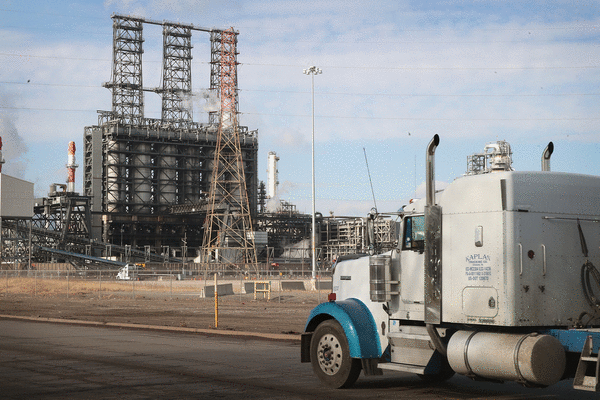
BP, the British oil major, has locked out roughly 800 union workers at its Whiting, Indiana, refinery after contract talks with the United Steelworkers broke down. This is no local matter. Whiting is the eighth-largest refinery in the nation, the largest in the Midwest, and a critical supplier of gasoline, diesel and jet fuel to the American heartland.
At a moment when energy markets are already under strain, BP has chosen to provoke a labor showdown at one of the country’s most important refineries. And in rejecting pattern bargaining, it appears to be doing so as an outlier.
Pattern bargaining has anchored labor stability in this sector for more than 60 years. One lead company negotiates the core economic terms. The rest of the industry generally accepts that pattern while resolving local issues separately.
This year, Marathon set the pattern. The agreement has now been accepted by about 30,000 workers at 26 companies. It provides a 15% wage increase over four years plus a $2,500 signing bonus.
BP is not merely resisting this pattern. It appears to be trying to bully the Whiting local into submission.
Reuters reported that 98.3% of workers rejected BP’s so-called final offer, with turnout above 94%. Instead of rethinking its position, BP came back with a worse deal.
The union says BP still wants to cut or outsource at least 100 jobs, slash base pay across nearly all classifications, weaken bargaining rights, limit the right to strike and wipe out seniority protections in layoffs. It also took away retroactive pay.
Even allowing for the usual exaggeration on both sides of a labor dispute, this does not look like cleanup bargaining at the margins. It looks like an effort to break the pattern and bully the union into submission.
What makes BP’s posture even more puzzling is that none of it appears driven by necessity. BP reported $7.5 billion in profit for 2025. Its stock has recently touched new 52-week highs. And it has been operating under a far more favorable climate shaped by President Donald Trump’s pro-production policies. Yet instead of taking the industry pattern and moving on, BP appears determined to force a fundamentally different deal at Whiting.
That is indeed a dangerous game. Whiting processes about 440,000 barrels a day. As the largest refinery in the Midwest, it helps supply gasoline, diesel and jet fuel across a broad swath of the American heartland.
The Energy Information Administration has shown that outages at Whiting can tighten supply and raise spot prices for petroleum products at the Chicago hub. When Whiting is disrupted, the pain does not stay inside the fence line.
Drivers feel it. Truckers feel it. Farmers feel it. Manufacturers feel it. America feels it.
Everything points in the same direction now. This dispute should be resolved quickly, and it should be resolved within the broad contours of the industry’s long history.
No one expects either side to surrender its position overnight. But for the sake of the country, BP needs to bring some good faith back to the bargaining table. The national oil pattern is already set. Most of the industry has already followed it.
In a volatile market, at a refinery this important, the wiser course is not escalation. It is a prompt return to serious bargaining and a rapid settlement that restores stability before damage is done.
____
Peter Navarro is the White House senior counselor for trade and manufacturing.
___
©2026 Chicago Tribune. Visit at chicagotribune.com. Distributed by Tribune Content Agency, LLC.



















































Comments