Editorial: Illinois Republicans aren't just losing. They're disappearing
Published in Op Eds
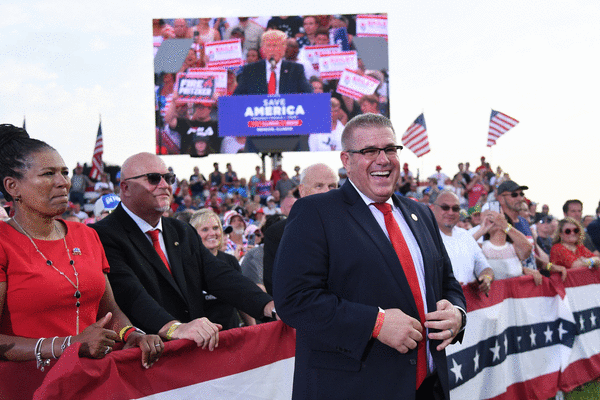
Tuesday’s primary delivered a stark warning for Illinois Republicans: Fewer voters are showing up, and in too many places, there was not enough on the primary ballot that was actually worth voters showing up for anyway.
In well-populated portions of the state, the GOP is steadily vanishing.
Official turnout results won’t come out until next month, but State Board of Elections spokesperson Matt Dietrich estimated that overall turnout — Democrats and Republicans — will end up being about the same as in 2022, at 22% statewide.
But, even considering the poor turnout, the numbers of votes cast in Republicans’ most important race were remarkably weak.
Republican gubernatorial candidates Darren Bailey, Ted Dabrowski, James Mendrick and Rick Heidner collectively secured far fewer votes than even the abysmally low-turnout 2014 primary. In 2014, despite just 18% turnout, Republican gubernatorial candidates collectively drew more than 816,000 votes. This time, the four Republican candidates combined for just 560,000, nearly 230,000 fewer Republican gubernatorial votes in the primary than the last time Bailey ran in 2022.
As troubling as the turnout, though, is what Republican voters encountered when they looked at their ballots. In too many districts — particularly in Chicago and the suburbs — there just wasn’t enough to vote for. No candidate for some key statewide offices. No challenger in many statehouse races.
Some Republican voters told us they pulled Democratic ballots instead. For these Republicans, there were some ultra-progressive congressional candidates to oppose, and they felt they would have more of an impact in that way than they would in choosing their own standard-bearers. We made that suggestion during the endorsement process in some races.
From a GOP point of view, though, that’s bleak.
Why is this happening? What we keep seeing from the minority party is a strategy that worked once at the statewide level — in 2014 — and has failed repeatedly since. Namely, wealthy donors throwing big money behind long-shot statewide races and failing to invest in and focus on winning in competitive statehouse districts. Even if Republicans could pull off another upset and secure the governor’s mansion, they’d still likely face a legislature with an overwhelming Democratic majority. We’ve seen how that plays out.
The vacuum created by the absence of a functional Republican electoral apparatus has been filled by consultants and operatives who continue to profit from losing campaigns. A small circle of donors and strategists, including conservative radio host and political consultant Dan Proft, has repeatedly produced the same result: expensive statewide bids that go nowhere. One close observer put it bluntly to us, describing Proft as “Pritzker’s most effective political operative,” despite being paid by Republicans. Proft reportedly hauled in $25,000 a month from the Dabrowski campaign, only to serve up a rematch between Pritzker and Bailey.
Democrats dominate Chicago and the inner suburbs. Republicans do the same downstate but have largely maxed out their gains there. The path to relevance in Illinois runs through the outer suburbs and exurbs. Any progress is sure to be incremental, requiring seat gains, stronger candidates and a rebuilt coalition, not a sudden statewide revolution.
The path forward is not mysterious, but it does require a fundamental shift in how Illinois Republicans think about winning.
The Illinois Republican Party is not failing because Illinois is unwinnable — after all, Donald Trump got roughly 44% of the vote here in 2024 — but because it behaves like a party one election away from a breakthrough instead of a party that must rebuild from the ground up. Republicans have done a poor job channeling that base of support into a broader, winning coalition. Trump is popular in some red states, but in northern Illinois, he’s an albatross. How to finesse MAGA’s unpopularity in the Chicago area is an internal debate Republicans will continue to have, but there are things they can do in the meantime to become more competitive north of Interstate 80.
Illinois Republicans need to focus on what matters to most voters regardless of party affiliation: reasonable cost of living, fiscal responsibility and good government. From an operations standpoint, the GOP must emphasize discipline, competence- and fiscal-focused messaging, and voter turnout.
Springfield politics also are distinct from what happens in Washington, D.C., where partisanship rules more firmly. Even with Democrats in control, governing in Springfield often means working across the aisle, building coalitions and passing legislation in a divided environment.
Until Republicans shift resources away from long-shot statewide bids and toward building a bench in competitive districts, the results will not change.
Instead of trying to strike gold with another Bruce Rauner-like gubernatorial flash in the pan, real wins look like breaking the super-minority status in the General Assembly, becoming competitive in more suburban districts, and restoring credibility with donors and persuadable voters.
The ILGOP also needs a resuscitated brand and should make competence its credo. In a blue state, a Republican Party that sounds like national cable TV all day is choosing to lose. There is real opportunity and need for a party that recognizes Illinois government is expensive, ethically suspect and often badly managed, and offers a clear alternative.
Finding the candidates to pursue this course obviously is a challenge, and we won’t shrug off the impediment that is Illinois’ egregious gerrymandering problem. But it can be done. Illinois Republicans need more mayors, county board members, school board members, sheriffs, business owners and community figures with real roots, and they need to get them into the pipeline earlier. Think two cycles ahead instead of only about today.
We have immense respect for leaders like House Republican Leader Tony McCombie of Savanna, who is a smart and serious person. She’s also a downstater. Republicans in the part of the state that decides elections — Chicagoland — have no clear leadership and no pipeline.
We write this not to kick the ILGOP while it’s down, but to encourage those who care about competitive state politics not to give up. We also write this out of deep concern for our state and the challenges single-party rule presents.
Improvement won’t happen overnight. Rebuilding a viable opposition party in Illinois will take years of disciplined candidate recruitment, message clarity and strategic focus on winnable races. But the alternative — continued erosion into irrelevance — should concern anyone who believes competitive politics leads to better governance. Illinois does not benefit from one-party rule, and voters deserve a functional, credible alternative.
___
©2026 Chicago Tribune. Visit at chicagotribune.com. Distributed by Tribune Content Agency, LLC.












































Comments