Editorial: How many conflicts can we manage?
Published in Op Eds
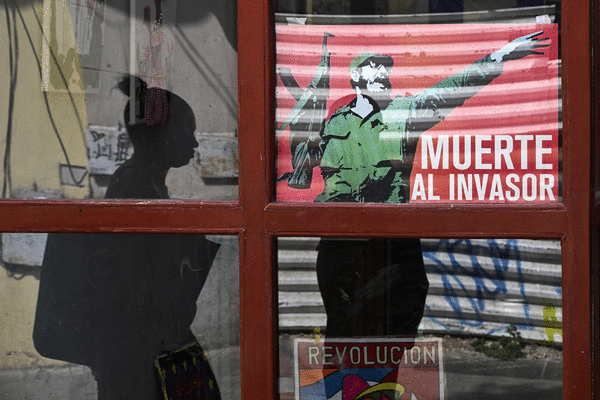
When a former president speaks of “taking” a sovereign nation like Cuba or floats the idea as a serious proposition, it demands more than partisan reaction. It demands reflection. It demands moral clarity. And it demands that we, as Americans, ask ourselves a difficult but necessary question: How much more are we willing to carry?
We are a nation already stretched thin by global entanglements. From the Middle East to Eastern Europe, our resources, our attention and most importantly, our young men and women in uniform have borne the weight of decisions made far from home. War, even when justified, is never clean. It is never contained. And it is never without consequence.
To now casually entertain the idea of extending American power into Cuba, whether through force, coercion or strategic dominance, reveals a dangerous blind spot. It ignores history. It ignores geography. And it ignores the hard-earned lessons of overreach.
Cuba is not an abstract chess piece. It sits just 90 miles from our shores, deeply intertwined with our national story politically, culturally and emotionally. Any aggressive posture toward Cuba is not a distant conflict. It is immediate. It is personal. And it carries risks that could reverberate directly onto American soil.
Meanwhile, a troubling warning from Canada should give Americans pause. The nation’s intelligence service warns that Iranian-linked operatives may be active within Canada, engaging in influence operations, intimidation and other covert activities. If even partially true, this raises serious questions about the security of our shared continent.
This is not just Canada’s concern. It is ours.
And it serves as a reminder that threats today are not confined to distant battlefields. They can exist quietly, within proximity, crossing borders not with tanks but through networks, influence and persistence. While we debate expanding our reach abroad, we must ask whether we are paying sufficient attention to vulnerabilities closer to home.
This is where moral clarity must prevail.
Strength is not measured by how many conflicts a nation can initiate or sustain. True strength is knowing when restraint is the wiser course. It is understanding that leadership in the modern world requires discipline, not just dominance.
We cannot fight the world while leaving our homeland and our immediate neighborhood vulnerable. That is not strategy. That is hubris.
At home, Americans are grappling with rising costs, strained infrastructure, a crisis of confidence in institutions and deep cultural division. These are not secondary concerns. They are the foundation of our national stability. Yet time and again, we are tempted to project strength abroad while neglecting the fractures within.
This is not an argument for isolation. America must remain engaged. But engagement does not mean escalation. It does not mean inserting ourselves into every conflict or entertaining new ones when diplomacy, patience, and strategic restraint could prevail.
We should also be honest about the human cost. Every escalation carries the potential for loss not just of life, but of trust, of global standing and of the moral authority we so often claim. We must ask whether these actions align with the values we profess or whether they erode them.
The American people deserve a voice in this conversation, not through slogans or fear-driven rhetoric, but through thoughtful debate, accountability and leadership that respects both the power and the limits of American influence.
We stand at a crossroads where bravado must give way to wisdom.
Because in the end, the greatest threat to a nation is not always from abroad. Sometimes, it is the failure to recognize our own limits and the consequences of ignoring them.
_____
©2026 The Baltimore Sun. Visit at baltimoresun.com. Distributed by Tribune Content Agency, LLC.

















































Comments