Juan Pablo Spinetto: A Cuban capitalist conversion won't unlock democracy
Published in Op Eds
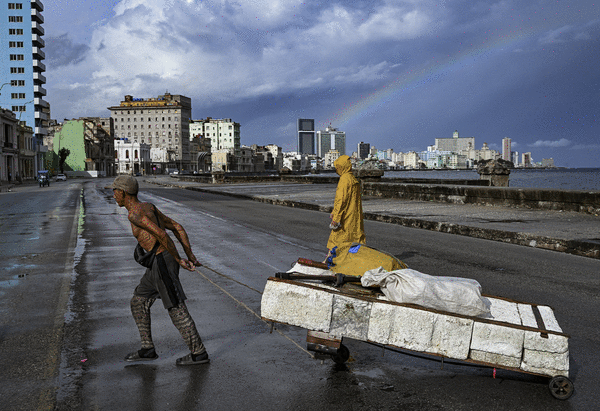
The White House’s playbook for Cuba is now unmistakable: strip away the regime’s public face to secure a decisive strategic advantage while stopping short of outright regime change.
That’s the model the Trump administration followed in Venezuela after extracting Nicolás Maduro earlier this year, and the approach it now appears to be pursuing on the Communist island. According to a report by The New York Times on Monday, Donald Trump is seeking to push Cuba’s handpicked president, Miguel Díaz‑Canel, out of power while leaving intact the repressive, military-backed system that has governed the country since Fidel Castro’s 1959 revolution.
The effort is unfolding alongside mounting economic and financial pressure designed to force Havana into de facto subordination to Washington. It overlaps with reports of multiple conversations between U.S. officials and figures close to Raúl Castro, the regime’s power broker. Call it a “contained transition”: a strategy meant to disrupt the status quo just enough to set change in motion under U.S. tutelage without resetting the regime’s underlying power dynamics, at least in the near term. As in Venezuela, it offers Trump a shiny win for the history books — “I’ll have the honor of taking Cuba,” he bragged — while seeking to avoid the risks of civil unrest, mass migration or outright state collapse.
The Cuban government, for its part, appears to be responding more proactively, perhaps mindful that similar backchannel efforts in Venezuela and Iran eventually gave way to military action. Last week, Díaz-Canel publicly acknowledged for the first time talks with Washington to explore “potential solutions for our bilateral differences,” while his government vowed to release dozens of political prisoners. These moves were followed by pledges to ease the participation of Cubans abroad in the country’s state-driven economy, including allowing them to invest in and own private businesses, a small but meaningful step toward capitalism that aligns with both diaspora interests and Washington’s push to strengthen a local private sector. The regime has also shown a willingness to cooperate on security matters, while strongly rejecting any links to terrorist groups or money laundering.
All these signals should be taken seriously. They point to a hinge in Cuba’s history. Reports from the island describe a fragile social landscape, marked by long blackouts and deepening scarcity after decades of economic mismanagement, compounded by the pandemic, a massive exodus and a sharp drop in external support. Politically isolated and squeezed by the Trump administration’s savage but effective restrictions on fuel shipments, the Cuban leadership has few options left but to engage with Washington. The real question is not whether Díaz-Canel can be removed, but how Havana will frame his displacement as something other than a humiliating concession of sovereignty to the Empire.
At the same time, Trump’s approach makes one thing clear: Democracy is not coming to Cuba anytime soon. If the goal is to force economic change without a meaningful political opening, expectations of genuine transformation should be sharply tempered. Secretary of State Marco Rubio put it bluntly at a Caribbean Community meeting in St. Kitts last month: “Cuba’s status quo is unacceptable. Cuba needs to change,” he said before adding: “It doesn’t have to change all at once. It doesn’t have to change from one day to the next.”
Here the parallels with Venezuela begin to break down. Access to Venezuela’s oil wealth was central to the calculus behind targeting Maduro. Cuba, by contrast, sits on the sharp end of a new era of energy weaponization, given its dependence on imported fuel. Nor is Cuba Venezuela politically: It lacks a mobilized opposition ready to govern and has no recent electoral tradition or liberal institutions; its last, imperfect democracy experiment dates back almost 75 years. In that sense, a “contained transition” may be the least risky path short of a destabilizing, and likely disastrous, military intervention. In fact, if Trump’s plan advances as it appears, this wouldn’t be the first time that the island finds itself under some sort of U.S. protectorate after the neo-colonialist period of the early 20th century.
The turbulent relationship between the two countries runs deep, and the White House may well declare victory simply by demonstrating that it can force action where other administrations failed. But a model of “Raúl without Raúl,” in which the Castros’ network still wields power from the shadows, may ultimately prove too thin a victory, especially for Florida’s Cuban-Americans, whose expectations extend well beyond a cosmetic reshuffling. That gap between symbolic change and substantive transformation carries domestic political risks for Trump and Rubio, particularly if turning around Cuba’s economy and infrastructure proves harder than anticipated.
Cuba’s unfolding transition is also testing Latin America and the Caribbean. After years of failing to articulate a coherent democratic response to Venezuela’s crisis, the region now has another opportunity to shape events. But expectations should remain modest. Deep ideological divides persist, even as the region tilts rightward. The leftist governments of Mexico and Brazil, long inclined to romanticize the Cuban regime, will have to recognize that change is inevitable. If they want a seat at the table, they will need to offer credible alternatives and a genuine willingness to mediate in a constructive way. Otherwise, they risk being sidelined once again by Washington, as they were in Venezuela.
In a recent book, the great Cuban writer Leonardo Padura reflects on the nostalgia and disenchantment of watching Havana, once dubbed the Paris of the Caribbean, fall into irreversible decay. A chance to reverse that trajectory may now be emerging, for the capital and the island alike, through a tightly managed political process. History suggests it just won’t be as quick or profound as many hope.
____
This column reflects the personal views of the author and does not necessarily reflect the opinion of the editorial board or Bloomberg LP and its owners.
JP Spinetto is a Bloomberg Opinion columnist covering Latin American business, economic affairs and politics. He was previously Bloomberg News’ managing editor for economics and government in the region.
©2026 Bloomberg L.P. Visit bloomberg.com/opinion. Distributed by Tribune Content Agency, LLC.













Comments