Editorial: Florida shouldn't give any governor the power to decide who is a terrorist
Published in Op Eds
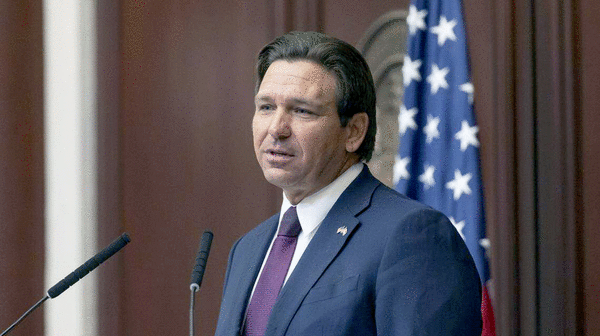
State officials will soon have the power to label terrorist groups, placing an enormous amount of power in the hands of a few politicians. That should give Floridians pause — regardless of political party.
Last week, the Legislature passed HB 1471, which allows the state to designate groups as a domestic or foreign terrorist organizations. Once designated, individuals associated with that group could face serious legal consequences. Students, for example, could face expulsion from public universities.
Critics see the potential for abuse. This bill could easily be turned into a political weapon against perceived enemies, and it puts free speech directly in its crosshairs. Gov. Ron DeSantis will certainly sign the legislation given his office helped write it, the Herald/Times Tallahassee Bureau reported.
Supporters say the bill creates a formal process for identifying terrorist organizations and combating extremism. But that’s a power that should be left to the federal government.
The question isn’t whether terrorism should be addressed. It’s who gets to decide what qualifies as such — and whether guardrails exist to prevent abuse of power.
Traditionally the U.S. State Department has the authority to designate terrorist organizations. Republican state Sen. Erin Grall, the Senate sponsor of the bill, told the Miami Herald, “These are very significant decisions. But they deserve not to be the topic... of a press conference or a press release, but of a process, a deliberative process of consideration of evidence.”
That process, however, offers less protection than Grall suggests. Under the bill, a group can be designated a terrorist organization even if no crime has been committed and no one in the group has been convicted of wrongdoing. The head of the Florida Department of Law Enforcement — a position appointed by the governor — would make a recommendation, which would then go to the governor and the cabinet for a vote. The Florida Cabinet is chaired by the governor and has three other elected officials: the attorney general, the chief financial officer and the commissioner of agriculture.
Groups could challenge the designation in court, but that would take time and money and may only happen when the group becomes aware of the designation. By then, the damage may be done — organizations dismantled, careers upended, students expelled. That’s not due process.
The concern isn’t hypothetical. A federal judge recently blocked an attempt by DeSantis to do exactly what the bill now legalizes.
DeSantis issued an executive order labeling the Council on American-Islamic Relations (CAIR) a terrorist organization. U.S. District Judge Mark Walker struck down the governor’s executive order earlier this month, writing, “The First Amendment bars the Governor from continuing the troubling trend of using an executive office to make a political statement at the expense of others’ constitutional rights.”
Walker’s ruling should’ve been the end of it. Instead, the Legislature has now handed the governor a statutory framework to try again.
The U.S. Constitution protects Americans’ right to assemble and speak freely — protections that exist to prevent the government from punishing political speech.
In a statement, Bacardi Jackson, executive director of the ACLU of Florida, said, “If dissent can be labeled terrorism, democracy cannot survive. The Constitution places a heavy presumption against systems that allow government officials to silence expression. Our democracy depends on the freedom to criticize those in power, to organize around shared values, and to advocate for change without fear that the government will label those efforts a security threat.”
Jackson’s warning should be taken seriously.
Terrorism is a genuine threat and deserves a serious response — including independent review and checks on executive power. That oversight has traditionally and appropriately belonged to the federal government.
HB 1471 risks becoming a political weapon masquerading as a public safety measure. The Legislature should have thought twice before opening Pandora’s box on executive authority. DeSantis would be wise to remember that one day he won’t be governor — and the same power could rest in the hands of a different party with different political priorities.
The governor and cabinet should focus on governing, not deciding who is a terrorist. Granting that authority pushes Florida into dangerous — and uncharted — territory where political power could end up at odds with the First Amendment.
___
©2026 Miami Herald. Visit at miamiherald.com. Distributed by Tribune Content Agency, LLC.



































Comments