Abby McCloskey: Republicans are squandering their MAHA moment
Published in Op Eds
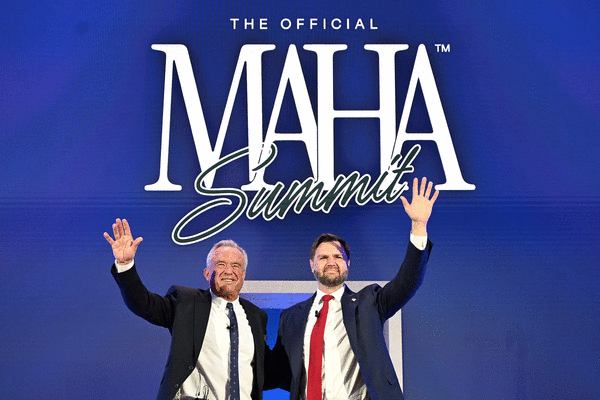
The MAHA base is bigger than you think. And the GOP is going to need all the support it can muster to survive what’s likely to be a bruising midterm.
Foughly four in 10 parents (38%) identify as supporters of the Make America Healthy Again movement, according to a KFF/Washington Post poll. I think this underestimates the movement’s political reach. For example, I wouldn’t put myself under the MAHA label, but I have my moments. I’ve thrown away any black plastic utensils exposed to heat, cook almost every night for our family and shudder at ingredient lists full of unpronounceables. I’m deeply concerned about the rise of chronic health conditions in kids and microplastics wafting out of the ocean.
But I also get my children vaccinated, don’t drink unpasteurized milk, prefer to leave peptides to Californians and purchase my flour instead of milling it myself. I don’t like the air of conspiracy that swirls in some of MAHA. Some see chem trails; I see clouds. Yes, big ag and big pharma do some bad things, but everything is not contaminated and corrupt.
Nor do I love that MAHA has become another partisan flag to wave. (Really, what isn’t these days?) According to KFF, six in 10 Republican parents (62%) identify as MAHA, compared to about one in six (17%) Democratic parents and one in three independent parents (34%). Thus, to be pro-MAHA or anti-MAHA or meh-MAHA is to associate with a bunch of unrelated positions on Iran, taxes and ICE.
But what’s fascinating is that underneath this partisan line-drawing are several shared health concerns. This suggests the potential for a very big movement, and one firmly nested within the GOP, which historically has not had the advantage on health-related issues relative to Democrats.
For example, a 2025 University of Michigan Mott Children’s Hospital poll found that 69% of parents think that children’s physical health is deteriorating, and 83% believe children’s mental health is in decline. The KFF poll found that a majority of parents (across MAHA and non-MAHA lines) believe social media, mental health and an unhealthy diet are major threats to their children. That and other polls have found strong support for increasing government regulations on ultra processed foods, dyes and sugar in school lunches.
Not that the Trump administration has thus far leaned into what could be a giant coalition of engaged parents. Aside from delivering a hefty and generally well-regarded report over the summer, Health and Human Services has a rather small list of “wins” from its first year: Many companies have promised to curb artificial food dyes (one of the least bad additives), the food pyramid has been remade and schools are serving 2% milk again.
Other actions, like questioning vaccinations, have rightfully drawn significant pushback from pediatricians (who remain the most trusted authority on health from MAHA and non-MAHA parents alike) and parents (86% of whom trust vaccines). At the risk of stating the obvious: A rise in measles cases makes children’s health worse, not better.
And within the Trump administration, MAHA has run into a buzzsaw. Just last month the administration released an executive order to boost domestic production of glyphosate. That pesticide had been flagged in last year’s White House MAHA report for studies showing “a range of possible health effects, ranging from reproductive and developmental disorders as well as cancers, liver inflammation and metabolic disturbances.” The EPA is cutting air quality regulations at the same time many in MAHA have called for more rules around food and environmental safety.
As such, there’s a real risk that the movement loses supporters. This, combined with the swing toward the Democratic Party predicted for the midterms, could leave the MAHA cause as a flash in the cast iron pan, one that seeks increasingly fringe sourdough recipes instead of lasting federal reforms that address the real and growing crisis in children’s health.
But that, too, underestimates something about the MAHA movement, which is that Democrats have an uphill climb to regain trust in and around children’s health. Arguably, one of the most searing memories for parents remains the Covid pandemic, when many Democratic cities kept schools closed for months even though it was clear that children were the least at risk from the virus.
When you look at the states that have taken action against social media companies and Big Tech — one of parents’ top issues — Republican states have done the most to require age limits and restore parental control.
Department of Health and Human Services Secretary Robert F. Kennedy Jr. deserves some credit for identifying and cultivating this group of voters and for bringing more of them into the GOP fold. The question is: How much will Republicans work to retain them? Thus far, the answer seems to be “not much.”
But Republican strategists scratching their heads would not have to scratch that hard to change course. Whether parents embrace the MAHA label, this is a large group of voters animated by a shared set of concerns. They remain an opportunity for whichever party takes them seriously.
____
This column reflects the personal views of the author and does not necessarily reflect the opinion of the editorial board or Bloomberg LP and its owners.
Abby McCloskey is a columnist, podcast host, and consultant. She directed domestic policy on two presidential campaigns and was director of economic policy at the American Enterprise Institute.
©2026 Bloomberg L.P. Visit bloomberg.com/opinion. Distributed by Tribune Content Agency, LLC.


























Comments