Commentary: The SAVE Act is a solution in search of a problem
Published in Op Eds
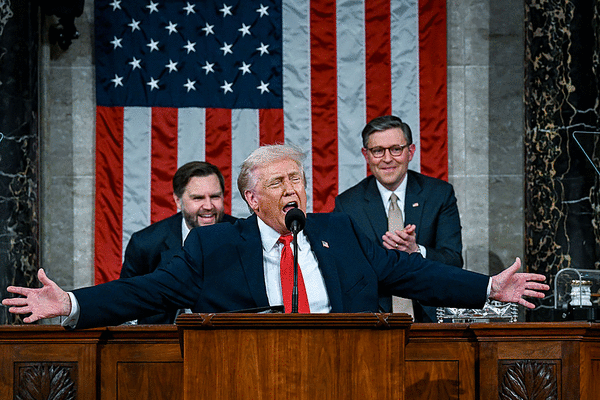
The federal government seems to be barreling toward a federal election power grab. Trump's State of the Union address called for the Senate to push through the SAVE Act, which has already passed the House, in the name of so-called "election integrity."
And the SAVE Act isn’t the only such bill. Like the SAVE Act, the Make Elections Great Again (MEGA) Act—introduced in the House—would require voters to provide a document outlined in the Act that allegedly proves their U.S. citizenship. We’ve been down this road before in Texas, and spoiler alert: It was unworkable.
Both the SAVE and MEGA Acts would disenfranchise millions of eligible U.S. citizens without making our federal elections more secure. They seek to roll out a faulty federal voter registration system, despite the existing separate registration and voting process for state and local elections. And these Acts target a minuscule “problem”—but would unleash mass voter purges and confusion.
Let’s be clear: these Acts primarily disenfranchise eligible voters. Only U.S. citizens can lawfully vote in state and federal elections, and noncitizen voting is vanishingly rare (about 0.0001 percent in the 2016 election). There are both criminal and immigration implications for voting while ineligible. On the other hand, almost 10% of eligible voters lack ready access to the documentation required by the SAVE Act, even though they are U.S. citizens.
Approximately 21.3 million people don’t have proof of citizenship readily available. And 3.8 million eligible voters don’t have the required documentation at all. Racial disparities also impact who has access to the required documentation. About 8% of white Americans don’t have the required documentation readily available, compared to 11% for voters of color.
That’s not the only problem. Under the SAVE Act, the only acceptable forms of identification for voter registration would be: a U.S. Passport, a military ID, a government-issued ID that confirms a person’s birthplace is in the United States, or a REAL ID that identifies U.S. citizenship.
But no REAL ID in the United States currently designates U.S. citizenship, nor do state IDs generally confirm your birthplace. Your driver's license or state identification card would thus need to match a government-issued document confirming a United States birthplace.
For most people, that would be a certified birth certificate. But anyone who has changed their name, whether because of marriage, gender affirmation, or just personal reasons, would suddenly need a passport just to register to vote. This would include approximately 69 million married women who would be unable to use their birth certificate to verify their citizenship under the SAVE Act.
A passport isn’t cheap. It currently costs at least $145 to get a Passport book and $65 to get a Passport Card. Nor is it a fast process, usually taking 4 to 6 weeks. If you need it faster in time to register to vote, it’ll run you over $200. Urgent processing is only available by appointment if a person has international travel within 14 calendar days. There is no provision for expedited or urgent processing for voter registration purposes under the SAVE Act, nor is the application fee waived. Poll taxes have been unconstitutional since 1964–but the SAVE Act’s ID requirements impose a nationwide poll tax masquerading as "election security."
Voters nationwide would suddenly have to contend with two different systems of voter registration and two different eligibility requirements: those to vote in federal elections, and those to vote in statewide and local elections. Beyond impeding the average voter, this would cause a nightmare for local election officials. The expense and logistics of implementing a federal voter registration overhaul during a midterm election year would fall on underfunded and understaffed state and county election officials across the country. Such a massive, complicated, and rushed undertaking will inevitably wrongly target eligible voters.
Texas recently looked at pushing a similar initiative in 2025. SB 16 would have required documentary proof of citizenship to register to vote. Like the SAVE Act, SB 16 would have forced people with name changes to obtain a passport to prove their identities. It would have separated state and federal elections in Texas, creating a two-tiered system of voter registration. And it would have cost taxpayers close to $800,000 in its first year, with over $270,000 annually every year after. SB 16 quietly died after it became clear to lawmakers that this system was expensive, unworkable, and would disenfranchise rural voters more than urban voters.
As Texas’s SB 16 showed, the SAVE Act would disenfranchise eligible citizens in the name of a problem we’ve long solved. But there’s still time to stop it. While the House has passed the SAVE Act, the Senate has yet to act. We can’t fall for the branding and fearmongering those in power are using to avoid accountability. Preserving our democracy requires that the ballot box remain open to every eligible voter.
____
Veronikah Warms is the Voting Rights Policy Attorney for the Texas Civil Rights Project and has worked in the Texas legislative sphere pre and post licensure for the past decade. Her specialties are voting rights and redistricting policy, but she is passionate about reforms that lift up marginalized communities and combat targeted rights rollbacks. The Texas Civil Rights Project is a non-partisan nonprofit organization that advocates for the civil rights of all Texans through voting rights, immigrants’ rights, and criminal justice reform throughout the state
_____
©2026 The Fulcrum. Visit at thefulcrum.us. Distributed by Tribune Content Agency, LLC.














































Comments