Editorial: How does this war end? The US needs a better answer
Published in Op Eds
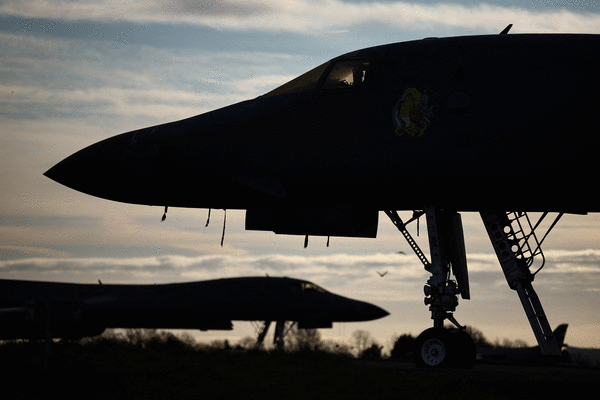
More than a week after the U.S. and Israel launched punishing airstrikes against Iran, neither side appears ready to pause hostilities. The Islamic Republic will surely pay the bigger price for its intransigence. But that doesn’t mean the U.S. can ignore the long-term costs of fighting without a realistic endgame in mind.
Despite claiming to have “already won in many ways,” the president said on Monday that the U.S. would “not relent until the enemy is totally and decisively defeated.” What exactly that looks like is unclear. The Pentagon has offered four tactical goals, only some of which appear achievable through airstrikes alone: to ensure Iran can’t build a nuclear weapon, destroy its navy and ballistic missile arsenal, and cut off its support for proxy militias such as Hezbollah. If the administration has a more detailed exit strategy, congressional Democrats briefed on its plans say they haven’t heard it. Meanwhile, continued efforts to dismantle the regime’s repressive apparatus are as likely to encourage chaos as a pro-democracy uprising.
There’s no doubt the world would be better off if Iran no longer threatened its neighbors, Israel and the West. And whatever happens, the military coordination, technological sophistication and sheer firepower already displayed by U.S. forces ought to give pause to rivals such as China, Russia and North Korea who might be inclined to test American will.
At the same time, even a successful campaign that ends soon would leave the U.S. and its regional allies dangerously short of key munitions, especially pricey missile interceptors that could take years to replace. Wear and tear on planes and warships will exacerbate readiness gaps. Although the Pentagon hasn’t formally asked Congress for additional funding, the bill for this undertaking is adding up fast — by close to $1 billion per day, according to one estimate.
Anything other than a clean and quick victory, meanwhile, threatens to further roil energy markets and erode other elements of American power. The administration has already picked fights with allies in Europe, annoyed partners in the Persian Gulf and caused a totally unnecessary diplomatic snafu with India. Elevated oil prices and sanctions relief for Russia will put more money into Vladimir Putin’s coffers, even as demand for Patriot missiles threatens to limit the flow of much-needed interceptors to Ukraine. Enemies are surely learning from the tactics on display in the U.S. campaign and will adjust their own military strategies accordingly.
The longer the fight goes on, moreover, the greater the danger that other countries will be dragged in. Iranian strikes could provoke Gulf nations to retaliate. A move by Kurdish insurgents to rise up against the regime could spread chaos that might spill over into Iraq, Turkey and Syria. However distant, the U.S. would not be immune: A destabilized region would be a constant strategic distraction even as the administration claims, like its predecessors, to want to refocus on China and other priorities.
With these risks in mind, the White House needs to settle on clear and achievable war aims. Regime collapse is unlikely without boots on the ground. What’s needed is a negotiated solution — one that leaves Iran whole and stable, but contained militarily.
Even after the appointment of hard-liner Mojtaba Khamenei as supreme leader, the administration should be working through back channels to explore whether there are figures within the Iranian system prepared to agree to acceptable security arrangements and to work with civil society to implement internal reforms. Diplomats should be seeking support for such a strategy from allies in the Gulf and elsewhere. Crucially, White House officials need to start looping Congress into their planning and offering plausible objectives to the public.
This war raises the same question as any other: “Tell me how this ends.” The administration needs to come up with a better answer, soon.
____
The Editorial Board publishes the views of the editors across a range of national and global affairs.
©2026 Bloomberg L.P. Visit bloomberg.com/opinion. Distributed by Tribune Content Agency, LLC.





















































Comments