Commentary: We need disapproval icons in our digital public square
Published in Op Eds
In my work on leadership and followership, I’ve noticed something simple but powerful: followers shape leaders. Leaders adjust themselves in response to the signals they receive — not just in rallies and speeches, but increasingly in the digital sphere.
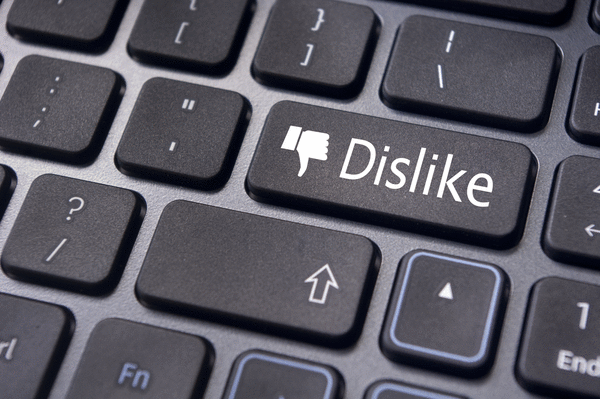
Social media “likes” and “hearts” send immediate feedback that can influence political behavior. In contrast, largely for commercial reasons, there are no equivalent icons to express dislikes or concerns.
Instead, one must enter the turbulent water of comments. These produce so much blowback that many otherwise engaged citizens avoid this option. A political leader or activist is left with a false view of the popularity of their ideas from the positive icons. This has consequences. Imagine a market in which only “buy” signals were possible, and not “sell” signals.
Anyone who has attended a political rally has seen this in action. A candidate says something that draws cheers. The crowd leans in. The candidate repeats the line, sharpens it, intensifies it, and hears more applause. Over time, that feedback loop pulls a leader further in a particular direction. Sometimes that produces clarity. More problematically, it produces excess that feeds the political hyper-polarization from which we now suffer.
This dynamic is not limited to one party. When strong rhetoric on the right gets rewarded, it escalates towards the authoritarian and “othering." When uncompromising language on the left gets amplified, it veers toward the dogmatic and shaming. Human beings respond to reinforcement. That is not ideology; it is social psychology.
Today, much of that distorting reinforcement happens on platforms such as X, Facebook, and Truth Social. Public figures receive immediate feedback. Approval takes one tap — a thumbs-up, a heart, or another positive icon. Disapproval, by contrast, requires a comment, which often means entering a highly distasteful fight.
The result is predictable. Applause is visible and measurable. Concern is either silent or argumentative. There is no simple way to say, “I’m not sure,” or “Slow down,” or “This is too much.” A distorted picture results that may become a basis for consequential action.
For those who care about institutional health, this engineered imbalance matters. In the mid-20th century, the Canadian media philosopher, Marshall McLuhan, summarized the phenomenon in the pithy saying, “The medium is the message." The design of our social media is further distorting our political and civic behavior.
In this dominant media form, we need ways to register concern without escalating into argument. In addition to a thumbs-up icon, why not have a thumbs-down option? Let’s go beyond that. Why not imagine additional civic signals? A question mark could mean, “I’m not sure about that.” A caution symbol could communicate, “Proceed carefully.” An extended outward palm could mean, “This is going too far.” A dial or gauge, “Turn it down a notch.”
Platforms design and test reaction buttons regularly. They experiment with small user groups, measure behavioral effects, and refine what works. These signals could be aggregated rather than personalized, allowing leaders to see the volume of concern without exposing individual users to retaliation. Responsible citizens can flock to the first major social media platform that adopts this, giving it and its competitors a commercial interest in supporting a civic virtue.
These enhancements will need to be insulated from manipulation by bot swarms and foreign dissimulators. They can be made more useful by offering an option to briefly explain why a follower is giving a signal, keeping this protected information.
If our public conversation increasingly takes place on privately designed platforms, then design choices carry public consequences. Democracy requires more than cheering with icons or mud wrestling in comments. It requires the steady ability of citizens to say: we have questions; we have concerns; let’s not go beyond the sensible to the dogmatic and extreme.
Given the omnipresence of social media, this is not a peripheral issue. It is a core design element for sustaining a coherent society and a functional representative democracy. Which platform will take the lead in better signal design, and who among us will follow them?
_____
Ira Chaleff is the author of “To Stop a Tyrant: The Power of Political Followers."
_____
©2026 The Fulcrum. Visit at thefulcrum.us. Distributed by Tribune Content Agency, LLC.












































Comments