Andreas Kluth: America second, Israel first?
Published in Op Eds
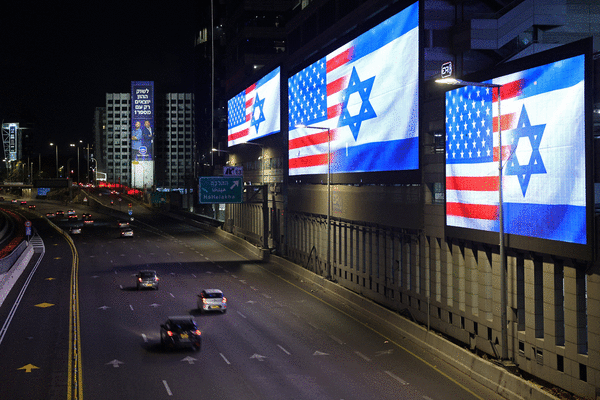
It was bad enough that Donald Trump hasn’t been able to explain clearly why he yet again felt he had to attack Iran, and why now. His national security advisor and secretary of state, Marco Rubio, then inadvertently made everything worse by implying that the president wasn’t so much leading — in the spirit of America First and Peace through Strength — as following. Worse yet, Trump seemed to be following a foreign power, Israel. Accidentally, Rubio inverted Trump’s entire foreign-policy shtick: America Second, Israel First.
Here’s Rubio’s original statement: “We knew that there was going to be an Israeli action, we knew that that would precipitate an attack against American forces, and we knew that if we didn’t preemptively go after them before they launched those attacks, we would suffer higher casualties.” That, Rubio said, was the “imminent threat”: not an Iranian strike out of the blue (which American intelligence wasn’t expecting) but an Israeli strike against Iran, against which Iran would have to retaliate.
In this narrative, Israeli Prime Minister Benjamin Netanyahu was the one making the primary decisions about war and peace, life and death, while Trump and the American superpower had at best limited agency. Not a good look.
Here is how Senator Angus King, an Independent, put it when grilling a Pentagon official the following day: “Have we now delegated the most solemn decision that can be made in our society, the decision to go to war, to another country?” That, King said, was the “breathtaking” meaning of Rubio’s slip: “We’re going to be taken into a war by the prime minister of another country.”
Unsurprisingly, that narrative got under Trump’s skin. “If anything, I might have forced Israel’s hand,” he insisted to reporters, without elaborating. Rubio, for his part, appeared mortified to have caused embarrassment to his boss and backpedaled as energetically as he could, with a torrent of words that boiled down to: Whatever I said was misunderstood, and what I meant is whatever the president has said, is saying or will say.
But the damage was already done, and in different ways for different audiences.
One audience is Trump’s Republican base, which is generally tired of forever wars and no longer as reliably pro-Israel and Zionist as it once was. The president’s own MAGA movement subsumes Christian Nationalist elements that are downright anti-Israel, if not anti-Semitic, and want to weaken or sever America’s quasi-umbilical link with Israel. Rubio’s quote is grist for their mills.
More generally, conservatives have been drifting away from “dispensationalist” ideologies espoused by some evangelicals that see American support for Israel as biblically ordained, and toward an American nationalism that sees entanglements in the Middle East as no less problematic than anywhere else. Independents are also turning away from Israel, while Democrats have largely done so. Nobody in any of these groups will be reassured by Rubio’s version of a casus belli.
The episode also exposes a larger inconsistency in the Trump administration’s view of America’s alliances. Israel, with its martial prowess, is now considered a “model ally.” (That of course reminds other allies, in Europe and Asia, that they are not; Trump has long disdained most of them as free-riders, even if they are now rearming as fast as their welfare budgets allow.)
Even model alliances, however, suffer from a problem called moral hazard. In this context, the term means that smaller allies tend to take bigger risks if they are convinced that the US has their back, thus pulling both into unnecessary wars.
Try this for a thought experiment: Imagine that instead of Israel, which is right to feel existentially threatened by the Iranian regime, the ally in question is Poland, which is equally justified in fearing Russia, or South Korea, which lives in the nuclear shadow of the North. Would Trump be as enthusiastic in going to war against Russia and North Korea if he thought the Poles or South Koreans felt it necessary to strike preemptively?
The confused and mixed signals coming out of the administration about its latest war of choice send the latest of many terrible messages.
In opening hostilities, the White House ignored international law and the American constitution, which reserves to Congress the right to declare war. The administration didn’t even try to make a clear and compelling case to the public why this war had to happen now, or at all. It is now wasting ammo and resources in the Middle East that will be dangerously scarce in other conflict zones. And into this big mess it may have stumbled rather than deliberately stepped.
The bloodcurdling reality may be, as Senator King put it in that hearing, that Rubio inadvertently told the truth.
____
This column reflects the personal views of the author and does not necessarily reflect the opinion of the editorial board or Bloomberg LP and its owners.
Andreas Kluth is a Bloomberg Opinion columnist covering US diplomacy, national security and geopolitics. Previously, he was editor-in-chief of Handelsblatt Global and a writer for the Economist.
©2026 Bloomberg L.P. Visit bloomberg.com/opinion. Distributed by Tribune Content Agency, LLC.
















































Comments