Editorial: War powers and the weight of the Constitution
Published in Op Eds
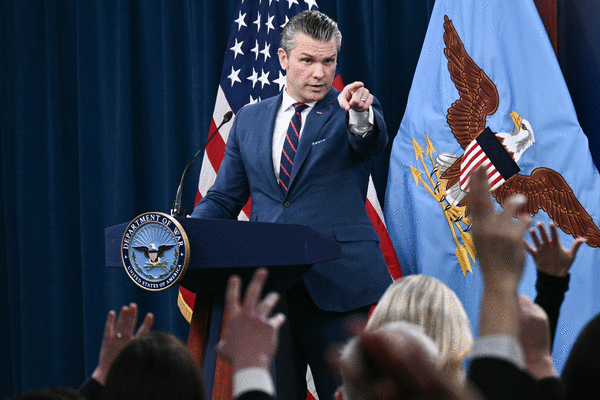
The gravest power entrusted to any American president is the authority to command the armed forces. With that authority comes a constitutional tension that has defined our republic since its founding: Congress declares war. The president conducts it.
When an administration moves toward open conflict — deploying forces, launching sustained strikes or widening military engagement — without explicit congressional authorization, it raises serious constitutional and strategic concerns. The framers did not divide war powers casually. They feared concentrating too much authority in one individual, especially in moments charged with fear, urgency and national emotion.
Article I gives Congress the power to declare war. Article II makes the president commander in chief. The design was deliberate: debate before bloodshed. Shared accountability before sustained conflict.
History, however, shows that presidents of both parties have tested and stretched that boundary.
Harry Truman committed U.S. forces to Korea under a United Nations mandate without a formal declaration of war. Lyndon B. Johnson relied on the Gulf of Tonkin Resolution to escalate in Vietnam, a broad congressional authorization that later haunted the nation. George W. Bush secured congressional approval for the wars in Afghanistan and Iraq. Barack Obama conducted extended operations in Libya under NATO authority without a specific new war authorization. Presidents of both parties have used the 2001 and 2002 Authorizations for Use of Military Force to justify actions far removed in time and geography from their original purpose.
In other words, this is not a partisan issue. It is an institutional one.
Supporters of swift executive action argue that modern threats move too quickly for prolonged congressional deliberation. Missiles travel faster than legislation. Cyber warfare requires an immediate response. Terror networks do not issue formal declarations. There is truth in that reality.
But there is also danger in normalization.
When presidents increasingly rely on executive authority to initiate or expand military conflict without clear, updated authorization from Congress, the threshold for war quietly lowers. Debate becomes optional. Public accountability becomes diluted. And the American people, whose sons and daughters serve, are left reacting rather than participating through their elected representatives.
The War Powers Resolution of 1973 attempted to rebalance this equation, requiring notification to Congress and limiting unauthorized deployments to 60 days without approval. Yet administrations from both parties have viewed it as constitutionally questionable or practically flexible.
The trajectory matters.
A republic drifts when precedent replaces principle. If one president expands executive war authority, the next inherits and often builds upon it. Over time, what was once extraordinary becomes routine.
This is not an argument for paralysis in the face of threat. The president must retain the ability to defend the nation swiftly. However, sustained conflict, particularly against state actors, across multiple theaters and with foreseeable escalation, demands more than executive interpretation. It demands congressional clarity.
The cost of war is measured not only in treasure, but in trust.
When the constitutional balance erodes, so does public confidence. And when confidence erodes, unity fractures precisely when it is most needed.
The question is not whether a president can act. The question is whether we are preserving the constitutional guardrails that ensure such action reflects the will of the nation, not merely the will of one office.
In matters of war, speed is sometimes necessary.
But shared authority is always essential.
_____
©2026 The Baltimore Sun. Visit at baltimoresun.com. Distributed by Tribune Content Agency, LLC.


















































Comments