Mark Z. Barabak: With midterm vote starting, here's where things stand in national redistricting fight
Published in Op Eds
Donald Trump has never been one to play by the rules.
Whether it's stiffing contractors as a real estate developer, defying court orders he doesn't like as president or leveraging the Oval Office to vastly inflate his family's fortune, Trump's guiding principle can be distilled to a simple, unswerving calculation: What's in it for me?
Trump is no student of history. He's famously allergic to books. But he knows enough to know that midterm elections like the one in November have, with few exceptions, been ugly for the party holding the presidency.
With control of the House — and Trump's virtually unchecked authority — dangling by a gossamer thread, he reckoned correctly that Republicans were all but certain to lose power this fall unless something unusual happened.
So he effectively broke the rules.
Normally, the redrawing of the country's congressional districts takes place once every 10 years, following the census and accounting for population changes over the previous decade. Instead, Trump prevailed upon the Republican governor of Texas, Greg Abbott, to throw out the state's political map and refashion congressional lines to wipe out Democrats and boost GOP chances of winning as many as five additional House seats.
The intention was to create a bit of breathing room, as Democrats need a gain of just three seats to seize control of the House.
In relatively short order, California's Democratic governor, Gavin Newsom, responded with his own partisan gerrymander. He rallied voters to pass a tit-for-tat ballot measure, Proposition 50, which revised the state's political map to wipe out Republicans and boost Democratic prospects of winning as many as five additional seats.
Then came the deluge.
In more than a dozen states, lawmakers looked at ways to tinker with their congressional maps to lift their candidates, stick it to the other party and gain House seats in November.
Some of those efforts continue, including in Virginia where, as in California, voters are being asked to amend the state Constitution to let majority Democrats redraw political lines ahead of the midterm. A special election is set for April 21.
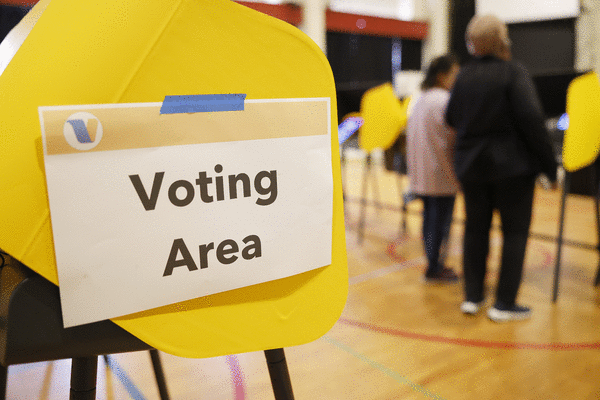
But as the first ballots of 2026 are cast on Tuesday — in Arkansas, North Carolina and Texas — the broad contours of the House map have become clearer, along with the result of all those partisan machinations. The likely upshot is a nationwide partisan shift of fewer than a handful of seats.
The independent, nonpartisan Cook Political Report, which has a sterling decades-long record of election forecasting, said the most probable outcome is a wash. "At the end of the day," said Erin Covey, who analyzes House races for the Cook Report, "this doesn't really benefit either party in a real way."
Well.
That was a lot of wasted time and energy.
Let's take a quick spin through the map and the math, knowing that, of course, there are no election guarantees.
In Texas, for instance, new House districts were drawn assuming Latinos would back Republican candidates by the same large percentage they supported Trump in 2024. But that's become much less certain, given the backlash against his draconian immigration enforcement policies; numerous polls show a significant falloff in Latino support for the president, which could hurt GOP candidates up and down the ballot.
But suppose Texas Republicans gain five seats as hoped for and California Democrats pick up the five seats they've hand-crafted. The result would be no net change.
Elsewhere, under the best case for each party, a gain of four Democratic House seats in Virginia would be offset by a gain of four Republican House seats in Florida.
That leaves a smattering of partisan gains here and there. A combined pickup of four or so Republican seats in Ohio, North Carolina and Missouri could be mostly offset by Democratic gains of a seat apiece in New York, Maryland and Utah.
(The latter is not a result of legislative high jinks, but rather a judge throwing out the gerrymandered map passed by Utah Republicans, who ignored a voter-approved ballot measure intended to prevent such heavy-handed partisanship. A newly created district, contained entirely within Democratic-leaning Salt Lake County, seems certain to go Democrats' way in November.)
In short, it's easy to characterize the political exertions of Trump, Abbott, Newsom and others as so much sound and fury producing, at bottom, little to nothing.
But that's not necessarily so.
The campaign surrounding Proposition 50 delivered a huge political boost to Newsom, shoring up his standing with Democrats, significantly raising his profile across the country and, not least for his 2028 presidential hopes, helping the governor build a significant nationwide fundraising base.
In crimson-colored Indiana, Republicans refused to buckle under tremendous pressure from Trump, Vice President JD Vance and other party leaders, rejecting an effort to redraw the state's congressional map and give the GOP a hold on all nine House seats. That showed even Trump's Svengali-like hold on his party has its limits.
But the biggest impact is also the most corrosive.
By redrawing political lines to predetermine the outcome of House races, politicians rendered many of their voters irrelevant and obsolete. Millions of Democrats in Texas, Republicans in California and partisans in other states have been effectively disenfranchised, their voices rendered mute. Their ballots spindled and nullified.
In short, the politicians — starting with Trump — extended a big middle finger to a large portion of the American electorate.
Is it any wonder, then, so many voters hold politicians and our political system in contempt?
____
©2026 Los Angeles Times. Visit at latimes.com. Distributed by Tribune Content Agency, LLC.
























Comments