Editorial: What's the point of the State of the Union?
Published in Op Eds
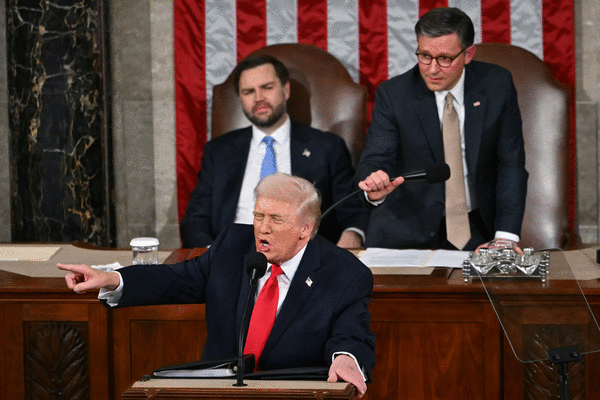
The President of the United States “shall from time to time give to the Congress Information of the State of the Union, and recommend to their Consideration such Measures as he shall judge necessary and expedient.” This is the constitutional basis for what has become known at the State of the Union address.
None of America’s founders would recognize the spectacle it has become. In fact, we no longer believe it serves a useful purpose in the political life of the nation.
Tuesday night’s address by President Donald Trump represented a new low point for the State of the Union. In addition to his habitual exaggerations and fabrications, the speech featured regular harangues of the Democrats — and a good deal of shouting right back at the president — turning the whole thing into a tawdry political spectacle.
In form, the address has degraded into a series of set pieces in which the president introduces guests — military heroes, victorious athletes, victims of violence — whose presence is meant to drive home some political point or simply to add to the spectacle. These people are often extraordinary and worthy of appreciation, but they typically have little to do with the actual state of the American union.
Meanwhile, anything that actually adds value to the nation’s political life — a report on the activities of the executive branch, a list of policies for Congress to consider or even some high oratory — has been placed in the shade. While the address has always included an element of spectacle, now it is almost pure spectacle.
George Washington delivered the first constitutional address to Congress in 1790, but the third president, Thomas Jefferson, felt the event was too monarchical and so submitted a written report instead. Woodrow Wilson returned to the Washingtonian tradition of a live address in 1913, but the term “State of the Union” didn’t emerge until the Franklin Roosevelt administration. By the end of the 1960s, during Lyndon Johnson’s presidency, the address had become a major television event — a top festival of the political year.
As we can see, traditions evolve over the decades. Sometimes those changes move closer to the original purpose of a ritual, and sometimes they depart from it. Sometimes they improve on the tradition, and sometimes they degrade it.
At this point, it is hard to see what the purpose of the State of the Union address is, besides being yet another exercise in political spectacle, public deception and vicious partisanship.
The address is only considered to be particularly important because it receives substantial media coverage, including wall-to-wall on broadcast networks. While legacy media no longer has the power it once did, it would be an important signal if, next year, the networks declined to broadcast the address.
In its current form, the State of the Union is no longer valuable to the nation’s political life. And pretending that it is something grander and more important than yet another spectacle is only making the country worse off.
_____
© 2026 the Pittsburgh Post-Gazette. Visit www.post-gazette.com. Distributed by Tribune Content Agency, LLC.













































Comments