Editorial: The Supreme Court's tariff ruling doesn't solve the problem
Published in Op Eds
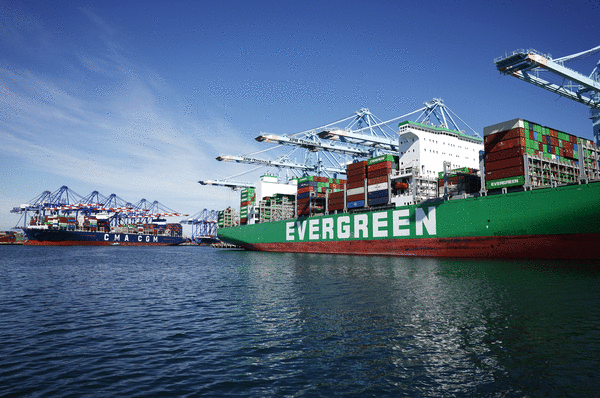
On the merits, the Supreme Court’s decision last week to invalidate much of the president’s global tariff regime is to be welcomed. Yet the court’s judgment, sound as it might be on constitutional grounds, can’t by itself undo the damage that America’s turn to protectionism has already caused — nor prevent worse to come.
Avoiding further harm will be entirely up to the administration and Congress. Unless they choose to put stability first, things could quickly spiral toward a crisis.
By a 6-3 margin, the court found that the president had exceeded his authority when imposing a blizzard of high tariffs last year. It ruled that the law the administration had invoked, the International Emergency Economic Powers Act, didn’t explicitly authorize such measures when conferring the power to “regulate” trade. Other crucial questions were left unresolved, however, not least whether the White House can replace the tariffs using other legal tools or if it can keep on declaring so-called emergencies to justify expansive executive action.
Plans to replace the duties are already underway. In response to the ruling, the president said that he’ll impose a new global 15% tariff under Section 122 of the 1974 Trade Act and start investigations with a view to imposing more levies using different authorities. This leaves the outlook no clearer than before. In particular, firms that have paid the now-illegal tariffs will seek redress. Whether refunds will be granted and how they’d be administered has been sent back to lower courts — with some $170 billion of government revenue at stake.
Whatever the result of this further litigation, the government’s fiscal calculations — which were already dubious, to put it generously — have now been torn up. Budget deficits, currently well above 5% of gross domestic product, were likely to keep growing despite more than $250 billion a year in expected future tariff revenue. Cutting off that income creates an enormous gap, and even the most expansive use of alternative authorities is unlikely to bridge it. In other words, the economy faces a new and potentially massive fiscal shock.
As if all this weren’t worrying enough, there’s yet another danger as the administration ponders this stinging defeat. If the president’s effort to reimpose tariffs by other means meets with further resistance from the court — an open possibility given the narrowness of last week’s ruling — he might turn his anger on the justices, in much the same way he has tried to intimidate the Federal Reserve. In that event, the court could be drawn into a struggle over who’s in charge. The government’s setback on tariffs might become a fiscal emergency (real, not imagined), an economic body blow and a constitutional crisis all in one.
It’s vital that wiser heads prevail. The administration should, at the very least, soften its approach to trade, seeking new agreements with trading partners and dispensing with any further tariff threats. It should work with Congress to start restoring fiscal control with orderly spending discipline, broad-based increases in revenue, and a workable, bipartisan target for future deficits. And it should struggle to contain its fury over a Supreme Court that just shot down its signature policy.
Just now, such advice might sound like asking for the moon. Before dismissing it, consider the alternative.
____
The Editorial Board publishes the views of the editors across a range of national and global affairs.
©2026 Bloomberg L.P. Visit bloomberg.com/opinion. Distributed by Tribune Content Agency, LLC.


















































Comments