Commentary: My parents were interned in camps for Japanese Americans. We are repeating that national sin
Published in Op Eds
My parents were just children when they were wrested from their homes into tarpaper barracks surrounded by barbed wire. The message: They were not welcome.
On Feb. 19, 1942, President Franklin D. Roosevelt issued Executive Order 9066, authorizing the incarceration of more than 120,000 people of Japanese descent — an entire group of people maligned and mischaracterized as a threat.
My parents both died late last year. Sadly, in their final days, they witnessed a resurgence of fabricated fear as justification for unnecessary, unfounded and unlawful action to strip other groups of people of their rights and dignity. They lived to see Immigration and Customs Enforcement agents here in Chicago forcibly rounding up neighbors for detention camps.
The premise of a threat again is being used to create a sense of “us versus them.”
But once again, many of us see “them” as neighbors rather than threats.
During World War II, the American Friends Service Committee, a Quaker organization, helped get Japanese Americans out of the internment camps and advocated for their rights. My grandparents were able to secure employment as a doorman at the Palmer House and a maid at the Edgewater Beach Hotel as a pathway out of the camps and found a place to call home: Chicago.
Inspired by and appreciative of the support they received when arriving in Chicago, my parents became good neighbors — ensuring newcomers felt welcome and cared for. Through their church, they hosted refugee families from Cuba and Vietnam. They opened our home to countless workers from Japan temporarily assigned to Chicago. And they became friends with new arrivals from across the U.S. who chose to relocate to the Windy City.
Our community in Chicago showed the strength of neighbors in an even bigger way recently. Like the “neighboring” we’re seeing now in Minnesota, people have stepped up to de-escalate dangerous situations, and organizations have stepped in with know-your-rights campaigns. At great risk to themselves, people are rallying together to protect our neighbors’ constitutional rights: freedom of speech, rule of law and the right to due process.
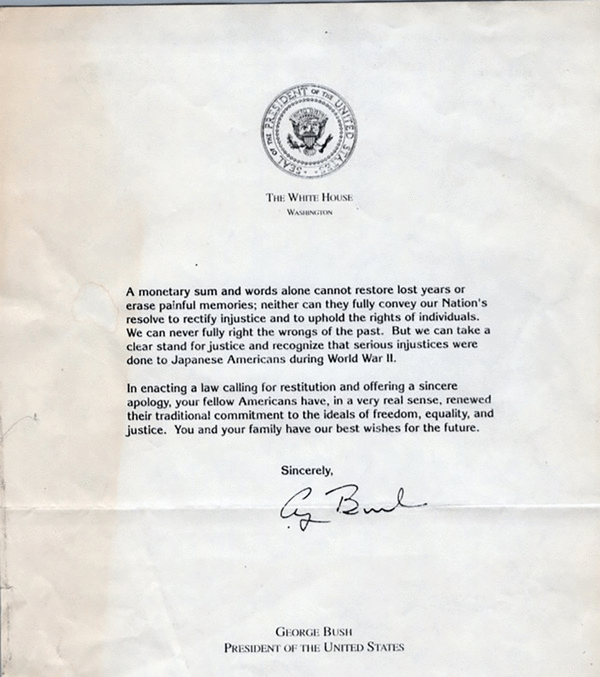
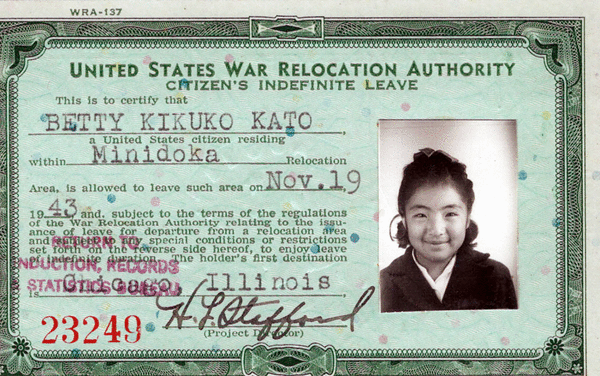
While emptying out my parents’ house, I found relics of their incarceration — my mom’s prisoner identification, pictures of my parents as small children in stark barracks and a copy of the apology letter from President George H.W. Bush that recognized the illegal actions of our federal government. They saved these artifacts so we would remember.
Remembering this history challenges us to see how fragile our civil liberties are and how easily they can be discarded during times of manufactured fear. It also reminds us that we must be vigilant to governmental actions that target specific groups based on race, ethnicity, religion or other identities. We must remember to speak out for our neighbors and push back when we see unlawful and unjust acts.
On this anniversary of the signing of Executive Order 9066, consider attending a Day of Remembrance event in your community — not only to mark what happened but to stop it from happening once again. Learn how fragile our rights truly are, how easily fear can be weaponized by those in power and the courage it took for people, often at great personal cost, to resist and defy injustice. And, most importantly — like those who supported my family when they were forced to relocate to Chicago and like the people today who are stepping forward to protect their communities — choose to be a good neighbor.
History is echoing. What matters now is whether we answer it as neighbors.
____
Dr. Julie Morita is president and CEO of The Joyce Foundation.
___
©2026 Chicago Tribune. Visit at chicagotribune.com. Distributed by Tribune Content Agency, LLC.








Comments