Mary Ellen Klas: The Parkland teens beat the gun lobby -- and fear they couldn't today
Published in Op Eds
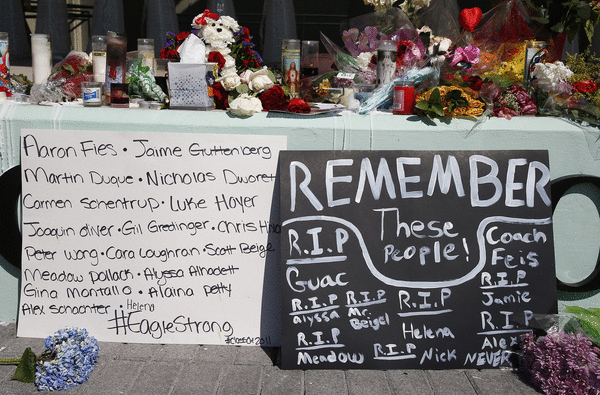
As the U.S. struggles with how to respond to the violent actions of federal immigration enforcement agents, it’s a good time to remember how one small Florida community turned its tragedy into a national movement.
Eight years ago on Valentine’s Day, a mentally unstable 19-year-old brought his legally obtained AR-15 semi-automatic rifle to his former high school and went on a shooting spree.
Nikolas Cruz entered Marjory Stoneman Douglas High School in Parkland 20 minutes before the bell rang and shot four students in a hallway. He then blasted through the windows of a classroom and gunned down the athletic director, the football coach and several confused students scrambling for cover.
As Cruz stood in the third-floor teacher’s lounge and watched students fleeing below, he raised his rifle and took aim again. But his bullets wouldn’t penetrate the hurricane-proof glass. He dropped his rifle and fled with the crowd, blending in with his JROTC polo shirt.
The massacre took four minutes, killed 17 and wounded 17 more. It was the deadliest high-school shooting in U.S. history. And it underscored how unprepared Florida was for the violence that had become too common on America’s school campuses.
From my vantage point as a Florida statehouse reporter, the timing was also remarkable. It occurred in the middle of a legislative session in a midterm election year during Donald Trump’s first term, and the Republican-led legislature was on the defensive.
Florida lawmakers had spent years passing some of the nation’s strongest pro-gun measures sought by the then-powerful National Rifle Association. Police had been warned of Cruz’s violent tendencies but could do nothing. The Parkland survivors were demanding reform.
As the school was still blocked off with police tape, two Democratic legislators invited their Republican colleagues to visit the school and see the carnage. The lawmakers described how they were haunted — by Valentine carnations still sticking in abandoned backpacks and the blood-splattered halls.
One week after the shooting, 100 Parkland students boarded buses for Tallahassee to lobby state lawmakers for stricter gun laws. They spent the day camping out in legislative offices, pleading with them to listen. “Our message is very simple,” a 16-year-old sophomore told me: “Never again.”
In three weeks, the students and parents of Parkland accomplished what I’d watched three decades of gun control activists fail to do. They beat the Florida gun lobby and forced an intransigent legislature to act. Lawmakers raised the age to possess a firearm from 18 to 21, banned bump stocks, and imposed a “red flag” law allowing police to confiscate guns from people deemed to be a threat.
But the students didn’t stop there. Their fearless calls for action galvanized public support, and they used that momentum to mobilize thousands of students in a national school walkout. They conceived and led March For Our Lives, a gun-safety movement that registered voters and engaged young people in political activism across the globe.
Exactly one month and 10 days after the shooting that had shattered their town, the students of Marjory Stoneman Douglas were rallying outside the Capitol in Washington before some 800,000 supporters in one of the largest public demonstrations in American history. Sister marches took place across the country and around the world.
The movement paid political dividends. Gun safety became a defining issue for the midterm elections, and turnout among voters ages 18–29 rose substantially. The youth vote helped carry Joe Biden into the White House and persuaded Congress to pass the Bipartisan Safer Communities Act, which directed hundreds of millions of dollars into gun violence prevention and led to a dramatic reduction in the overall gun homicide rate, according to White House data. And the Republican leaders who supported the Florida gun reforms got reelected.
But today, there’s a sad coda to this story. Three of the leading organizers who helped mobilize their generation eight years ago told me that if the shooting were to happen now, they could not accomplish what they achieved then.
“Under no circumstances would it have come even close,” said Cameron Kasky, the Parkland survivor who famously confronted then-Senator Marco Rubio about accepting NRA money during a televised town hall in 2018. “The world was a completely different place.”
Social media now chips away at everybody’s attention spans, he said. The Trump administration has so effectively “flooded the zone” with reports of ICE raids, international grievances, and a steady stream of norm-shattering outrages, he told me, that it leaves “no room for tragedies to bear the weight that they should.”
“The Republican Party of the Parkland era still had this sense of virtue signaling, where they did feel pressure to act as though they have any consideration for innocent lives,” Kasky continued. “Now, they’re shooting people in the back of the head and proudly touting that they knocked out a domestic terrorist.”
“Moral courage is in short supply,” agreed David Hogg, the student leader who recorded his first video calling for stronger gun laws as he was squeezed in a closet with other Parkland students. The social media environment and political persecution of administration critics make policy change more difficult than ever right now, he said.
And Florida lawmakers want to go backward, too. The Florida House recently passed a bill to repeal the 21-year minimum age to buy a high-powered weapon.
Jackie Corin, the Marjory Stoneman Douglas junior who came up with the idea of bringing busloads of students to the state Capitol, said of their moment, “We had lightning in a bottle.”
But each of them told me that Americans need to remember what their experiences taught them.
Corin, who returned to March for Our Lives last year to serve as its executive director, said she reminds people: “The thing that always got people to turn their heads was us telling our story. Survivors have a moral authority that makes people stop and listen.”
“Change is possible,” Hogg told me. “I used to think if somebody doesn't agree with everything that I’m saying about guns, that I’ve failed. But I realize now half the battle is just getting them to see you as a human being and figuring out what small amount of agreement you do have.”
In year when many Americans are bravely standing up to a power-hungry regime while others capitulate to it, the students of Parkland offer an important lesson: While they lost their innocence, they found their moral urgency. They showed America that elected officials can be shamed into doing what’s right. As long as they are confronted with enough people who have moral conviction and passion, it can be done.
____
This column reflects the personal views of the author and does not necessarily reflect the opinion of the editorial board or Bloomberg LP and its owners.
Mary Ellen Klas is a politics and policy columnist for Bloomberg Opinion. A former capital bureau chief for the Miami Herald, she has covered politics and government for more than three decades.
©2026 Bloomberg L.P. Visit bloomberg.com/opinion. Distributed by Tribune Content Agency, LLC.















Comments