Commentary: The world rewards Iran's bloodiest crackdown with diplomacy
Published in Op Eds
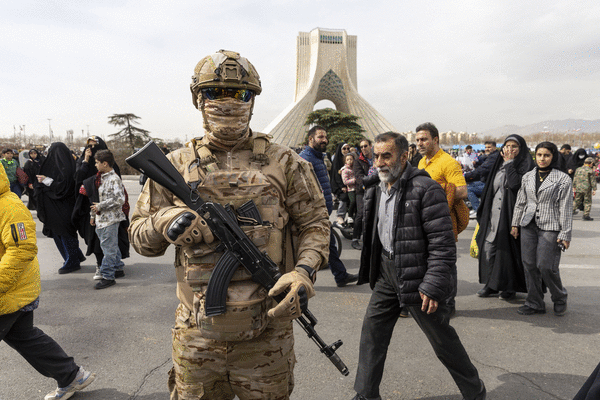
One month has passed since Iran’s bloody crackdown, and Iranians — inside the country and abroad — have been left among the most defenseless people facing a ruling power, watched over by a world that largely remained a spectator.
Since the 1979 revolution, Iranians have endured waves of brutal repression: the mass political executions of the 1980s, the killings during the Green Movement, the November 2019 protests and the nationwide uprising following the killing of Mahsa Amini. Yet even with this long history of violence, neither those who watched from afar nor those who took to the streets anticipated repression on this scale.
I spoke with an elderly man whose son and grandson called him the night of Jan. 18 and said, “Let’s go together to the demonstration.” He described crowds pouring in from every direction toward the main street. Encouraged by messages from figures such as Reza Pahlavi and President Donald Trump suggesting that help was on the way, many genuinely believed the regime was approaching its final moments. The belief was simple: Gather in the streets and finish it. Then the Islamic Revolutionary Guard Corps opened fire.
People were killed in large numbers before their eyes, the elderly man told me. As they tried to flee, security forces advanced through side streets, firing indiscriminately. “It was as if we were a foreign enemy,” he said.
This account mirrors countless others from those nights. While the scale of violence exceeded expectations, the belief that international support was imminent undeniably emboldened many protesters. They confronted the regime’s forces with a level of courage that proved tragically costly.
Media outlets documented bodies in the streets, wounded protesters executed with so-called “mercy shots,” doctors and medical workers arrested for providing treatment and detainees now facing death sentences. Even today, families continue searching for loved ones, uncertain whether they are imprisoned or dead.
Yet the promised help never arrived.
Instead, what has emerged are negotiations between Iran and the United States in Muscat, Oman. The first round reportedly took place on Feb. 6, involving Iran’s foreign minister, U.S. envoy Steve Witkoff and even the commander of U.S. Central Command. As in past encounters, Tehran sought to avoid direct talks, opting instead for indirect exchanges through intermediaries.
On Tuesday, Ali Larijani — a senior member of Iran’s National Security Council and a close ally of Supreme Leader Ayatollah Ali Khamenei — arrived in Muscat to conduct parallel consultations. At the same time, Israeli Prime Minister Benjamin Netanyahu traveled to the United States to meet with Trump to discuss the negotiations’ implications.
Inside Iran, memorials for those killed continue across the country. The Iranian public, meanwhile, watches these diplomatic maneuvers in shock.
The Islamic Republic, having convinced itself it has “won” the protest cycle, now appears to have succeeded in something even more consequential: compelling the international community into silence in the face of mass killing. Domestically, arrests have intensified. Several reformist figures have been detained in recent days. Nobel Peace Prize laureate Narges Mohammadi— arrested weeks earlier — now faces an additional seven years in prison.
Once again, Khamenei’s governing logic has prevailed: maximum repression at home combined with engagement abroad. Internet shutdowns, mass arrests, intimidation through mourning and fear have crushed public mobilization — while negotiations with powerful states restore the regime’s standing on the global stage.
At present, Iran appears devoid of the social capacity needed to sustain street protests. Society is gripped by disbelief, collective trauma and the aftermath of more than 30,000 deaths.
Outside Iran, Gulf states are exerting intense pressure to prevent regional war. U.S. Sen. Lindsey Graham has even warned Turkey against attempting to preserve Tehran’s repressive regime in the name of stability.
All eyes now rest on the U.S.-Iran talks. If negotiations proceed, they risk retroactively legitimizing the bloodshed and broken promises that encouraged people into the streets. If they fail, the specter of war looms — once again threatening civilians first.
Some argue that limited military action targeting the Revolutionary Guard and security infrastructure — while sparing civilians — may be the only remaining path to ending this authoritarian system. Others fear any escalation will deepen human suffering.
Meanwhile, at press time, Iranians abroad were preparing for large demonstrations on Feb. 14 in Munich, Los Angeles and Toronto, with Pahlavi expected to attend. These rallies may amplify voices from inside Iran — but none will shape the regime’s fate as decisively as Western accommodation of Tehran.
The most painful lesson Iranians must confront after this massacre is clear: Relying on foreign intervention for rapid salvation is neither reliable nor sustainable. What remains essential — however daunting — is collective organization and internal solidarity among people who now know that even the smallest act of protest will be met with ruthless force.
Whether negotiations can restrain Iran’s regional proxies or whether Tehran’s long-range missile capabilities are deemed too dangerous to confront — thus preserving the regime in the name of regional stability — remains the central question.
The tragedy unfolding in Iran exposes a recurring and dangerous pattern in international politics: When repression succeeds, it is rewarded with diplomacy. The Islamic Republic has demonstrated that mass violence against civilians can be followed not by isolation but by negotiation — sending a devastating signal not only to Iranians but to authoritarian regimes everywhere.
Western governments face a choice that extends far beyond Iran’s nuclear program. They can pursue short-term de-escalation while tacitly endorsing internal repression, or they can recognize that sustainable stability cannot be built on the graves of civilians. Negotiations divorced from accountability risk entrenching authoritarianism and teaching regimes that bloodshed is merely a prelude to diplomatic rehabilitation.
For Iranians, the lesson is bitter but unavoidable: Change will not arrive from conference rooms in Muscat or Washington. Yet for the international community, the lesson is equally stark. Appeasement in the face of mass repression does not prevent conflict — it postpones it, while ensuring a far higher human cost down the road.
____
Pegah Banihashemi, a native of Iran, is a legal scholar and journalist in Chicago whose work focuses on human rights, constitutional and international law, and Middle East politics.
___
©2026 Chicago Tribune. Visit at chicagotribune.com. Distributed by Tribune Content Agency, LLC.






































Comments