Editorial: Trump's DHS order is a good step toward de-escalation
Published in Op Eds
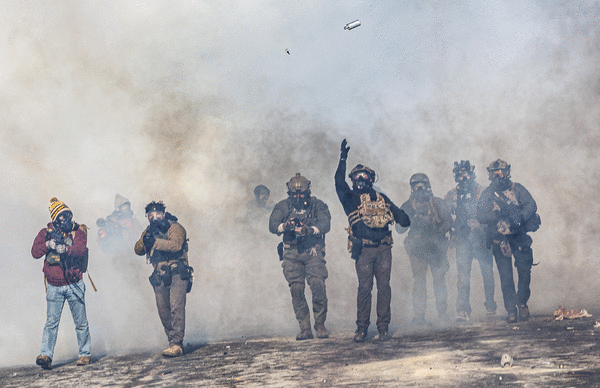
At moments of protest and volatility, public trust depends on clarity: who is responsible, who is accountable and who answers to the people on the ground. That is why the decision to request federal assistance should rest solely with state and local officials, except in rare crises or in the narrow circumstance where federal property or personnel are directly threatened.
This principle is not ideological. It is constitutional and practical.
Local and state leaders are elected by, and answerable to, the communities experiencing unrest. They understand local tensions, histories and fault lines in ways federal agencies cannot. When they determine that outside help is necessary, federal support can be additive and legitimate. When federal forces arrive uninvited, however, they risk being perceived not as stabilizers, but as occupiers regardless of intent.
Recent protests following aggressive federal deployments have illustrated this danger. Rather than calming tensions, unilateral federal involvement has often intensified demonstrations, deepened mistrust and blurred lines of responsibility. In volatile environments, perception matters as much as policy. When citizens no longer know who is in charge or why, order deteriorates quickly.
That is why President Donald Trump’s directive limiting Department of Homeland Security involvement in protests — unless requested by state leaders or when federal property is threatened — is a positive development that affirms an important restraint on federal power. It emphasizes that Washington should not substitute itself for local governance, especially in politically sensitive moments.
Clear lines of authority reduce violence. Confusion multiplies it.
There is also a deeper democratic concern. Federal law enforcement, when deployed without coordination or consent, risks being viewed through a partisan lens. That perception, fair or no,t undermines confidence not only in policing but in the neutrality of federal institutions themselves. Once law enforcement is seen as political, legitimacy collapses, and every action becomes suspect.
None of this argues for inaction in the face of real threats. When federal property is endangered, or when state leaders request assistance, the federal government has both the authority and the obligation to respond. But restraint is not weakness. It is discipline.
De-escalation begins with respect for constitutional boundaries. It depends on cooperation, not command; support, not substitution. The goal is not merely to restore order, but to preserve trust, because without trust, peace is temporary and violence returns.
In times of unrest, the most powerful tool government possesses is not force, but legitimacy. And legitimacy begins by knowing when not to intervene.
_____
©2026 The Baltimore Sun. Visit at baltimoresun.com. Distributed by Tribune Content Agency, LLC.



















































Comments