Commentary: Iran's crisis is a test of US moral leadership
Published in Op Eds
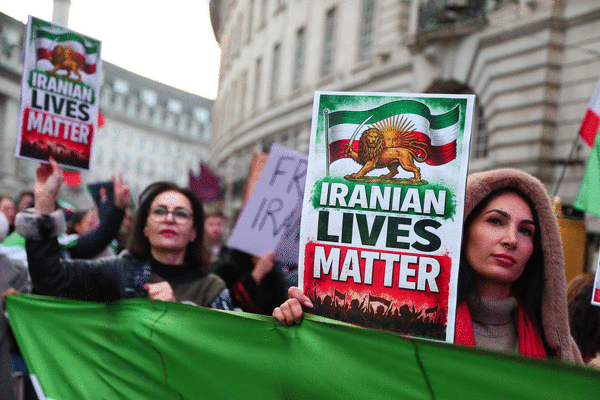
Right now, as you read this, Iranian protesters are facing live ammunition in Tehran’s streets. Women risk execution for removing their hijabs. Some 12,000 to 20,000 people are feared dead from the protest crackdown. The regime is vulnerable, weakened by strikes on its nuclear program, facing economic collapse, confronting a population that has repeatedly chosen death over submission. The window to support regime change is open. But it’s closing fast.
The Trump administration made commitments to the Iranian people. Now, facing the moment of decision, there’s troubling hesitation. This isn’t just another foreign policy challenge: It’s a binary test of whether American leadership still possesses the will to act on its stated principles. Fail here, and we confirm that international relations have lost their moral compass entirely.
Harvard’s Joseph Nye taught that foreign policy morality requires integrating intentions, means and consequences. Good intentions without adequate implementation produce catastrophic outcomes. We’ve stated our intentions. The question is whether we’ll employ the means — or allow bureaucratic caution and geopolitical calculation to paralyze us until the opportunity passes.
The Iranian regime is a 47-year totalitarian theocracy that has terrorized its population, sponsored terrorism from Hezbollah to Hamas to the Houthis, supplied drones to Russia for killing Ukrainian civilians and pursued nuclear weapons while declaring itself America’s mortal enemy. Supreme Leader Ali Khamenei has ordered protesters “put in their place.” The judiciary announced all participants will be tried for moharebeh— “enmity against God” — a capital offense.
Yet the international left remains conspicuously silent, frozen in power analysis and identity politics. In too many minds around the world, Iranian protesters fail to generate solidarity because their oppressors — the mullahs — are classified as victims of Western imperialism.
Consider the Tudeh Party — Iran’s communist left. As protesters face bullets, they condemn the demonstrations while warning against American imperialism. Some progressive Iranian American academics have dismissed calls for change as Westernized and illegitimate. They use anti-imperialism to silence Iranians demanding their God-given rights. When ideology replaces principle, you get moral blindness masquerading as sophistication.
The stakes transcend Iran. Since the modern nation-state system was organized by the Treaty of Westphalia in 1688, state sovereignty has been the bedrock of international law. But it’s become a shield for regimes that brutalize their populations. The post-1945 American-led international order assumed sovereign states would protect citizens’ basic rights and that the international community would act when they did not. We face a choice: sovereignty conditional on protecting citizens, or cynical realism where might makes right.
What’s required is clear. First, an unambiguous statement that the U.S. supports the Iranian people’s right to choose their government and will not accept continued mullah rule. Second, escalating sanctions targeting the regime’s economic foundations while ensuring humanitarian aid reaches Iranians. Third, robust communications infrastructure support so protesters can coordinate despite attempts at censorship. Fourth, diplomatic isolation and coalition-building. Fifth, material support for opposition forces sufficient to tilt the balance.
The question is whether the Trump administration recognizes this as a defining test — whether it understands that failure here signals to every authoritarian regime that the West lacks resolve, to every oppressed population that American principles are empty rhetoric, to every ally that American commitments are negotiable.
If we allow the window to close — if bureaucratic hesitation or fear of opposition paralyzes us — the regime will reconsolidate. It will crush the protests with even greater brutality. It will execute thousands more. And it will emerge convinced that the West lacks the will to oppose it meaningfully. Every adversary will be emboldened. Every ally will question our word.
But if we act — if we follow through with real support for removing the mullahs — we affirm that moral principles still matter in international affairs. We demonstrate that the Judeo-Christian foundations of American order remain vital and actionable. We show that universal human dignity still commands our allegiance, that freedom is still worth defending at cost and risk.
The American founders understood rights as flowing from the Creator, not the state. They established a republic acknowledging transcendent moral law as the foundation of human law. Thomas Jefferson recognized that resistance to tyranny is obedience to God. The Iranian people are asking us to honor these principles — not abstractly, but concretely.
Protesters have risen despite knowing the cost. They’ve demanded freedom despite facing torture and execution. They’ve trusted that America stands for something beyond geopolitical calculation. The time for decision is now. Not next month, not after more studies, not when conditions are perfect. Now. And on that decision hangs not only Iran’s fate but also the moral credibility of the entire international order we claim to defend.
We can support the Iranian people’s efforts to remove the mullahs, or we can watch another opportunity for freedom slip away while we hesitate. History will record which we chose.
____
Daniel J. Arbess is founder of Xerion Investments, a lifetime member of the Council on Foreign Relations and a co-founder of No Labels, a political group promoting bipartisan collaboration.
_____
©2026 Los Angeles Times. Visit at latimes.com. Distributed by Tribune Content Agency, LLC.

































Comments