Beth Kowitt: Target's ICE response shows corporate America's overcorrection
Published in Op Eds
When Donald Trump was elected president of the United States in November 2024, corporate America took it as yet another sign that it had misjudged the political landscape. Many companies scrambled to roll back whatever remained of their DEI efforts and watered down sustainability goals. Executives apologized for past corporate activism, saying they had gone too far and promised to root out “wokeness” from their cultures.
The moves were designed to appease the new administration and avoid its wrath. But they were also attempts to realign with where management teams believed broader society had moved — sharply toward Trump and to the right.
A year or so later, signs are emerging that corporate America’s attempted recalibration has turned into an overcorrection. And the clearest example of how executives misread the room is playing out right now in Minneapolis as ICE roils the city.
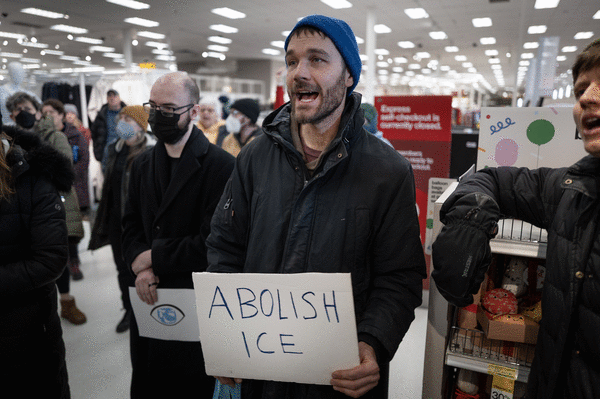
Start with national retailer Target Corp., one of the largest employers in its hometown of Minneapolis. In the entryway vestibule of its store in the suburb of Richfield, an employee was tackled by ICE agents and hauled off in a van while shouting that he was a U.S. citizen. In the widely circulated video, you see an unsuspecting customer nearly caught up in the scuffle. Ultimately, two Target employees were taken by ICE during the episode; both were U.S. citizens, a local lawmaker said, and were later released. (The Department of Homeland Security said one of the individuals was arrested in connection with “assaulting, resisting, or impeding federal officers.”)
What does Target have to say about all this? No comment. Its executives might think their silence is broadcasting neutrality, but to customers and employees it more likely suggests cooperation or collusion — a position that puts the company very much at odds with public sentiment.
It also does not help the broader crisis in trust toward corporate America. A recent Gallup poll found that the share of Americans who view business as the biggest threat to the U.S. matches a high that was last hit more than two decades ago.
A staggering 69% of Americans have watched the video of an ICE agent fatally shooting Renee Good, according to an Economist/YouGov poll, and more consider the shooting unjustified than justified by a 20 percentage-point margin. “The data suggests that the more Americans see, the less they like,” Peter Hamby wrote in Puck News regarding ICE’s tactics. As Hamby reports, ICE’s net favorability among Americans has swung 30 points to negative 14 since Trump was inaugurated. A full 46% support abolishing ICE — a position that not all that long ago was viewed as a far-left rallying cry.
Despite the data, Target’s no-response response is the predominant strategy across America’s C-suites right now: stay quiet on controversial issues or cultural flashpoints. For Target in particular, silence is part of its ongoing efforts to neutralize its image as a progressive and inclusive company, a position it cultivated until it became a liability with the right. However, its reversal has hurt both its business and reputation; the company slipped from No. 17 on Fortune’s World’s Most Admired Companies ranking in 2021 to No. 27 last year. Its shares have slid 42% over the past year as the S&P 500 Index gained about 77%.
But for Target, ICE is no longer a political or culture-war issue that can simply be ignored — not once violence happens in one of your stores and makes national headlines. That distinction is one the retailer could have made in a statement. It could have said that it does not coordinate with ICE but it must comply with the law — meaning it can’t keep federal agents out of public spaces like its stores and parking lots. It could have said it requires warrants if agents want to access private spaces like back offices. It could have explained how it’s supporting the affected workers and its plans to keep staff and customers safe going forward. Such a public statement wouldn’t just be for its customers, but also for employees who likely now feel disheartened to work for a company that won’t stand up for its people.
Like Target, hotel chain Hilton Worldwide Holdings Inc. seems to have either missed or ignored the public mood. After DHS accused one of its Hampton Inn franchisees of canceling a booking made by its agents, Hilton issued a standard statement saying its hotels are “welcoming places for all” and that the franchisee had violated its policies. That’s certainly a defensible policy position. But Hilton then went a step further, calling its franchisee’s action discriminatory and turning the whole thing into a spectacle by requiring the offending Hampton Inn remove its signage.
It’s worth considering whether the Hilton of six years ago would have responded the same way. In 2020, after reports showed one of its franchisees had housed migrants detained by the government, the company put out a statement saying that this “is not activity that we support or in any way want associated with our hotels.”
What’s happening on the ground in Minneapolis, where protestors have clashed with law enforcement and citizens are forming community patrols, has only further amplified corporate America’s inaction. As Alison Taylor, a professor at New York University’s Stern School of Business, recently wrote on her Substack, one of the prime lessons of the last few weeks “is that ordinary people are much more willing to challenge ethically egregious government actions than powerful corporations.”
Companies may say they’re just staying out of politics. But when they refuse to speak as federal agents create danger and chaos in their workplaces, silence starts looking complicit rather than cautious.
_____
This column reflects the personal views of the author and does not necessarily reflect the opinion of the editorial board or Bloomberg LP and its owners.
Beth Kowitt is a Bloomberg Opinion columnist covering corporate America. She was previously a senior writer and editor at Fortune Magazine.
_____
©2026 Bloomberg L.P. Visit bloomberg.com/opinion. Distributed by Tribune Content Agency, LLC.
















































Comments