Commentary: Meta revolutionizes commercial nuclear energy
Published in Op Eds
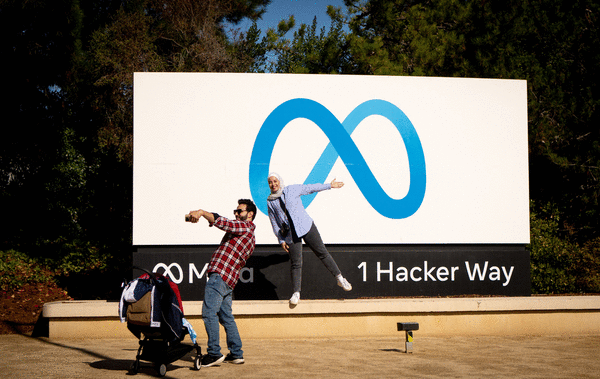
“The biggest risk is not taking any risk,” as Mark Zuckerberg famously put it. Judging from Meta Platforms, Inc, parent company of Facebook, announcement that it’s investing in new nuclear energy -- supporting up to 6.6 Gigawatts-- he wasn’t kidding. The plan includes two plant life extensions, three power expansions, and two advanced reactor designs.
That’s enough electricity to power nearly 5 million homes. Much of this will be used to power Meta’s operations, but the benefits to everyday Americans could be enormous.
For example, Meta’s investment expands the electricity pie, which is critical since electricity demand is on the upswing. Adding grid power protects American families from competing with industry for limited electricity. Instead, more electricity will be produced for everyone, which is essential for American competitiveness, lowering prices, and creating more jobs.
Yet that’s not even the exciting part. If successful, it could unleash a massive expansion of new infrastructure, technology, and energy that could drive the nation to new plateaus. American business has the capital, the technology, and the drive to do this, but no one has forged a path to success. Meta’s plan might be that.
A major challenge in modern America is that building new energy infrastructure is difficult and building new commercial nuclear infrastructure is nearly impossible. This is because of burdensome regulation, costly permitting processes, special interest opposition, market distorting subsidies, and public policy uncertainty.
This led to poor investment decisions that had been going on for decades, but that politically driven energy spending massively expanded over the past 15 or so years. This ultimately weakened U.S. energy infrastructure to the point that America now faces threats of energy shortages. Simultaneously, the nation is facing major power demand growth and the result is an emerging energy crisis.
While building new nuclear plants seems like a good solution, it is not that easy. Any project to commercialize new technology faces significant financial and technological risks. Such risks are amplified by misguided public policy, burdensome regulation, and market distorting subsidies — risks that become untenable when project costs reach hundreds of millions or billions of dollars. The result is that nothing gets built.
President Donald Trump, who was elected on a platform of lowering electricity costs, has issued several Executive Orders to challenge almost every aspect of the nuclear regulatory establishment. One result is growing enthusiasm for nuclear energy. But enthusiasm doesn’t power homes. The federal government has made building nuclear power plants so difficult for so long that no one wants to be the first to build one, regardless of regulatory and policy reforms.
This is why Meta’s announcement is potentially different and offers strong reason for optimism.
Most importantly, the announcement was driven by demand for electricity. Meta needs access to reliable and clean electricity to support its growing operations, and the electricity supply was insufficient. So, Meta issued a Request for Proposal to find additional suppliers. Because Meta is risking its own money, applicants were judged based on their ability to meet Meta’s tangible economic objectives. This merit-based, competitive process is essential in pushing any new industry forward -- and merit is often secondary at best when Uncle Sam is making the decisions.
Further, power plants are built to sell electricity, and thus electricity supply and demand will ultimately define the economics of those projects. Meta’s plants will be built to supply, in large part, electricity for industrial purposes. Electricity is not the consumer good. It is an input along the supply chain. This changes the economics substantially.
Importantly, Meta exhibits an entrepreneurial spirit that is necessary for any emerging technology. It is not just the classic story of turning an idea into a massive business, it’s the willingness to take risks along the way that catapults it to success. Whether virtual reality or artificial intelligence, both of which come with uncertain payoffs, Meta has shown a willingness to invest tens of billions of dollars to ensure its future success.
But it is not just about Meta. TerraPower and Oklo, the reactor design companies chosen to build new reactors, share DNA with the nimble, competitive and entrepreneurial tech world. This brings new thinking around how power plants are built and operated and ensures that plenty of capital will be available as challenges arise, which they certainly will. They will put a premium on operational efficiency and won’t stand for government bureaucrats getting in the way. They have no choice if they want to stay competitive, and from all indications, they do.
It’s that competitive drive, entrepreneurial spirit, access to capital and new thinking that makes the Meta announcement potentially transformational. If anyone can successfully build those first one, two, and three reactors, it will be a company like Meta working with companies like Terrapower and Oklo.
New nuclear power needs pioneers to prove that nuclear is profitable. Once that happens, the commercial Nuclear Revolution will have begun.
____
Jack Spencer is a Senior Research Fellow for Energy and Environment in the Heritage Foundation’s Center for Energy, Climate, and Environment and the author of Nuclear Revolution: Powering the Next Generation (Optimum Publishing International, 2024).
_____
©2026 Tribune Content Agency, LLC.





































Comments