Commentary: The Cuban people's resilience is a strength but also a trap
Published in Op Eds
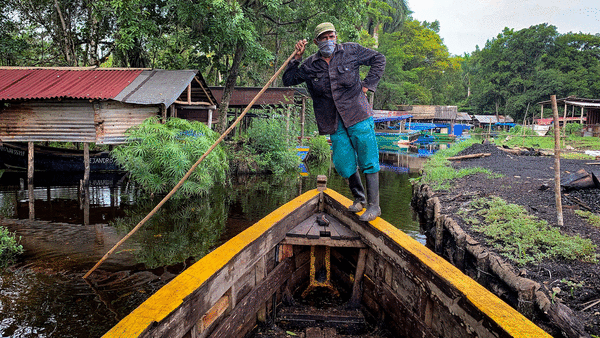
When I heard President Donald Trump boast early this month that Cuba, without the aid of a decapitated Venezuela, appears “ready to fall,” I immediately thought of Joseito, a Cuban man in his mid-30s I got to know a few years ago while doing research for a book. He lived in Havana with his wife and two young daughters in the rooms adjacent to his mother, Lili, a die-hard communist. Joseito doesn’t share his mother’s loyalty to the revolution, but with two small children, he can’t just leave.
Joseito wrestled a living out of repairing furniture. His biggest challenge, he told me many times, was simply procuring the materials he needed. So, as I’ve seen many Cubans do, he adapted to the shortages inherent in the centrally controlled Cuban economy by improvising. He carefully removed nails and screws and reused them. He scavenged crates and pallets for linear lumber to repair chairs and sofas. And astonishingly, he searched around Havana for discarded tires that he ingeniously converted into straps to form a replacement web for sagging sofa seats and chairs.
Joseito, and the many other Cubans like him whom I’ve met, are the reason that I’m not at all convinced that Cuba is ready to fall. For all the admiration I feel for Cubans and their resilience in the face of troubling conditions that only ever seem to get worse, it is clear to me that their greatest strength also creates their most precarious weakness. It is their ability to adapt, as Joseito does, that has given them the strength to survive the 60-plus years of Fidel Castro’s failed revolutionary promises.
They’ve learned how to cannibalize cars to keep their fabulous ’50s convertibles on the road — just don’t look too closely at the rust spots on the fenders or the bastardized Chinese parts under the hood. Shortage of beef? They devised a way to roast grapefruit skins to resemble steak. Cuban women discovered that the inky innards of batteries can double as hair dye. Nothing is disposable there, and everything is reused. One-liter plastic soda bottles do nicely as replacements for leaky motorcycle gas tanks.
Cutting off Venezuela’s vital oil surely will make Cubans more miserable than they already are. For years they’ve lived with long blackouts, which they call apagones in Spanish. But they have grown so common, and so long-lasting, that Cubans sarcastically now celebrate alumbrones, the brief hours when the lights can be turned on. They’ll figure out a way to deal with the coming belt-tightening without pulling down the government the way Washington envisions. When people have so little, few will risk losing it by attracting the wrath of the government.
Only twice has there been anything like a popular uprising. Once in 1994, during the so-called Periodo Especial after the collapse of the Soviet Union ended the billions in subsidies that kept the Revolution afloat. And again in 2021, when Cubans linked by their cellphones took to the street to let out their rage.
Both times, the Castro government quickly shut down the protests, and the people’s misery resumed unabated. There is only one political party in Cuba. There are no organized groups of dissent. Those who protest are jailed. Those who tire of protesting leave. There are no guns, no opposition media, no land border across which a revolt can be organized.
Although more than 2 million Cubans have fled the island since 2020, many loyalists who are living off the regime remain, and they have too much to lose to just turn on the leftist gerontocracy that continues to pull the strings. The regime has successfully co-opted the Army, the one Cuban institution that is still functioning, by putting generals in charge of tourist hotels and directing tourism revenue toward supporting the armed forces.
Another reason that people on the street may reluctantly resist change is that many fear that closing the door on the Castro era would open the way for the Cuban diaspora in Miami to return and reclaim what had once been theirs. There are also racial tensions as the majority Black and mixed-race Cubans on the island worry about the wealthy, mostly white expatriate Cubans once again being in charge.
Most likely, it will take a push from outside to bring down the six-decade-old Castroite system. If, how and when are unknowns. For now, as the nation becomes poorer without Venezuelan trade, loyalists such as Joseito’s mother, Lili, will continue keeping an eye on dissenters. And the resilience of Cubans such as Joseito will continue to be tested. When he runs out of bald tires to recycle, he’ll find some other way to get what he needs — while wishing that he and his family were somewhere else.
____
Anthony DePalma, a former New York Times foreign correspondent, is the author of several books, including “The Cubans: Ordinary Lives in Extraordinary Times” and the forthcoming “On This Ground: Hardship and Hope at the Toughest Prep School in America.”
©2026 Los Angeles Times. Visit at latimes.com. Distributed by Tribune Content Agency, LLC.


























Comments