Commentary: With high deductibles, even the insured are functionally uninsured
Published in Op Eds
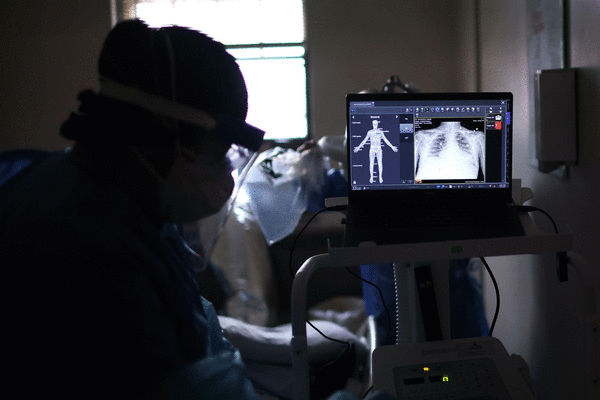
I recently saw a patient complaining of shortness of breath and a persistent cough. Worried he was developing pneumonia, I ordered a chest X-ray — a standard diagnostic tool. He refused. He hadn’t met his $3,000 deductible yet, and so his insurance would have required him to pay much or all of the cost for that scan. He assured me he would call if he got worse.
For him, the X-ray wasn’t a medical necessity, but it would have been a financial shock he couldn’t absorb. He chose to gamble on a cough, and five days later, he lost — ending up in the ICU with bilateral pneumonia. He survived, but the cost of his “savings” was a nearly fatal hospital stay and a bill that will quite likely bankrupt him. He is lucky he won’t be one of the 55,000 Americans to die from pneumonia each year.
As a physician associate in primary care, I serve as a frontline witness to this failure of the American approach to insurance. Medical professionals are taught that the barrier to health is biology: bacteria, viruses, genetics.
But increasingly, the barrier is a policy framework that pressures insured Americans to gamble with their lives. High-deductible health plans seem affordable because their monthly premiums are lower than other plans’, but they create perverse incentives by discouraging patients from seeking and accepting diagnostics and treatments — sometimes turning minor, treatable issues into expensive, life-threatening emergencies. My patient’s gamble with his lungs is a microcosm of the much larger gamble we are taking with the American public.
The economic theory underpinning these high deductibles is known as “skin in the game.” The idea is that if patients are responsible for the first few thousand dollars of their care, they will become savvy consumers, shopping around for the best value and driving down health care costs.
But this logic collapses in the exam room. Health care is not a consumer good like a television or a used car. My patient was not in a position to “shop around” for a cheaper X-ray, nor was he qualified to determine if his cough was benign or deadly. The “skin in the game” theory assumes a level of medical literacy and market transparency that simply doesn’t exist in a moment of crisis. You can compare the specs of two SUVs; you cannot “shop around” for a life-saving diagnostic while gasping for air.
A 2025 poll from the Kaiser Family Foundation points to this reality, finding that up to 38% of insured American adults say they skipped or postponed necessary health care or medications in the past 12 months because of cost. In the same poll, 42% of those who skipped care admitted their health problem worsened as a result.
This self-inflicted public health crisis is set to deteriorate further. The Congressional Budget Office estimates roughly 15 million people will lose health coverage and become uninsured by 2034 because of Medicaid and Affordable Care Act marketplace cuts. That is without mentioning the millions more who will see their monthly premiums more than double if premium tax credits are allowed to expire.
If that happens, not only will millions become uninsured but also millions more will downgrade to “bronze” plans with huge deductibles just to keep their premiums affordable. We are about to flood the system with “insured but functionally uninsured” patients.
I see the human cost of this “functional uninsurance” every week. These are patients who technically have coverage but are terrified to use it because their deductibles are so large they may exceed the individuals’ available cash or credit — or even their net worth.
This creates a dangerous paradox: Americans are paying hundreds of dollars a month for a card in their wallet they cannot afford to use. They skip the annual physical, ignore the suspicious mole and ration their insulin — all while technically insured. By the time they arrive at my clinic, their disease has often progressed to a catastrophic event, from what could have been a cheap fix.
Federal spending on health care should not be considered charity; it is an investment in our collective future. We cannot expect our children to reach their full potential or our workforce to remain productive if basic health care needs are treated as a luxury. Inaction by Congress and the current administration to solve this crisis is legislative malpractice.
In medicine, we are trained to treat the underlying disease, not just the symptoms. The skipped visits and ignored prescriptions are merely symptoms; the disease is a policy framework that views health care as a commodity rather than a fundamental necessity.
If we allow these cuts to proceed, we are ensuring that the American workforce becomes sicker, our hospitals more overwhelmed and our economy less resilient. We are walking willingly into a public health crisis that is entirely preventable.
____
Joseph Pollino is a primary care physician associate in Nevada.
_____
©2026 Los Angeles Times. Visit at latimes.com. Distributed by Tribune Content Agency, LLC.











































Comments