Jennifer Brooks: For Minneapolis, ICE killing evokes familiar fear, pain
Published in Op Eds
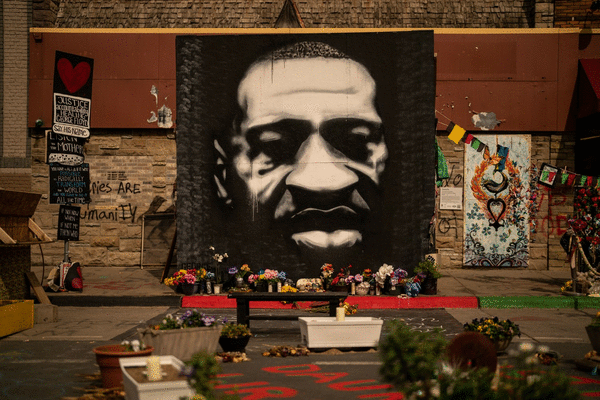
Renee Nicole Good. George Floyd. Different tragedies, but the same grief for a community betrayed by the people who were supposed to protect and serve.
Crowds gathered again in Minneapolis on Wednesday, Jan. 7, marching through the same streets where some of them were protesting five and a half years ago after Floyd’s murder.
The full force and fury of the federal government landed on Minnesota last week.
“You will be held accountable for your crimes,” Homeland Security Secretary Kristi Noem said Jan. 6, as the largest immigration enforcement action in agency history surged into the state. It felt like she was addressing all Minnesotans, not just the handcuffed man she paraded before the cameras.
Minnesotans reeled as masked ICE agents descended on the state. They said they’d come to root out fraud. They tackled people to the ground in city parks and harassed parents and children on the way to school.
They shot and killed a 37-year-old woman who would still be alive if ICE had never come to town.
“Get the fuck out of Minneapolis,” said Mayor Jacob Frey, who remembers Memorial Day 2020 when a police officer murdered a man on camera as neighbors pleaded with him to stop kneeling on the helpless man’s neck.
Five and a half years ago, police tried to pass Floyd’s murder off as a “medical incident.”
On Jan. 7, Noem accused a dead woman — killed by an agent who fired into her vehicle, on camera, at point-blank range — of being “a domestic terrorist.” The president claimed on social media that Good had run over the agent who shot her, despite clear video evidence from other angles that this was untrue.
But this is the same administration that once tried — and failed — to level a felony assault charge against a man who hurled a salami sub at a Customs and Border Enforcement agent in D.C.
Five and a half years ago, protesters gathered and law enforcement pushed back with mace and foam bullets. The crowd marched from 38th and Chicago to the Third Precinct police station. For days, the violence escalated until the precinct was in flames, until Lake Street was burning, until the whole city smelled like smoke and tear gas and grief.
Minneapolis rebuilt. Minneapolis was trying to move on. Until the president of the United States started calling Minnesotans “garbage.” Until the federal government put the city in its crosshairs.
But the killing of George Floyd didn’t end in the smoldering rubble of the Third Precinct. It ended in a courtroom.
Derek Chauvin, who knelt on George Floyd’s neck for nine and a half minutes, was put on trial and convicted of murder. He went to jail, along with three other officers who stood by and did nothing to stop him. He’s still in jail. Killing a Minnesotan on camera is a very bad idea.
On Wednesday, Minneapolis marched. On the long, cold walk down Portland, from the site of the killing toward downtown, they cried out against the administration that thought Minneapolis would make a fun backdrop for a new round of Trump memes.
But Minneapolis is five and a half years older and wiser. Minneapolis knows that violence is exactly what this administration craves. Trump deployed the National Guard to quell protests in Los Angeles and deployed troops to Chicago and Washington, D.C., for no reason in particular.
“I feel your anger. I’m angry,” Gov. Tim Walz said Wednesday. “They want a show. We cannot give it to them. We cannot.”
_____
©2026 The Minnesota Star Tribune. Visit startribune.com. Distributed by Tribune Content Agency, LLC












































Comments