Abby McCloskey: The GOP's identity crisis is deepening by the day
Published in Op Eds
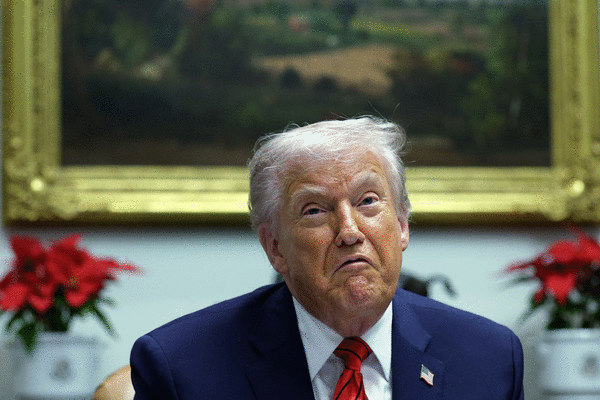
This might be Republicans’ last big year to get things done for a while. President Donald Trump is in the second year of his second term — his last before reaching lame duck status. His party is unlikely to hold Congress after the midterms if history is any indication.
What do Republicans want? As 2026 begins, I’m not sure they know. Last year was the big push: the DOGE cuts; the reconciliation bill; tax relief; deportations; tariffs; securing the southern border. It was a four-year term shoved into one.
It almost feels too soon to ask, “What now?” But we are in a moment in history where time is speeding up, not slowing down, as the capture of Venezuelan President Nicolas Maduro and his wife underscores. But what about policy on the home front?
I called some Washington insiders for their take. A long-time operative: “They want to win the House again in 2026. They just don’t know how to keep it.” A former Hill chief: “The GOP are excited for a tax season when people get bigger refunds and Trump Accounts start being seeded.”
In other words, 2026 is about the tailwind from the 2025 whirlwind. But is it blowing in the right direction?
More than three-quarters of Americans rang in the New Year thinking that the country is going in the wrong direction, according to Gallup. Approval for President Trump is at 36%. Approval for Congress fell to 17%, the lowest in over a decade. (Recall that Trump won the majority popular vote a mere 14 months back; the party punch didn’t taste as good as it looked.)
Time is ticking for the GOP to pass landmark legislation, and with it, their long-shot dream of preserving their Washington trifecta. Certainly, there’s interest in the MAGA base in advancing an affordability agenda and rightfully so, given that prices for housing, education and healthcare remain high. The tax rebates in April will help. Trump Accounts, too, are something new and fully branded to the GOP’s benefit.
But food prices have gone up partly because of President Trump’s tariffs. And much of the affordability stress is also around healthcare. Reducing healthcare costs has been a thorn in the GOP’s side ever since the party failed to come up with a convincing alternative to the Affordable Care Act a decade ago.
Perhaps there will be a surge in bipartisanship around supporting working Americans. I am usually bullish on bipartisanship, but that’s because it tends to represent prudence and compromise. If there is bipartisanship in 2026, it seems more likely that it will represent a uniting of extremes — like the photo op of New York City Mayor Zohran Mamdani and Trump in the Oval Office in November. Or the idea floating around policy circles to turn tariff revenue into stimulus checks, which is about as progressive as it gets.
But it’s my sense that it’s hard to have a sustained agenda in the midst of an identity crisis, which the GOP is most certainly in.
The transition from free-market orthodoxy and limited government to populism and protectionism has been anything but smooth or complete. Contradictions in the modern GOP include: extolling American patriotism while vilifying the civil service; obsessing over military “lethality” while disparaging allies; claiming to be pro-growth while restricting capital and labor; arguing against the “Deep State” while mandating MAGA loyalty pledges; decrying the deficit while passing unfunded spending bills; embracing social conservatism while distancing itself from pro-life causes. And the latest: military interventionism versus America first and only.
This all will take years to sort out. In the interim, there are other areas of low-hanging policy fruit that the GOP could advance this year.
For example, there’s no question that America’s children are not healthy or well. Food dyes and Tylenol are red herrings. The party should create a National Commission on Children and Families that looks at — among other things — how we are going to protect children in the age of social media and artificial intelligence. That would be forward-looking and legacy-building, like President Ronald Reagan’s war on drugs or President Lyndon Johnson’s war on poverty.
Chase affordability the conservative way: Declare the Southern border secure (it is) and the world at attention (they are) and relax the erratic restraints on goods and labor that are anything but conservative. Usher in regulatory relief. Get the schools performing again. Take a page out of the second-term Reagan playbook and use this as a chance for some budget control; limit the federal debt to a percentage of GDP. Future generations will say thank you.
And it’s worth saying again what has been said many times before: America is a big, diverse country. We are split almost down the middle politically. Popular mandates are slim and short-lived, as polling confirms. Shouting about the radical left or Bidenomics is not a legacy, it’s a reaction.
Over the last decade, no Democrat has held more political power than Trump does now. So please, stop disparaging previous presidents. Stop pitting Americans against each other. The political leaders who have risen above America’s deepest divisions are the ones we honor.
2026 is our exceptional country’s 250th anniversary. There’s no better time for the GOP to make a change in direction.
____
This column reflects the personal views of the author and does not necessarily reflect the opinion of the editorial board or Bloomberg LP and its owners.
Abby McCloskey is a columnist, podcast host, and consultant. She directed domestic policy on two presidential campaigns and was director of economic policy at the American Enterprise Institute.
©2026 Bloomberg L.P. Visit bloomberg.com/opinion. Distributed by Tribune Content Agency, LLC.


















































Comments