Noah Feldman: The Supreme Court generals failed their troops this year
Published in Op Eds
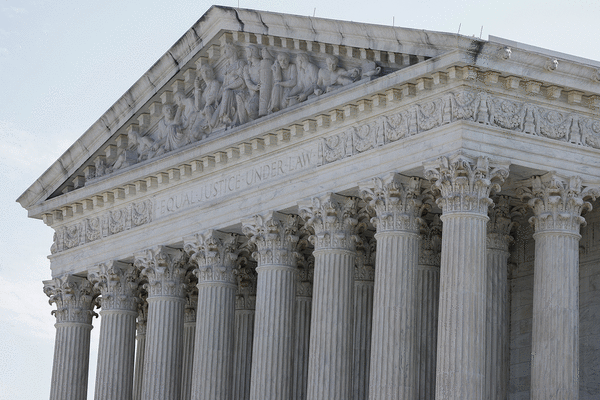
This will go down as the year when the president of the United States openly went to war against the rule of law. I’ve been writing about the many battles of this war throughout 2025.
In this column, I’m going to zoom out and take a broad view of the overall state of the battlefield, with special attention to the main combatants defending the law: the lower federal courts, which are the frontline troops; and the Supreme Court justices, who serve as the generals of the joint chiefs of staff.
The first thing to understand about the conflict is that President Donald Trump’s primary weapon is unilateral executive action. He started issuing executive orders that violate constitutional and legal norms on day one of his administration.
Through the shock troops of the Department of Government Efficiency (DOGE), the president indiscriminately fired federal employees, shut down entire departments created by Congress, and canceled billions of dollars in federal contracts and grants allocated by law. Through the Department of Justice as well as other cabinet departments and commissions, he has targeted the speech rights of anyone who disagrees with him.
You’ll notice that Congress is nowhere in this attack strategy. Its unwillingness or inability to act in the face of the offensive brings home, more powerfully than anything else, just how much this branch of government has withered away in recent decades. I’m not going to speak much more about Congress in this column — because, rather than being a participant in the war, Congress is effectively an irrelevant bystander.
Another striking aspect of the president’s war is who the immediate victims have been. First, there are immigrants — both visa holders and those who are undocumented — who are among the most vulnerable people in the U.S., legally and practically. At the other end of the spectrum are elite institutions like universities and law firms. This target selection reflects the president’s apparent objective of creating maximum publicity for his effort to break the legal order.
The most vulnerable can’t do much about it. The powerful can choose between trying to reach compromises with the president or deploying legal tools. If they choose the former path, they strengthen Trump by bending the knee. If they choose the latter, they create more attention for him. Either way, he can claim victory.
The possibility of legal defense brings us to the federal district courts. Thus far, they are the heroes of the effort to defend the Constitution. On hundreds of occasions, the lower courts have stood up to unlawful executive action by issuing orders that apply existing law and freeze the administration’s executive actions. Judges like U.S. District Court Judge James Boasberg in Washington, DC, have gone even further, demanding accountability for the administration’s violation of court orders.
This resistance is not only admirable but risky. If the Trump administration decides to openly defy court orders, it could trigger a constitutional crisis. And depending on the specific factual circumstances, there is no guarantee that the courts would win. Yet avoiding such a crisis is arguably not the job of the lower federal courts, which are supposed to follow the law regardless. It’s the responsibility of the justices of the Supreme Court, especially Chief Justice John Roberts.
Let me say this bluntly: The generals are not doing a good job of conducting the war to defend the rule of law. Where Trump is unrelenting and single-minded, the justices have been inconsistent and unpredictable, and therefore appear irresolute. They have used their emergency docket — which allows them to address urgent requests without the usual full briefings and oral arguments — to an unprecedented degree, not to defend the rule of law against executive overreach, but to undermine the lower courts’ efforts by reversing orders restraining the administration.
Not content to weaken their frontline troops, some of the justices have made the disastrous decision to publicly rebuke them for failing to interpret what the Supreme Court means by its unsigned, minimally reasoned emergency decisions. This is not simply bad for morale — a serious enough problem. It is also an invitation to the enemy, namely the president, to continue the tactic of condemning federal judges as lawless. In effect, by criticizing the lower courts, a handful of Supreme Court justices are coming dangerously close to betraying, rather than protecting, the rule of law.
Worse, the conservative justices of the Supreme Court appear not to realize that, in a war, internal disagreements and ideological agendas must be set aside in the service of unity in the struggle. The main problem here is the conservative constitutional theory of the unitary executive, which holds that the president must have near-absolute control over everyone who works in the executive branch.
The conservatives have been pushing the unitary executive agenda for decades. During that time, the theory was wrong, but arguably not disastrous in its practical consequences. Now, with a president who cares nothing for existing rules and seeks total control over not just the executive branch but the entire government, the theory of the unitary executive has become uniquely dangerous.
It’s one thing to say that a president should be able to fire the head of a newly created agency like the Consumer Financial Protection Bureau, as the court held a few years back. It’s a very different thing to empower Trump to fire Federal Trade Commission commissioners, who oversee mergers and acquisitions. The latter would give the president nearly unfettered authority to intervene personally in significant financial transactions for the benefit of his friends and allies.
Consider that, when Netflix announced a deal to buy Warner Bros., speculation ran high that Trump’s appointees on the formerly independent government commissions might block the deal to revive Paramount’s takeover bid, which is controlled by the Ellison family — close Trump allies. This form of corruption is only possible in a world where the president controls independent agencies. It is painfully evident that this is the wrong moment for the Supreme Court to announce a new doctrine granting the president inherent authority to fire the commission members who make these decisions. Yet the Supreme Court, including the chief justice, seems not to care.
To be sure, the justices are not giving Trump total carte blanche. They have upheld a few lower court injunctions — though they have not explained their reasoning in those cases any more clearly than they have when they’ve reversed the lower courts. And based on the oral argument, it appears more likely than not that the justices will strike down Trump’s tariffs imposed under the International Emergency Economic Powers Act.
Doing so would certainly count as a counterattack against the president’s lawlessness. Still, it would serve the interests of business rather than those of, say, vulnerable immigrants — a distinction sure to be noticed by the president and everyone else.
Probably the most disheartening aspect of the Supreme Court generals' weakness has been the cavalier way they ruled in one of the leading cases involving immigration. Allowing agents with Immigration and Customs Enforcement to grab people on America’s streets based on their appearance and the fact that they might be speaking Spanish is the kind of historically disastrous decision that will delegitimize the court for a generation.
It may well end up on a par with the court’s decision to bless the internment of Japanese Americans during WWII — an act that, it’s fair to say, the court has not lived down more than 80 years later. That the court did this in an unsigned order tells you all you need to know about the justices’ failure of leadership.
Things could get better in the new year. The justices will have the opportunity to issue actual opinions in fully argued cases involving important Trump policies. If they get those right, they might begin rallying the troops for a serious stand in support of the principle of legality.
To do so, however, would take an act of genuine will — the will necessary to win wars. Right now, the reason the war has not yet been lost is that the district court frontline troops are committed, brave and capable. It’s time for the justice-generals to do their job, too.
_____
This column reflects the personal views of the author and does not necessarily reflect the opinion of the editorial board or Bloomberg LP and its owners.
Noah Feldman is a Bloomberg Opinion columnist. A professor of law at Harvard University, he is author, most recently, of “To Be a Jew Today: A New Guide to God, Israel, and the Jewish People."
_____
©2025 Bloomberg L.P. Visit bloomberg.com/opinion. Distributed by Tribune Content Agency, LLC.















































Comments