Editorial: Rise in military crashes, deaths warrants additional scrutiny
Published in Op Eds
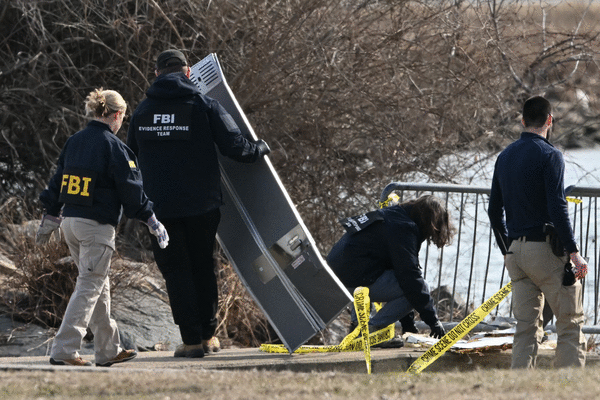
A deadly crash involving an Army helicopter and a passenger jet near Washington D.C. early this year was the most horrific military aviation accident in recent memory, but unfortunately it was not an anomaly.
Data recently released by the Defense Department shows the rate of severe accidents has risen sharply since 2020, a trend that demands greater scrutiny by both the Pentagon and Congress.
In the 2025 budget year, the severe accident rate per 100,000 flight hours spiked 55% for military aircraft over the same period four years earlier, with the Marine Corps showing the biggest increase, nearly triple its previous rate. Ninety people lost their lives, and the accidents cost billions of dollars in damage.
Sen. Elizabeth Warren, a Massachusetts Democrat, asked the Pentagon to provide the data this year while investigating deadly accidents involving the V-22 Osprey tilt-rotor aircraft. The Osprey, as well as the H-64 Apache helicopter and the C-130 transport plane accounted for much of the increase in 2024, according to an examination of the data by The Associated Press.
As of late last year, 64 personnel died and 93 injured in Osprey crashes since the aircraft’s introduction several years ago, according to the Associated Press. In the 2024 budget year, the severe accident rate for the Apache was about 4½ times four years ago. The severe accident rate for the C-130 almost doubled last year over the same period four years ago.
Although data for 2025 was not part of this release to Congress, it appears the trend has continued this year. The Navy, which has a large presence in Hampton Roads, saw a significant increase in the most serious aviation accidents, known as Class A, jumping to 14 this year from eight in 2024. Two jets fell off the deck of the USS Harry S. Truman aircraft carrier this year, and in October, a Super Hornet jet and a helicopter from the USS Nimitz both crashed into the South China Sea. And a collision between an Army H-60 Black Hawk helicopter and a commercial aircraft at Washington’s National Airport killed 67 people.
Military experts interviewed by the AP indicate there could be multiple factors influencing the increase, including an accelerated pace of military operations over the past five years. In addition, flying time dropped during the COVID-19 pandemic, hampering the ability of pilots to gain valuable experience.
As the Navy noted in a statement to the AP, pilots also fly in “incredibly complex conditions.” While acknowledging the increase in accidents must be addressed, the statement noted, “As a learning organization, we treat every flight and ground evolution as an opportunity to develop better training, create more effective procedures, and safeguard the operational readiness we work tirelessly to generate.”
The Navy and other branches of the military no doubt take safety seriously, but the Pentagon should welcome additional scrutiny from Congress. The public has a right to know that every effort is being made to protect military personnel and civilians as well as the hundreds of billions of taxpayer dollars invested in aircraft.
The Trump administration may be reluctant to accept additional oversight from Congress, and particularly Sen. Warren, but the interest here is certainly bipartisan. Warren, in fact, has joined Sen. Dan Sullivan, an Alaska Republican and fellow member of the Senate Armed Services Committee, in calling for greater transparency in investigations by the military’s safety boards.
Currently, investigation reports are not shared with the public or Congress. National security concerns may come into play in some accidents, but there is no reason the reports cannot be shared with the Armed Services Committees in the Senate and House.
Any trends in the root causes of these accidents — from equipment failure to potential shortcomings in training — need to be identified swiftly to ensure the men and women aboard our military aircraft are adequately protected and that the planes and helicopters are providing safe, optimal performance.
_____
©2025 The Virginian-Pilot. Visit at pilotonline.com. Distributed by Tribune Content Agency, LLC.




















































Comments