Noah Feldman: Firing immigration judges threatens more than immigrants
Published in Op Eds
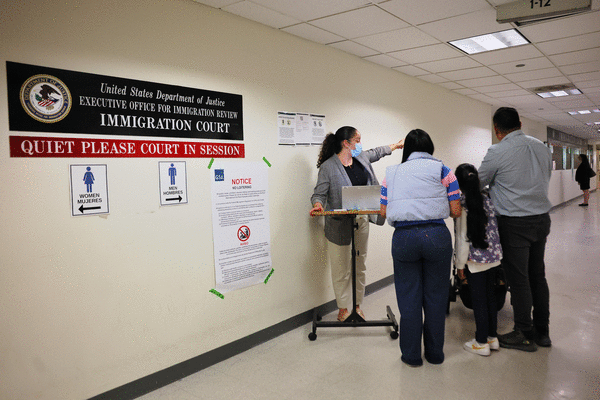
The Trump administration’s latest outrage is firing immigration judges and replacing them with military lawyers who lack experience in immigration law. The move combines two of President Donald Trump’s signature initiatives: It’s part of his war on immigrants and also part of his effort to make civil servants obey the administration’s policies — or be fired.
To make sense of what’s happening, let’s start with the curious legal status of immigration judges. They aren’t part of the federal judiciary established by Article III of the Constitution — such judges have life tenure, and even the Trump administration hasn’t claimed it can fire them.
Rather, immigration judges are essentially civil servant lawyers who work for the Department of Justice. They fall under the DOJ's Executive Office for Immigration Review (EOIR). Their job is to decide cases involving asylum, deportation, removal and detention under the Immigration and Nationality Act.
Once immigration judges have completed a two-year probationary period, they are covered by the Civil Service Reform Act, which prohibits their dismissal for political reasons. This protection dates back to 1883, with the landmark Pendleton Civil Service Reform Act.
Before civil service reform, the president could fire all executive branch employees on the day he took office and replace them with patronage appointees. Known as the “spoils system,” this way of doing things was grossly inefficient and invited widespread corruption. If any modern government innovation were thought to be impossible to overturn, it was civil service reform.
Enter Trump 2.0. Since January, the EOIR has been firing immigration judges hired during the Joe Biden administration who are within the two-year probationary period; telling judges who’ve just finished their two years that they won’t be continuing; and firing judges who’ve completed their probationary period and thus have full civil service protections. The scale of the firings appears unprecedented: at least 90 of 600 immigration judges have been fired this year. And the replacement of immigration judges by military lawyers certainly seems calculated to recruit judges who might be unsympathetic to immigrants.
The current Trump administration came into office already believing that the Biden administration had tried to hire more liberal immigration judges. Andrew Arthur, a former immigration judge and fellow at the Center for Immigration Studies, helpfully pointed me to allegations that the previous administration had deliberately sought to change the composition of the immigration courts to be more pro-immigrant.
In 2022, the Washington Times alleged that “the Biden administration has been quietly packing the nation’s immigration courts, ousting Trump-hired judges and installing judges deemed to be friendlier to the immigrants whose cases they hear.” And in February 2025, the Trump official heading the EOIR issued a memo objecting to “questionable and problematic personnel practices” under Biden.
Trump’s desire to control the nonpartisan civil service dates back to day one of the administration, when he issued an executive order titled “Restoring Accountability to Policy-Influencing Positions within the Federal Workforce.” The order created so-called Schedule F, designed to reclassify career civil servants as fireable political appointees.
In its most extreme form, the Trump view holds that the president can fire anyone in the executive branch, even career civil servants. Emboldened by the Supreme Court foreshadowing (in its emergency docket) that the president may lawfully fire even “principal” officers for any reason despite Congress saying he can only fire them for cause, this administration seems to be laying the groundwork to argue that the president can also fire “inferior” officers — like civil servants — for any reason at all.
In at least one instance, the Justice Department told an administrative judge with the Merit Systems Protection Board (the body that adjudicates the firing of civil servants) that a civil servant “was removed from her position … under Article II of the United States Constitution.” Translated from legalese, that likely means the basis for firing the employee wasn’t failure to perform her duties as specified by a statute or regulation, but rather the president's inherent power under Article II.
There are several cases that will give the administration the opportunity to make this argument at greater length. Some fired immigration judges have sued, alleging they were fired for discriminatory reasons barred by Congress; the Trump administration could argue that it can’t be constrained by statute when it comes to firing.
Maureen Comey, daughter of former FBI director James Comey, is suing the DOJ for firing her in violation of her civil service protection as a career Justice Department attorney. The administration hasn’t alleged any failure of duty on her part, either. So the only defense the administration will be able to make is that it can fire her for any reason.
The upshot is that it’s becoming clear that immigration judges need stronger protection from executive overreach. House Democrats have introduced legislation that would require temporary immigration judges to have at least relevant legal experience. Congress should investigate whether the administration is violating civil service protections. The lower federal courts and the Supreme Court should forcefully reject the idea that the president has the authority to fire inferior officers in violation of civil service laws.
And if the Supreme Court decides to bring us back to the spoils system, Congress should take the next logical step and give the federal judiciary jurisdiction over immigration cases, appointing new federal judges to handle the caseload.
In the end, both of Trump’s objectives here — attacking immigrants and trying to bend civil servants to his will — need to be addressed by Congress. Existing law doesn’t give lawyers enough ammunition to fight these battles to victory, and the Supreme Court’s willingness to change constitutional precedent makes lawyers’ efforts vulnerable.
When the executive is overreaching, and the Supreme Court is prepared to fold, the legislative branch is the best option we have.
____
This column reflects the personal views of the author and does not necessarily reflect the opinion of the editorial board or Bloomberg LP and its owners.
Noah Feldman is a Bloomberg Opinion columnist. A professor of law at Harvard University, he is author, most recently, of “To Be a Jew Today: A New Guide to God, Israel, and the Jewish People."
_____
©2025 Bloomberg L.P. Visit bloomberg.com/opinion. Distributed by Tribune Content Agency, LLC.
















































Comments