Commentary: The American West's most iconic tree is disappearing
Published in Op Eds
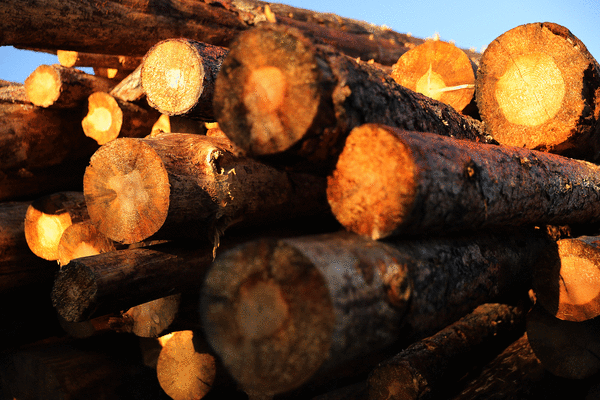
A profound unraveling is underway in the American Southwest, happening across a thousand-mile arc from Santa Fe, New Mexico, to the central Sierra. In an unprecedented calamity, the most widely distributed, most iconic tree of the region — the beautiful ponderosa pine — is disappearing. So significant is this loss, both visually and ecologically, that it’s reasonably fair to say it may be triggering the first post-climate-change landscape in America.
It was the ponderosa pine that more than 1,100 years ago allowed the rise of the first cities in what would later become the United States, providing structural beams for the multi-storied dwellings of the Ancestral Pueblo. More than 700 years later, under the tutelage of the Nez Perce, Lewis and Clark hewed boats from ponderosa trunks, using them to paddle from the mountains of western Montana to the Pacific Ocean. Settlers used the tree with abandon, fashioning everything from barns to saloons, opera houses to hardware stores to livery stables. Ponderosa gave us literally millions of track ties for our railroads, then often provided the fuel for the fireboxes of the locomotives that ran along them.
Since 2000, more than 200 million ponderosa have died. More alarming still is that many of those forests won’t be coming back, likely yielding the ground to what will be grass and shrublands for centuries to come. Some ecologists caution that in just another few decades, more than 90% of the Southwestern ponderosa forests could vanish. And with them will go some of the more than 200 species that make their homes in those forests — from goshawks to white-headed woodpeckers, and from Mexican spotted owls to tassel-eared squirrels. The loss of forest will also mean much faster melting of the spring snowpacks, since the snow will no longer be shaded by trees. That means less water for streams, rivers and aquifers — this in a region currently facing its 32nd consecutive year of drought.
For us humans, there will also be profound emotional impacts. Across much of the Southwest, ponderosa are the only trees of real stature, with their cinnamon-colored trunks towering more than a hundred feet higher than the pinyons or junipers. Furthermore, the soaring trunks of a mature ponderosa forest are widely spaced — so much so that early explorers often marveled about how it was possible to ride a horse through them at full gallop. It was this combination of physique, color and spaciousness that led to the ponderosa being routinely cast in countless films and television shows, including “Easy Rider,” “The Electric Horseman,” “Bonanza” and “Yellowstone.” It’s why they showed up in the writings of John Muir, Zane Grey, Norman Maclean and D.H. Lawrence; and finally, why this tree was such a favorite for artists such as Ansel Adams and Georgia O’Keeffe. Hands down, ponderosa groves are the most iconic and most celebrated forests across the Southwest.
That this level of loss is happening to a tree long known for its hardiness, able to withstand sizzling heat and excruciatingly dry summers, not to mention the usual outbursts of pine beetles and blight and wildfires, is indicative of just how deeply we’ve altered conditions on the planet. These ponderosa pines — and plenty of other trees, including the giant sequoia — are disappearing under the blows of a devastating one-two punch: The first of those blows spotlights our terrible choice across much of the 20th century to suppress all wildfires, a move that allowed both an overly dense growth of young trees and great masses of debris and fallen trees — what firefighters call “fuel loads” — piling up on the forest floor. It was a policy that utterly ignored the fact that in the arid West, fire is the primary means by which nutrients are recycled through an ecosystem, thereby keeping it healthy.
The second blow to ponderosa, as you might guess, is climate change, which has led to measures of heat and drought severe enough to leave tens of millions of trees as easy prey for insects and disease. When heavy fuel loads and climate change collide, there often come the extraordinarily big, hot wildfires we now routinely see roaring across the landscapes of the West. And when those severe wildfires come often enough, as they increasingly are, all that can survive in the end are grasses and shrubs.
It’s not that we’re just sitting idly by. Fire crews are increasingly conducting prescribed burns, a technique that can create healthier forests by clearing debris and reducing the overcrowding of young trees. But with some 300 million acres in the West currently under excessively heavy fuel loads — an area about three times the size of California — we’re only managing to perform prescribed burns across about 10% of the lands that need it. At the same time, replanting efforts are underway in many places. But that task, too, is incredibly daunting. So far, in any given year we’re replanting only about 3% of the fire scars that really need it.
For untold thousands of years, ponderosa have fed and sheltered an astonishingly varied collection of life across the West — humans and butterflies, woodpeckers and warblers, foxes and owls and squirrels. And at the same time, for many humans these forests offered up a profound, soul-deep satisfaction, the gift of a singularly peaceful yet soaring natural beauty. Beyond all the practical losses that will be laid at our feet as these forests vanish, there will surely be a cavernous, tree-shaped hole in our hearts.
____
Gary Ferguson has written for Vanity Fair, Outside and the Los Angeles Times. His latest book, “The Twilight Forest: An Elegy for Ponderosa in a Changing West,” was released in October.
©2025 Los Angeles Times. Visit at latimes.com. Distributed by Tribune Content Agency, LLC.



















































Comments