Commentary: The rising national debt is eroding American wages
Published in Op Eds
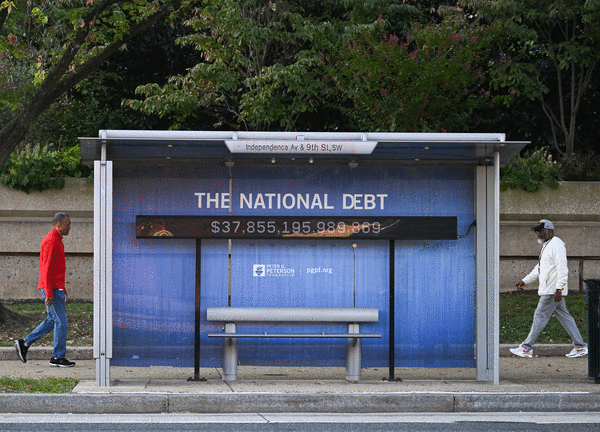
In almost every election cycle, politicians toot their own horn when it comes to rising wages, pointing to higher paychecks as proof that the average worker is thriving. But under the Biden administration, millions of Americans—faced with mounting grocery bills, rising rent, and shrinking savings—could see that these higher paychecks did not tell the full story.
While millions of Americans do in fact see their nominal wages rising, for many, their actual standard of living is falling. The fault lies in the explosive growth of the national debt and the rampant inflation it has helped cause.
Deficits, run up through the unconstrained spending of Congress, continuously add to this pile of debt, which is ultimately the primary driver of inflation-adjusted, or real wage decreases. Debt and deficits remain a crucial factor behind depressed productivity and are the most predictable measures of diminished national prosperity. Thus, inflation is just the symptom of this country’s great infirmity: debt.
Before explaining just how gravely debt destroys the American household, let’s put to rest any misunderstandings about the inflation that our nation is experiencing. While many assume that inflation has resulted from price gouging or “greedy” corporations, the data show that corporate profits have stabilized since the pandemic. Further research suggests that inflation adjusting these profits reveals that, in real terms, corporate profits have essentially returned to pre-pandemic levels.
Others may assume that the inflation we experience today results from supply-side inflation. But in the aftermath of international supply-chain shocks and disruptions, our sustained inflation at 3% can no longer be blamed just on the echoes of the pandemic-era world.
Instead, the agent responsible for inflation has undoubtedly been Congress and the Federal Reserve. Congress, with its power of the purse, has borrowed trillions of dollars to fund seemingly unlimited consumption by the federal government and those favored by the government.
Over the past few years, Congress has flooded the economy with increasingly debt-financed spending. The Federal Reserve has been all too accommodating, printing trillions of new dollars. This has created the classic situation of more dollars chasing the same or fewer goods and services – a tried-and-true recipe for inflation. As a result, prices have surged, as have the costs of doing business. While nominal wages appear to rise, real wages are stagnating as all nominal prices rise.
Even if the government-driven inflation begins to cool, the high debt burden of the government suppresses wage growth through what we call the crowding out of private investment. With the government borrowing over $1 trillion every year, it limits the amount of capital which can enter the private sector for investment. From there, investors finance government spending, which is not used for factories, industry, land development, or really anything productive.
Almost all government spending is a net loss for the American taxpayer. Essentially, by stealing investment from private enterprise, the government eliminates greater opportunities for more productive businesses and higher wages for their workers.
Of course, the debt erodes American wages in another sense: by increasing the tax burden on our children. Every year, the interest payment burden on the federal debt grows larger. Just last year, the net interest payments on the debt surpassed both Medicare and our National Defense spending.
In the near future, Congress will give American workers three options: default on the debt, wrecking our economy and likely putting millions out of work; hyperinflate away the value of the debt and obliterate the value of dollars in paychecks and bank accounts; or force the American workers of tomorrow to pay massive taxes to finance the reckless spending of today’s congressmen.
Think about it this way. Recently, workers have sensed these changes at every store’s checkout counter. The recent raise they just got from their employer does nothing as they realize their groceries, home repairs, or electricity bills continue to rise in cost.
Congress keeps spending at record deficit levels to effectively transfer the wealth and hard-earned incomes of Americans to the federal government even before Congress votes to raise taxes. As Washington borrows more money, Americans have their wages stolen right out of their pockets year-round, not just when they are filing taxes.
Federal lawmakers invented this problem, and now they must solve it. Only by implementing hard spending caps, by reducing taxes for all Americans, and by reforming deficit spending will this country have a chance at giving back to Americans their hard-earned wages.
If not, and if the current trend continues, we will see even lower real wages, a decline in homeownership, quality of life, and family stability. Debt-driven inflation risks eroding not only American wages, but the American dream itself.
_____
Richard Stern is Acting Director of the Roe Institute for Economic Policy Studies at the Heritage Foundation and Director of its Grover M. Hermann Center for the Federal Budget. Frank Anstett is a member of Heritage’s Young Leaders Program.
_____
©2025 Tribune Content Agency, LLC.





















































Comments